Downturned Eyes · Wispy · Volume
The wispy lash map for downturned eyes, built in Volume — zone order, where the length peaks, and the point this one usually goes wrong.
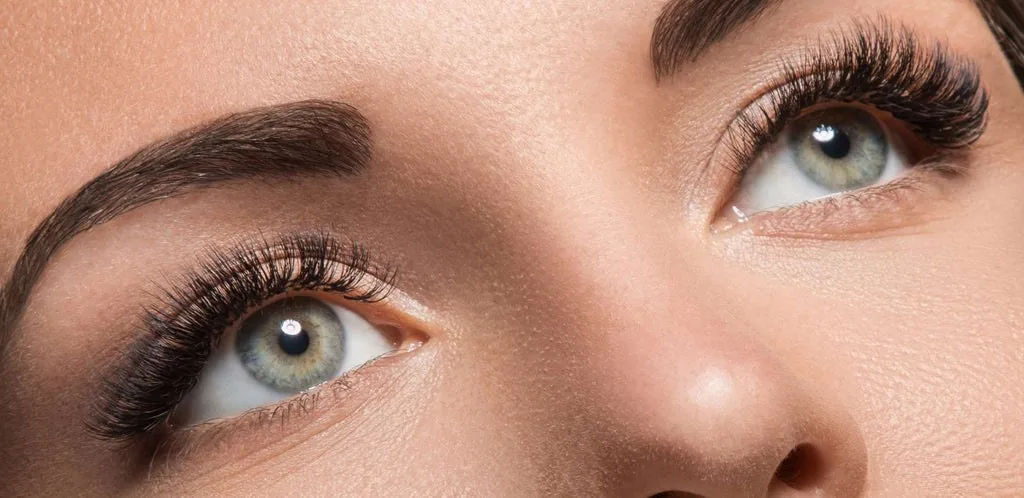
- ShapeDownturned — the outer end of the lid sits lower, so weight out there reads as tired.
- EffectWispy in fans: a dense base with narrow tall fans rising out of it over the middle.
- Where everyone strugglesThe upper layer goes up, not outward. Extending it toward the corner undoes the whole map.
Why Why it is laid out this way
Built entirely in fans, a wispy set stops being a scatter of long strands and becomes two layers doing different jobs. Underneath, density; above it, a few narrow fans standing taller to make the edge move. On this eye shape the second layer is also the dangerous one, because it is the part that can quietly grow toward the corner.
The order the zones go on, fan by fan
- Build the base denseOrdinary fans at base lengths across the middle zones, closed up so there are no visible gaps. This layer is the fabric.
- Raise a narrow upper layerOver the pupil, add taller fans kept deliberately narrow. Narrow is what makes them read as strands rather than as bulk.
- Aim the tall fans upwardThe upper layer should sit above the base, not further out along the lid. Direction here is the whole difference.
- Fade the layer inwardEither side of the centre the tall fans get shorter and rarer, ending well before the outer third.
- Single-layer the last zonesThe outer two zones are base only, short, narrow and strongly curled. Nothing stacks out there.
The length curve on downturned eyes
The diagram is a doll curve with a sharp centre spike, and in this cell the sharpness comes from a second layer rather than from individual strands. The base follows the curve; the upper layer only exists across its high point. Everything outboard of that is one quiet layer stepping down, which is what keeps the eye reading lifted rather than loaded.
Where does a wispy map go wrong on downturned eyes?
Deep The physics underneath
The layout above is two layers. Below is why one of them can be pushed and the other cannot.
The same map, built four ways
- Classic 1:1
- A long single strand is still the simplest way to make one lash stand above its neighbours, and dropping a few into a fanned set keeps the edge from looking uniformly manufactured. Used alone it cannot give this map the dense base underneath.
- Handmade volume
- It builds both layers here, but with opposite settings: wide and short below, narrow and tall above. Getting those two the wrong way round is the most common way this cell goes wrong.
- Promade / pre-made fans
- Consistent width makes them efficient for the base layer, where every fan is meant to look like its neighbour. As the upper layer they are usually a step too wide and too stiff, and a stiff tall fan over the middle of the lid does not move like a lash.
- Woven / clover
- Excellent under the base, where broad coverage costs nothing visually. Anywhere the client can see the edge they defeat the effect, since the point of the upper layer is separation.
Spread angle versus weight
This cell needs two spreads on the same lid, and the contrast between them is the effect. The base wants enough width to leave no daylight between fans, while the upper layer wants the narrowest spread you can place and still call a fan — anything wider stops reading as a raised strand and starts reading as a second dark line. Because the tall fans are narrow, their mass sits close to the axis, which is the only reason a set can carry them at that height over the centre of the eye.
What a downturned lash line can carry
- The two layers have different ceilings. The base is short and shared across many lashes, so it takes pressure well; the upper layer is tall and lands on individual lashes, so it is where the map runs out of room.
- Height is what costs on the upper layer, not width — a narrow tall fan is nearly all lever, and every step you add to it moves its balance point further from the root of a lash that is also holding a base fan.
- Check the host before you raise anything. If a central lash is already carrying a base fan it may not want a tall one on top, and skipping it costs less than a leaning fan over the middle of the eye.
Where this map fails first
The upper layer settles into the base, and once it does, the set stops fluttering. It rarely sheds first, because these fans are narrow and reasonably light; what happens is that the lashes carrying two things gradually rotate under the combined load, and the tall fans lie down among the short ones. The client describes it as the lashes going flat, which is accurate. Rebuilding the upper layer at refill restores the look faster than adding anything to the base.
FAQ Common questions
How do I make spikes out of fans?
Keep them narrow and let them be taller than the base around them. A wide fan at the same height reads as bulk, not as a raised strand.
Should the upper layer run the whole lash line?
No. On this shape it belongs over the middle only, fading out well before the outer third — running it to the corner is stacking outward, which loads the part of the lid that already falls.
Is a layered wispy set too heavy for downturned eyes?
Not inherently, since fans are light for the coverage they give. It becomes too heavy when both layers sit on the same lashes across the whole lid rather than only across the centre.
Why does the texture disappear after two weeks?
The tall fans are settling into the base as their hosts rotate under the double load. Narrow them, take a step off their height, and skip the weaker central lashes entirely.
Print this page or save it as PDF — the diagrams are drawn to stay readable in black and white on plain paper. Or download the diagrams below as SVG. No account, no fee, nothing to sign. Every file carries this page’s address, so wherever it ends up it can be traced back here.
Teaching from these? The offer, and how to credit it.
Also in: Downturned eyes · Wispy · Volume
Read next: what makes a lash map wispy rather than spiky · questions clients ask about lash extensions