Hooded Eyes · Wispy · Classic 1:1
The wispy lash map for hooded eyes, built in Classic 1:1 — zone order, where the length peaks, and the point this one usually goes wrong.
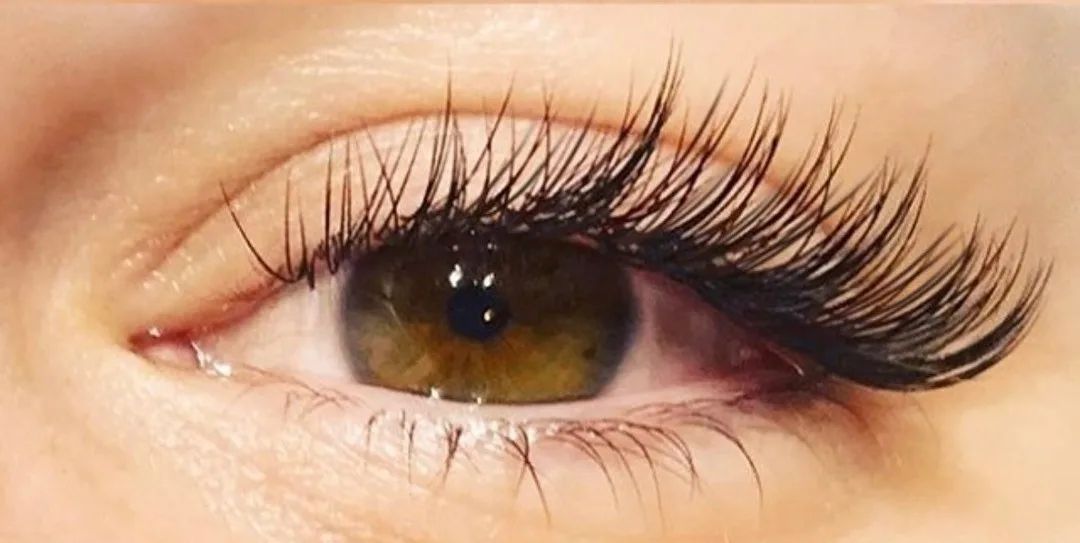
- ShapeHooded — the fold takes the lower part of the lash line out of the picture.
- EffectWispy in singles: a low base with taller fine strands standing above it.
- Where everyone strugglesSpikes stay fine. A covered lid cannot carry thick texture, however short it is.
Why Why it is laid out this way
Here is one effect where a hooded lid almost helps: the spikes are the part standing highest, so they are the part the skin cannot swallow. That means a very modest base plus a scattering of taller strands buys more visible change than a heavier set built flat. The catch is that every spike is a long single lash, and long singles are the most expensive thing on any hooded map.
The order the zones go in
- Set the base low and evenBuild a quiet base first, longest through the two middle zones and short at both ends. It is a backdrop, nothing more.
- Pick the spike zonesSpikes belong in the zones that stay uncovered when she opens her eyes. Below that line they are weight with no picture.
- Keep every spike fineLength is the only thing a spike is allowed to add. The moment they get thick, the lid starts wearing the set instead of the other way round.
- Break the rhythmTwo close together, then a gap, then one on its own. Regular spacing is what makes texture look manufactured.
- Taper the base at both endsThe base falls away at the inner corner especially, so the spikes never have competition from below.
The length curve on hooded eyes
The curve under the spikes is a plain two-zone top with both ends dropping away, and it is drawn low on purpose. Every bit of height the set has is meant to be in the spikes, because they are the only part standing clear enough of the skin to register at a glance. Lift the base and you lose the contrast between base and spike, which is the entire effect.
Where does a wispy map go wrong on hooded eyes?
Deep The physics underneath
A spike is not a decoration with its own rules. Mechanically it is the longest, most demanding item you can put on a lash.
The same map, built four ways
- Classic 1:1
- This cell, and the only version where the spikes are literally single strands — nothing bonded, nothing bundled, the smallest possible thing at each tip. That is why it suits a hooded client with fine lashes who still wants texture.
- Handmade volume
- Fans would let the base look fuller behind the spikes without gaining much weight. Whether you want that is a question about the client, because a full base is the thing that quietly erases a wispy effect.
- Promade / pre-made fans
- Even and quick through the base zones, and a wispy base does not need much thought. The thicker root is worth avoiding under a fold when the base is meant to be the light part of the set.
- Woven / clover
- Broad coverage per bond, which fills the spaces between tips. The spaces are the effect here, so this is the one technique that directly undoes the map.
Spread angle versus weight
There is nothing fanned on this cell, so the variable is gap width — how much clear space you leave between one spike and the next. Gaps that are too small merge into a serrated line, gaps that are too wide leave the base looking bare where the skin already dulls it. Group two or three spikes, leave a clear run, and let the base show between them.
What a hooded lash line can carry
- A spike is one strand at the greatest length on the map, which means the greatest weight and the greatest reach on a lash chosen more or less at random. Choosing that lash deliberately is most of the skill.
- Because the base is short and light, almost the whole load on this set sits on the spiked lashes. Count spikes rather than measuring the set as a whole.
- Never spike a lash that is fine, short or newly grown, even if the spacing wants one there. Move the spike a lash along — the pattern is meant to be irregular anyway.
Where this map fails first
The spikes are always the first thing to leave, because each one is the heaviest object on the lash it sits on and there is nothing beside it sharing the job. When enough of them have gone the set does not look thin at all — it looks tidy, because what remains is the quiet base with none of its texture. Clients read that as the set losing its personality within a fortnight. Rebuild spikes at every fill and expect to move them to different lashes each time.
FAQ Common questions
Why does wispy suit a hooded eye better than a fuller set?
The spikes stand highest, so they are the part the fold cannot cover. You get visible texture for far less weight than a dense flat set would cost.
How much taller than the base should the spikes be?
Clearly taller — enough that the gap between base and tip is obvious at a glance. A subtle difference reads as an uneven set rather than as texture.
Can I use thicker strands for the spikes so they stand out?
No. Thickness makes them sit down against the lid, which is the opposite of standing out, and it puts the most weight on your longest strands.
Where should spikes never go?
In the covered zones, and on any lash that is fine or short. Both mistakes cost the same and only one of them is visible.
Print this page or save it as PDF — the diagrams are drawn to stay readable in black and white on plain paper. Or download the diagrams below as SVG. No account, no fee, nothing to sign. Every file carries this page’s address, so wherever it ends up it can be traced back here.
Teaching from these? The offer, and how to credit it.
Also in: Hooded eyes · Wispy · Classic 1:1
Read next: what makes a lash map wispy rather than spiky · questions clients ask about lash extensions