Hooded Eyes · Wispy · Hybrid
The wispy lash map for hooded eyes, built in Hybrid — zone order, where the length peaks, and the point this one usually goes wrong.
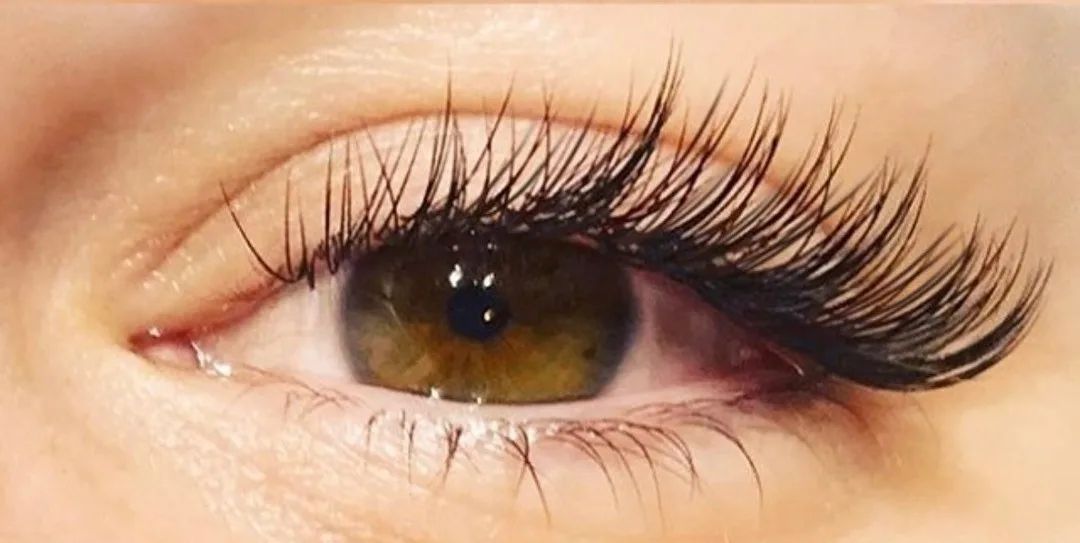
- ShapeHooded — the lid casts a shadow over the lash line as well as covering it.
- EffectWispy in a mix: a light fan base with clustered spikes above the visible strip.
- Where everyone strugglesBuild the base lighter than you would on an open lid. The fold darkens it for you.
Why Why it is laid out this way
Two things make a wispy set work: what stands up, and what is left empty between. A fold complicates the second one, because the skin over the lash line already dims everything beneath it, so a base built to your usual density arrives looking heavier than you intended. Under-build the base, cluster the spikes, and the gaps do the rest.
The order the zones go on, and where the fans land
- Watch the shadow, not just the skinLook at her upright and note where the lid dims the lash line. That zone needs less base than it looks like it needs.
- Lay a light fan baseNarrow fans following the map, top length shared by the two middle zones, ends dropping away. Stop before it looks finished.
- Spike in clustersClosed fans standing well above the base, placed two or three together with clear runs between them.
- Nothing tall below the shadow lineInside the covered strip the base runs on alone. Spikes there are paid for and never seen.
- Check the gaps lastStep back and look for the empty runs. If you cannot see the base through the texture, you have built too much.
The length curve on hooded eyes
The base curve is modest and level through the middle so it can act as a backdrop rather than as the set itself. Spikes sit above it in clusters, which is what makes the eye read separate lashes instead of one dark line — the single thing a fold is best at destroying. Everything in the map is arranged around keeping contrast alive on a lid that is working to remove it.
Where does a wispy map go wrong on hooded eyes?
Deep The physics underneath
The base and the spikes are priced completely differently. Knowing which is which stops the set drifting heavier at every visit.
The same map, built four ways
- Classic 1:1
- Single strands make good spikes when her lashes are strong, and they are the least bulky option at the root. Where they struggle is the base, which on this map wants to be light and full at the same time.
- Handmade volume
- The base, and made narrow so it stays a backdrop. Building them yourself matters here because a wispy base needs to be less dense than the tray default, and only a hand-made fan lets you dial that down.
- Promade / pre-made fans
- They tend to arrive fuller than a wispy base wants, and the temptation is to keep the density they were built for. Useful for a fast base under a fold if you accept the spikes will need to be taller to beat it.
- Closed fans — spikes
- Almost no spread, so the whole bundle behaves as one thick strand with its mass on the lash's own line. The bond area is generous, which helps it stay attached; the weight is real, which decides how many you place.
Spread angle versus weight
Two spreads, two purposes, and they must not converge. Base fans stay narrow so they stack close without their edges merging into a solid tone under the shadow. Spikes close to nothing, which is what makes them stand — and the moment a spike is allowed to open a little, it stops being a spike and joins the base as an unusually long fan.
What a hooded lash line can carry
- Every spike is the heaviest thing on the lash it sits on, so clustering them means several neighbouring lashes are each at their limit at the same time. Cluster the spikes; do not cluster them on adjacent lashes.
- The base is light enough to be nearly free, which is why the weight of this set can be estimated almost entirely by counting spikes. That count is the number to hold across fills.
- Under a fold the load is not only downward. A lash gets pressed sideways for as long as her eyes are open, so a spike that would sit fine on an open lid can lean on a hooded one.
Where this map fails first
Two failures with two different clocks. The outer spikes lean before they shed, because they are long, heavy and sitting where the lid rests hardest — the cluster loses its edge and the texture goes soft while everything is still attached. The inner base thins at the ordinary rate, but on this map it is barely there to begin with, so it shows sooner than it would on a fuller set. Read a spike that has turned as a spike to replace, not as one that still counts.
FAQ Common questions
Why build the base lighter on a hooded eye?
Because the lid already dims the lash line, so the same density reads as more. A base built to your usual level arrives looking like a full set with a few spikes on it.
Should spikes be clustered or spread out?
Clustered, with clear runs between the groups. Singly spaced spikes read as stray lashes, particularly under a fold where contrast is low.
What do I do about the gaps at the fill?
Leave them. Filling gaps is the most common way a wispy set turns into a heavy one over two or three appointments.
Classic or fan spikes on a hooded lid?
Either, chosen by her lash strength. A closed fan spreads its grip over more bond area; a single strand keeps the root smaller under a lid that presses on it.
Print this page or save it as PDF — the diagrams are drawn to stay readable in black and white on plain paper. Or download the diagrams below as SVG. No account, no fee, nothing to sign. Every file carries this page’s address, so wherever it ends up it can be traced back here.
Teaching from these? The offer, and how to credit it.
Also in: Hooded eyes · Wispy · Hybrid
Read next: what makes a lash map wispy rather than spiky · questions clients ask about lash extensions