Hooded Eyes · Wispy · Volume
The wispy lash map for hooded eyes, built in Volume — zone order, where the length peaks, and the point this one usually goes wrong.
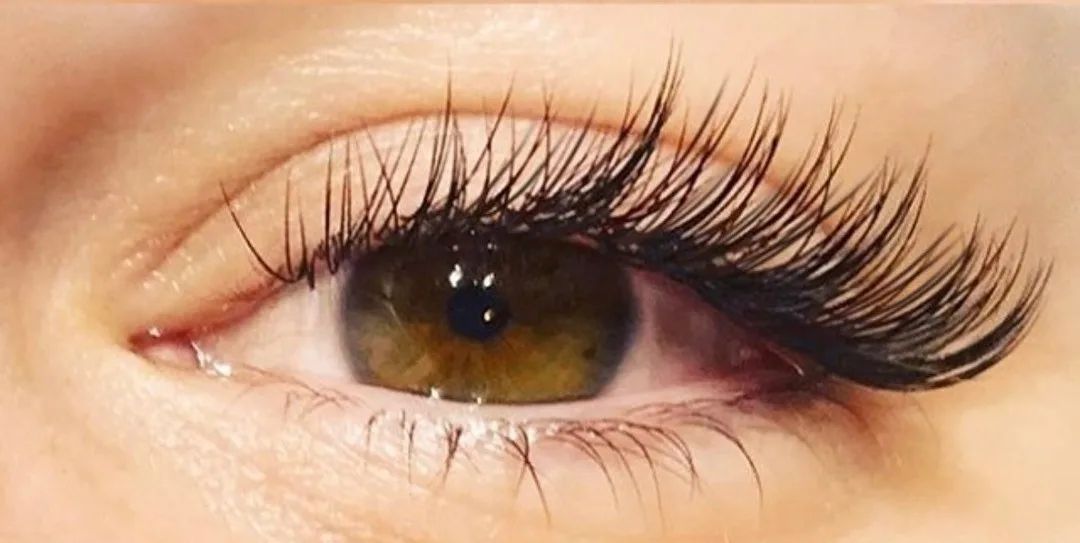
- ShapeHooded — a lid that rests on the set for every hour she is awake.
- EffectWispy in fans: an open fanned base with spiked tips standing above it.
- Where everyone strugglesNo stacked top layer. The spikes are the second level and there is no room for a third.
Why Why it is laid out this way
Of everything in this shape's library, a fanned wispy set is the easiest to overbuild: the base is fans, the spikes are fans, and neither feels heavy going on. On a lid that presses down all day that combination has a real limit, and finding it after the appointment is expensive for both of you. Build the base open, spike it once, and stop.
The order the zones go on, fan by fan
- Decide the count before you startLook at her lash line and settle on how many spikes each eye gets. Deciding while building is how sets get heavy.
- Open base, narrow fansFine narrow fans spaced with visible air between them, top length across the two middle zones.
- Spike, and that is level twoClosed fans standing above the base. They are the only thing that goes on top — no further layer over anything.
- Skip the covered stripBase only where the skin sits. Whatever you would have spiked there, spend it in the zones on show.
- Drop both ends awayShorter, sparser fans at the inner corner and a gentler fall at the tail, both free of spikes.
The length curve on hooded eyes
The base curve is level through the middle and low at both ends, drawn so the fans never have to reach and the spikes always have somewhere to stand. Because both parts of this set are fans, the diagram is really a weight plan — its flatness is what keeps the total on any one lash small enough for a lid that never stops leaning on it. The height you actually see comes from the spiked tips, not from the curve.
Where does a wispy map go wrong on hooded eyes?
Deep The physics underneath
Both halves of this set are made of the same thing. That makes the total easy to lose track of and easy to calculate.
The same map, built four ways
- Classic 1:1
- Single strands would give a lighter set overall and a base that never merges into a band. What they cannot do is fill a hooded lash line enough to look full without the strands getting thick.
- Handmade volume
- This cell, twice over — the base and the spikes both. The advantage is that you set the width of each one, so the base can stay open and the tips can close down to a point.
- Promade / pre-made fans
- Consistent width across a base that wants consistency, and quick on a dense line. Two ready-made bases on one lash is where hooded retention tends to break, so if you use them, do not also spike that lash.
- Woven / clover
- Excellent coverage from a single bond, which on this map fills the very gaps you left on purpose. If it appears anywhere here, it is in the low inner zones and nowhere near the texture.
Spread angle versus weight
The base and the tips sit at opposite ends of the same dial. Base fans want just enough spread to bridge the gap to the next fan and no more, because an open fan under a fold takes a sideways twist and ends up lying along the lash line. Spikes want no spread at all, so they behave as one strand and stay standing — and everything in between those two settings is a fan that has failed to be either.
What a hooded lash line can carry
- Two fans on one lash is the line this set walks. A base fan and a spike on the same natural lash is a decision, not something to do wherever the spacing suggests it.
- Height costs more than fullness here. A spike a step taller adds weight and pushes its balance point further out, while a fan a shade wider mostly moves material sideways.
- The gaps are structural. They leave lashes unloaded, and unloaded lashes are what carry the set through the second half of the cycle when the spiked ones start to give.
Where this map fails first
The spikes in the middle of the visible strip go first, and they lie down rather than fall off. They are the longest items on the set sitting where the lid makes the most contact, so the tip tilts toward the lash line and the standing texture becomes part of the base. The set does not thin, it smooths — which is why clients say it looks flat rather than saying it looks sparse. If the whole set flattens at once instead of gradually, the base was carrying a layer it should not have had.
FAQ Common questions
Can a hooded lid handle a full volume wispy set?
Only with fine fans, an open base and no extra layer. The set has two levels — base and spikes — and adding a third is where hooded retention gives out.
Why keep the base open when volume is meant to look full?
Because the gaps are the effect and the unloaded lashes are the insurance. A closed base under a fold reads as a dark band anyway, so you would be paying for something you cannot see.
Should spikes go on lashes that already carry a base fan?
Preferably not. Spread the spikes onto their own lashes so no single follicle is holding two of the heaviest items on the set.
How tall should the spikes be here compared to an open lid?
Shorter. On an eye without a fold you can spike for pure height; here the tip only needs to clear the skin, and anything past that leans.
Print this page or save it as PDF — the diagrams are drawn to stay readable in black and white on plain paper. Or download the diagrams below as SVG. No account, no fee, nothing to sign. Every file carries this page’s address, so wherever it ends up it can be traced back here.
Teaching from these? The offer, and how to credit it.
Also in: Hooded eyes · Wispy · Volume
Read next: what makes a lash map wispy rather than spiky · questions clients ask about lash extensions