Round Eyes · Wispy · Hybrid
The wispy lash map for round eyes, built in Hybrid — zone order, where the length peaks, and the point this one usually goes wrong.
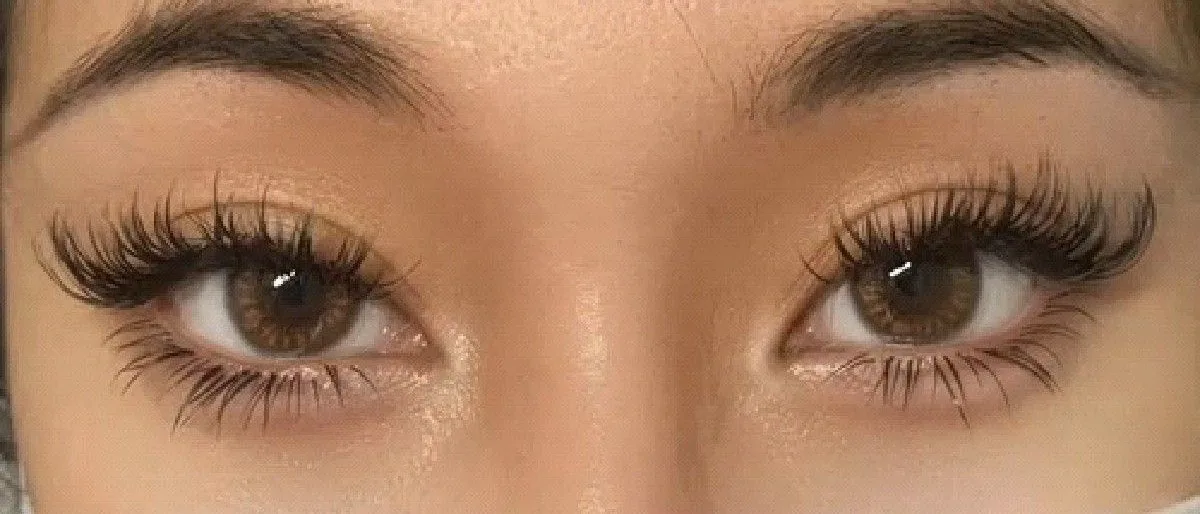
- ShapeRound — vertical and horizontal measure close to the same.
- EffectWispy in a mix: a filled outer-leaning base with tall points above it.
- Where everyone strugglesContrast is the effect. If the base creeps up to meet the spikes, it dies.
Why Why it is laid out this way
A wispy set is a torn edge rather than a cut one, and hybrid is the easiest way to build that: fans give the base a continuous line, single strands give it the tears. On a round eye the tears all have to sit in the outer half, or the eye gains height instead of length. The rest of the craft is keeping enough distance between the base and the tall points that the contrast survives a fortnight.
The order the zones go on, and where the fans land
- Fill the base with fansRun soft fans from the inner corner outward, holding the two zones before the corner at full base length.
- Ease the last zone downThe corner steps back slightly from the top so the base ends softly and the spikes stand clear of it.
- Add tall points past centreSet the tall strands in the outer third only, standing well above the base rather than just above their neighbours.
- Break the spacing on purposeCluster two, leave a gap, place one. Even distribution is the fastest way to lose the wispy read.
- Close the fans near the tall pointsAround each spike the fans stay narrow, so the tall strand is the only thing catching the light there.
The length curve on round eyes
The base curve above rises, holds level across two zones in the outer half, then steps down once — it is a shape you could wear on its own, which is the point. Spikes are added onto a base that already works, not used to rescue one that does not. Because the level stretch sits past the middle, the tall points have somewhere to stand where they read as elongation rather than as lift.
Where does a wispy map go wrong on round eyes?
Deep The physics underneath
Two jobs on one lid: a base that fills and points that stand out. They compete for the same lashes.
The same map, built four ways
- Classic 1:1
- Single strands make the cleanest tall points, since nothing about them can open or fluff with wear. Keep them for the spikes and for any zone where the base has to stay especially lean.
- Handmade volume
- The base is where handmade fans earn their place, because you can widen them across the short inner run and close them right down under the tall points. A spike standing over a wide fan loses half its contrast.
- Promade / pre-made fans
- Good for laying a continuous base quickly and poor at varying it, which is what this map asks for zone by zone. Their bases also sit slightly proud, and proud bases fill the gap the spikes need.
- Closed fans — spikes
- A fan closed to almost nothing behaves like a single thick strand with all its mass on the axis, but it can be built finer than any single strand you stock. That makes it the lighter way to put a tall point on a fine outer lash.
Spread angle versus weight
Spread on this map controls contrast as much as weight. Every fan you open under the outer third raises the visual height of the base, so the gap to the tall points closes and the wispy effect quietly disappears. Take your width across the inner zones, where the base is short and the tall points are absent.
What a round lash line can carry
- Base and spike compete for the same host lashes in the outer third. Placing a tall point on a lash that is already carrying your fullest fan is how the corner ends up overloaded without anything on the map looking wrong.
- The tall points are the longest objects on the set and sit furthest out on the lever, so they set the ceiling even though they are the smallest part of the material used.
- Read the corner strand by strand before you spike it. A zone can look healthy and still contain half a dozen new, fine lashes that will bend under a tall point within days.
Where this map fails first
The tall points fail by softening rather than by disappearing. A closed fan out at the corner takes daily contact from pillows and fingers, and it opens a little each time until the tip is a small fluff rather than a point. The base underneath survives, so the client keeps a full-looking set with none of the texture she came for. If the wispy edge is why she booked, treat the outer third as the thing the infill is really for.
FAQ Common questions
How far above the base should the tall points sit?
Far enough that the gap is obvious across a room. If you have to look closely to see which strands are the spikes, the map has no contrast left.
Fans or single strands for the spikes?
Either works. A closed fan can be made finer than a single strand of the same length, which is worth having on the fine lashes of the outer third.
Can the base be as full as a volume set?
Not under the tall points. A full base there raises the visual line and swallows the spikes, so keep the density inboard where the base is short.
Why does the base still step down at the corner?
So the line ends softly and the tall points have clear air above them. A base held at full length to the very edge crowds the spikes and blunts the whole effect.
Print this page or save it as PDF — the diagrams are drawn to stay readable in black and white on plain paper. Or download the diagrams below as SVG. No account, no fee, nothing to sign. Every file carries this page’s address, so wherever it ends up it can be traced back here.
Teaching from these? The offer, and how to credit it.
Also in: Round eyes · Wispy · Hybrid
Read next: what makes a lash map wispy rather than spiky · questions clients ask about lash extensions