Upturned Eyes · Wispy · Classic 1:1
The wispy lash map for upturned eyes, built in Classic 1:1 — zone order, where the length peaks, and the point this one usually goes wrong.
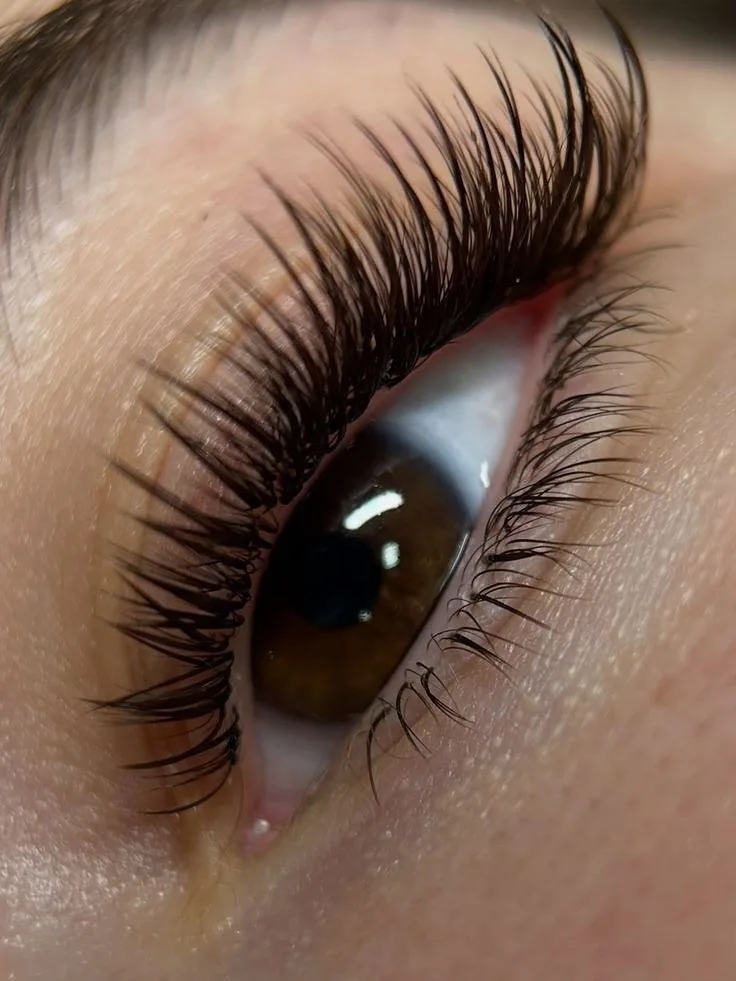
- ShapeUpturned — the outer half of the line already rises on its own.
- EffectWispy in single strands: a plateau outer of centre, spiked lightly.
- Where everyone strugglesSpikes barely clear the base. A tall spike on this corner looks spiky.
Why Why it is laid out this way
Wispy is a rhythm rather than a shape, and the rhythm has to be quiet on an eye that already tilts up. The base curve does the work here — it rises to a two-zone stretch just outer of centre, exactly where the lid is highest — and the spikes only mark it. In classic they are simply your longest singles, which makes them very easy to overspend.
The order the zones go in
- Lay the base first, all the wayComplete the plotted base curve across every zone before a single spike goes on. A wispy set built spike-first ends up spike-led.
- Keep the inner short and continuousThe inner zones stay well below the plateau and get no spikes at all. The eye's own line drops away at this end.
- Hold the plateau over two zonesThe base runs at its longest across the two zones outer of centre. A single high point would be a cat map with texture on it.
- Spike a hair above the baseEvery spike sits just proud of its zone's base length, not a zone longer. Two hairs of difference is a wisp; more is a spider.
- Break the spacing on purposeVary the gap between spikes across the plateau. Even spacing reads as a pattern and this map has no length change to hide one.
- Leave the last zone unspikedNothing extra on the outer corner. It is the highest part of the eye and it does not need announcing.
The length curve on upturned eyes
The base climbs steadily, holds its longest length across two zones outer of centre and eases back for the corner. That plateau is where the lid is already at its highest, so the spikes sit there and get their lift for free. The corner easing back afterwards is the restraint that keeps a wispy set on this shape from reading as spiky rather than soft.
Where does a wispy map go wrong on upturned eyes?
Deep The physics underneath
A spike is the longest single object on the eye, sitting on one natural lash. That is the whole mechanical story of this map.
The same map, built four ways
- Classic 1:1
- Here the spikes and the base are the same kind of object, so the only thing separating them is length — which makes overspending on a spike both easy and expensive. Budget each one as the longest strand you will place all appointment.
- Handmade volume
- Fanned strands give the base its softness for less mass, leaving room in the budget for the spikes to stand slightly proud. Spread stays narrow across the plateau so the wisps still read as points.
- Promade / pre-made fans
- Fast and identical, and identical is the enemy of a wispy rhythm. Keep them to the inner zones where they are just filling a short line.
- Woven / clover
- One bond, wide repeating coverage — the opposite of what a wispy rhythm wants anywhere near the plateau. If it appears at all it belongs low on the inner line, closing a short zone that carries no accents.
Spread angle versus weight
The plateau runs across two zones outer of centre, which is both the longest base length and the highest part of this lid, so it is the one stretch that cannot afford width. A spike is only a spike if its mass stays on the lash's own line — open it up even slightly and it sags sideways instead of standing, and the wispy effect turns into a rough edge. Any width you want belongs inboard on the short inner zones.
What an upturned lash line can carry
- Spikes hit the deflection ceiling long before the base does, because they are the longest objects on the eye by design — a spike that settles low does not merely disappear, it lies across the base and blunts it.
- The extra length on a spike is charged twice over, mass and reach together, which is precisely why keeping it a hair above the base rather than a zone above is a mechanical decision and not only a stylistic one.
- Choose the natural lash for each spike deliberately: the strongest lash in the zone, never whichever one is free, because the weakest lash under the longest strand is the one guaranteed failure on this map.
Where this map fails first
The spikes go first and they go conspicuously. Each one is the longest strand on the eye sitting on a single natural lash, so as those lashes shed the rhythm develops holes that a base-only set would never show. What remains is the plateau on its own, which is a decent map but not the one she booked. Fill on the spikes' schedule and check them by looking at the silhouette, not the density.
FAQ Common questions
How proud of the base should the spikes sit?
Barely. A hair or two proud of its zone's base length is the working limit — a spike a full zone longer stops reading as texture and starts reading as the outline of the set.
Should the outer corner get a spike on upturned eyes?
No. That corner is the highest point of the lash line already, and putting the longest strand on the set there turns a soft wispy look into a hard flick.
Where do the spikes go on this map?
Across the two-zone plateau outer of centre, with the spacing deliberately uneven. That is where the lid is highest, so the wisps get their lift from the eye rather than from extra length.
Can spikes use a stronger curl than the base?
Not on this shape. Extra curve on the longest strands of an already-lifted eye is how a wispy set ends up looking startled.
Print this page or save it as PDF — the diagrams are drawn to stay readable in black and white on plain paper. Or download the diagrams below as SVG. No account, no fee, nothing to sign. Every file carries this page’s address, so wherever it ends up it can be traced back here.
Teaching from these? The offer, and how to credit it.
Also in: Upturned eyes · Wispy · Classic 1:1
Read next: what makes a lash map wispy rather than spiky · questions clients ask about lash extensions