Upturned Eyes · Wispy · Hybrid
The wispy lash map for upturned eyes, built in Hybrid — zone order, where the length peaks, and the point this one usually goes wrong.
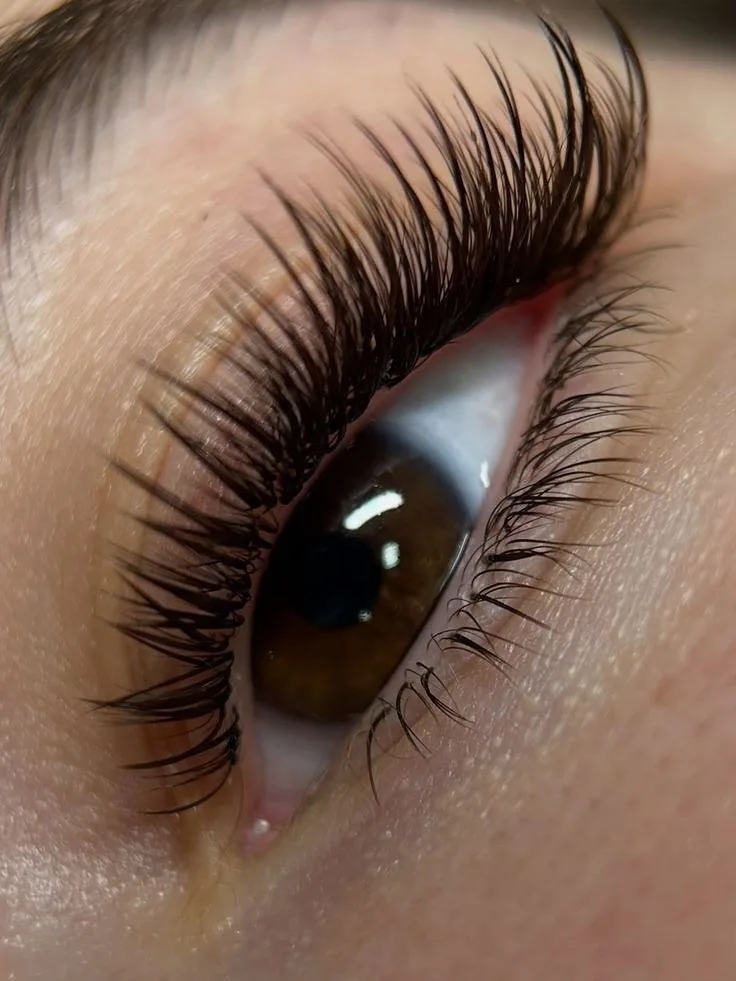
- ShapeUpturned — the outer half of the lash line is raised before you start.
- EffectWispy in mixed texture: soft base, accents clustered outer of centre.
- Where everyone strugglesAccents belong on the plateau, not the corner. And barely above the base.
Why Why it is laid out this way
This is the build most techs mean when they say wispy: a base of mixed singles and fans with closed accents dropped through it. On an eye that lifts by itself the accents have almost no room to grow, so the interest comes from where they sit and how unevenly, never from how far they reach. Hybrid makes that easy to do well and very easy to overdo.
The order the zones go on, and where the fans land
- Mix the base as you goAlternate fine singles and soft fans at each zone's plotted length. The base is where the softness lives; the accents only punctuate it.
- Keep the inner half accent-freeInner zones stay short here, and the eye keeps them lower still. Fill them densely, leave them unpunctuated.
- Cluster accents on the plateauThe two zones outer of centre hold the longest base length and the highest part of the lid. Put your accents there and let the eye supply the lift.
- Close the accent fans tightA wispy accent is a fan pinched almost shut. Any spread and it reads as a clump instead of a point.
- Keep them a hair proudEach accent sits just above its zone's base length. On this shape that margin is smaller than on any other.
- Ease the corner back, plainThe final zone drops slightly and carries nothing extra. It is the top of the eye and it needs no announcement.
The length curve on upturned eyes
The base rises steadily, holds its longest length across two zones outer of centre and eases back at the corner. Placing the accents on that plateau puts them where the lid is naturally highest, so they get their height from the eye rather than from length you have to add. The corner easing back afterwards is what keeps the punctuation from turning into a point.
Where does a wispy map go wrong on upturned eyes?
Deep The physics underneath
A closed accent is mechanically a thick single with all its mass on the axis, and it is the tallest thing on the lid. Everything below follows from that.
The same map, built four ways
- Classic 1:1
- Singles make the cleanest accents because there is no bond node and no spread to control, and they keep the base honest between them. The limit is that a fuller base can then only be bought with thicker material.
- Handmade volume
- Fans soften the base for less mass than singles of the same coverage, which leaves headroom for accents that still stand proud. Pinching a fan almost shut is also how most accents on this map get made.
- Promade / pre-made fans
- Even and quick under a textured set, and they save time in the inner zones where nothing is being punctuated. Across the plateau their sameness sits badly beneath an intentionally uneven rhythm.
- Woven / clover
- Wide coverage from one bond and a shape that repeats, which is the one quality a wispy plateau cannot carry. Inner zones only, if at all.
Spread angle versus weight
Two spreads live on this map at once and they must not be confused: the base fans open enough to close the line, the accents pinched almost shut. On the plateau, where the base is longest and the lid is highest, both should be at their tightest — width out there parks mass off the lash's line and the accent leans instead of standing. Save the open spreads for the short inner zones.
What an upturned lash line can carry
- Accents reach the deflection limit first on any wispy map, and here they sit on the plateau where the base is already at full length — a settled accent lies down across the base and reads as a flaw rather than as a missing point.
- Every extra hair of accent length costs mass and lever at once, which is why the margin over the base is so tight on a shape that supplies its own lift and gives you nothing back for spending it.
- Pick the strongest natural lash in the zone for each accent. The rest of the map tolerates an average lash; the longest strand on the eye does not.
Where this map fails first
The rhythm fails before the density does. Accents sit on individual lashes and shed with them, so within a couple of weeks the uneven pattern you placed has become an uneven pattern nobody placed. The inner zones fail quietly in the other direction, thinning under a base that was mapped short there to begin with. Book this set on a shorter cycle and say why at the consultation rather than at the complaint.
FAQ Common questions
What is the difference between a spike and a wispy accent?
Only degree. Both are the longest thing in their zone; on this shape the accent has to stay a hair above the base rather than a zone above it, or the softness turns hard.
Why no accents at the outer corner?
Because the corner is the highest part of an upturned lash line. Anything long placed there gets the eye's own lift added to it and reads as a drawn-on flick.
How uneven should the spacing be?
Uneven enough that you cannot count a repeat. Cluster two accents close, leave a wider gap, then one on its own — regular spacing is what makes a wispy set look manufactured.
Do wispy sets need more frequent fills?
Yes. The accents are single points of interest on single lashes, so a normal shed cycle costs this map its character long before it costs it fullness.
Print this page or save it as PDF — the diagrams are drawn to stay readable in black and white on plain paper. Or download the diagrams below as SVG. No account, no fee, nothing to sign. Every file carries this page’s address, so wherever it ends up it can be traced back here.
Teaching from these? The offer, and how to credit it.
Also in: Upturned eyes · Wispy · Hybrid
Read next: what makes a lash map wispy rather than spiky · questions clients ask about lash extensions