Upturned Eyes · Wispy · Volume
The wispy lash map for upturned eyes, built in Volume — zone order, where the length peaks, and the point this one usually goes wrong.
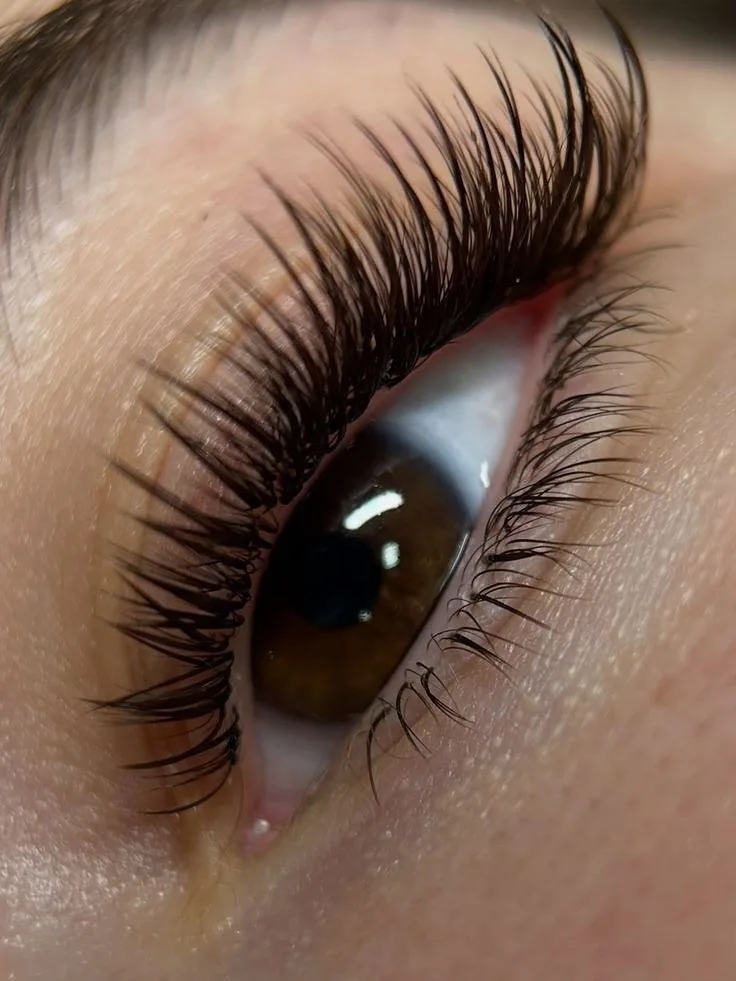
- ShapeUpturned — the outer half of the line sits high with no help from you.
- EffectWispy in fans: a layered base with pinched accents outer of centre.
- Where everyone strugglesDensity is what makes the gaps read. Accents stay barely above the base.
Why Why it is laid out this way
There is a contradiction in a volume wispy set that has to be resolved before you start: fans exist to close gaps and wispy exists to show them. The way out is to build a base dense enough that the deliberate gaps look chosen, then punctuate it lightly. On this shape the punctuation gets its height from the lid, so it barely needs any of its own.
The order the zones go on, fan by fan
- Build a full, even baseOne consistent layer of fans across the whole plotted curve. Gaps only read as intentional when everything around them is solid.
- Give the inner zones body, not reachThe short inner half gets its fans narrow and complete. This is the low end of the eye and it stays at its plotted length.
- Add the second layer on the plateauA light layer over the two zones outer of centre, where the base runs longest. That depth is what the accents will stand out of.
- Pinch the accents nearly shutAccent fans close to almost no spread so they land as points. An open accent in a dense set is just a heavy patch.
- Keep the accents low and irregularA hair above the base length, spacing deliberately uneven. On an eye that lifts itself, height is the one thing you do not need to buy.
- Ease the corner and leave it cleanThe last zone comes back down a notch, single layer, no accents. The highest part of the lid is finished by subtraction.
The length curve on upturned eyes
The plotted base climbs, holds its longest length across two zones outer of centre, then eases off for the corner. In volume that plateau gets a second layer, because a wispy effect needs a dense field for its gaps to register against — thin the base and the gaps become holes. The accents then only have to clear a base that the lid has already raised for them.
Where does a wispy map go wrong on upturned eyes?
Deep The physics underneath
The plateau on this map carries two layers, the longest base length and every accent. That one stretch of lid is the whole engineering problem.
The same map, built four ways
- Classic 1:1
- Singles keep the plateau light and make the sharpest accents, but a base dense enough to show its gaps then has to be bought with thickness. On the longest zones of this map that is the costly way to buy it.
- Handmade volume
- Coverage for less mass is exactly what a dense wispy base needs, and hand-made fans let you close the accents to almost nothing while opening the base fans slightly. Two spreads on one lid is not a luxury here, it is the method.
- Promade / pre-made fans
- Efficient for laying an even base under an uneven pattern, with the extra bond mass sitting at the root where it counts least. Their identical width becomes visible on the plateau, where there is nothing else changing.
- Woven / clover
- Wide coverage per bond suits the short inner zones that need closing quickly. On the plateau it lays repeating width beneath a rhythm that depends on not repeating.
Spread angle versus weight
This map runs two spreads deliberately: the base fans open enough to build a continuous field, the accents pinched to almost nothing so they read as points. Across the plateau, which is both the longest base length and the highest part of this lid, pull both of them in — off-axis mass out there twists as it settles and turns a crisp accent into a lean. The generous spreads belong on the short inner zones where the lengths are modest.
What an upturned lash line can carry
- Two layers plus accents all land on the two plateau zones, so this is the only map in the shape's set where the deflection ceiling is approached by stacked work rather than by length alone — and it fails as a sag of the whole plateau.
- The accent's extra hair of length is charged as mass and reach together, on top of a base that is already at its longest there; that is why the margin over the base has to stay small however tempting a taller accent looks in the chair.
- Put each accent on the strongest lash in its zone and keep the fans off the weakest, because in a dense set the finest strands are invisible until the day they let go and take a fan's worth of coverage with them.
Where this map fails first
The plateau carries everything and it gives way as a unit. Its accents settle onto the base rather than shedding cleanly, so instead of gaps appearing the punctuation simply disappears into the field and the set flattens into a dense ordinary line. Because the density masks it, clients often notice the loss of character a week after it started. Refill the accents and the top layer together, and treat the base as the part that can wait.
FAQ Common questions
Isn't volume the opposite of wispy?
It looks that way until you build one. The gaps only read as intentional when the base around them is solid, so a dense field is what makes a wispy set look designed rather than grown out.
How do I keep accents from looking like clumps?
Pinch them almost shut. An accent needs its mass on the lash's own line to land as a point; any width and it lands as a dark patch instead.
Where does the second layer stop?
At the end of the plateau. Carrying it into the last zone darkens the highest part of an already-lifted eye, which is the fastest way to make this map look severe.
How much taller than the base can the accents go here?
Less than on any other shape. The lid supplies the height for free on the plateau, so a hair above the base is enough and anything more is spent for nothing.
Print this page or save it as PDF — the diagrams are drawn to stay readable in black and white on plain paper. Or download the diagrams below as SVG. No account, no fee, nothing to sign. Every file carries this page’s address, so wherever it ends up it can be traced back here.
Teaching from these? The offer, and how to credit it.
Also in: Upturned eyes · Wispy · Volume
Read next: what makes a lash map wispy rather than spiky · questions clients ask about lash extensions