Wide-Set Eyes · Wispy · Classic 1:1
The wispy lash map for wide-set eyes, built in Classic 1:1 — zone order, where the length peaks, and the point this one usually goes wrong.
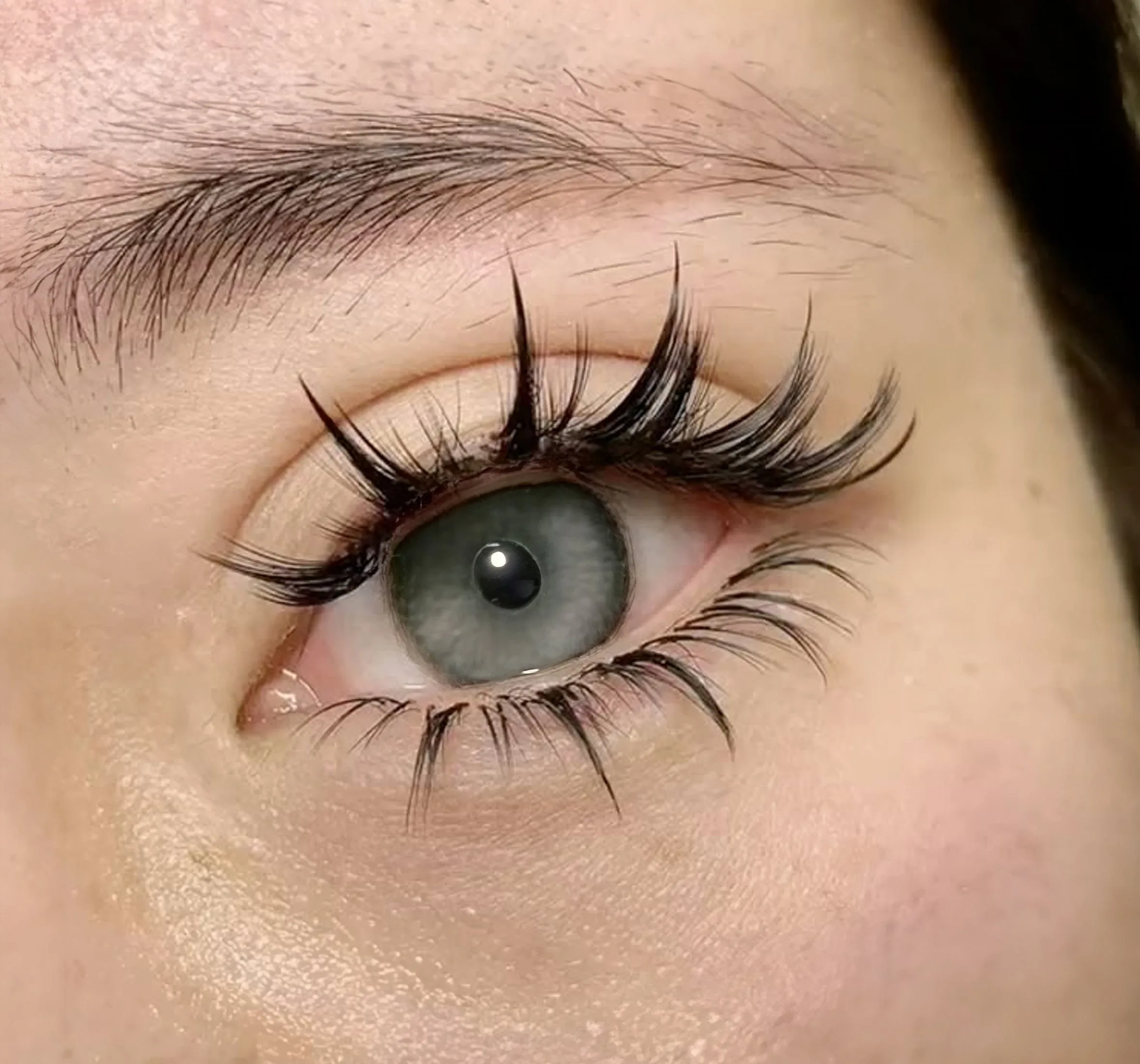
- ShapeWide-set — the space between the eyes is what this map treats.
- EffectWispy, spiked inboard: bright points in the inner-to-middle third.
- Where everyone strugglesOuter-third spikes are the failure. Keep the tail plain.
Why Why it is laid out this way
Wispy is a game of bright points, and bright points are exactly what wide-set spacing has to place carefully. Every spike on this map lives in the inner-to-middle third, with the outer third left as a plain soft base. In classic 1:1 the spikes are long single strands, which makes their placement even less forgiving.
The order the zones go in
- Build the soft baseLay the whole length curve in plain singles first — fuller inner start, level peak pair, short tail.
- Mark the spike zonesDecide the spike positions before placing any of them. All sit inboard of the peak pair's outer edge.
- Lift each spike slightlyA spike runs a step longer than the base around it, standing just above the line.
- Space them unevenlyIrregular gaps between spikes. Even spacing reads as a pattern, and a pattern draws the eye along the whole line.
- Leave the outer thirdPlain, short, no spikes and no extra length. The quiet tail is what stops the face reading wider.
The length curve on wide-set eyes
The base curve starts full, holds level over the pupil and drops to its shortest at the corner, and the spikes sit on the first two-thirds of it. A spike is the brightest thing on a lash line, so wherever the last one goes is where the eye stops travelling — put it in the outer third and the eye finishes at the temple. The length map corrects the spacing; the spike map decides whether the correction is visible.
Where does a wispy map go wrong on wide-set eyes?
Deep The physics underneath
A spike is not a decoration mechanically — it is the longest, heaviest thing on the set, sitting on one lash.
The same map, built four ways
- Classic 1:1
- Every spike here is a single strand, longer than its neighbours, on one natural lash — the highest load per lash on any wispy map. Budget them: a handful across the inner two-thirds, never a row.
- Handmade volume
- Closed fans give the same spike silhouette with the mass split across several fine strands, which is easier on the lash underneath. A different cell, and the sensible route when her lashes are too fine for single-strand spikes.
- Promade / pre-made fans
- Consistent bases speed up the plain sections. They cannot make a spike look accidental, and an accidental look is the entire point of a wispy line.
- Woven / clover
- Wide coverage from one bond, repeating identically. A wispy map is already a pattern of bright points, and a second repeating pattern underneath turns the line into a texture rather than a scatter.
Spread angle versus weight
There is no spread on a 1:1 set, which is exactly why the spikes are risky — all the mass sits on the lash's own line at full length with nothing distributing it. That puts the spikes over the peak pair closest to their deflection limit, and a spike that deflects points outward rather than up. Keep spikes off the finest lashes even where the zone calls for one.
What a wide-set lash line can carry
- A spike is the longest strand on the map, so it charges the maximum on both counts at once: more mass, further out on the lever. One every few lashes, never a run.
- The base carries its mapped lengths comfortably; the spikes are what sit near the ceiling. Judge this set by whether the spikes still stand, not by whether the base is full.
- A zone's finest lashes set its limit, and a spike ignores zone averages entirely because it lands on one specific lash. Choose the lash rather than the position.
Where this map fails first
The spikes over the peak pair, because they are the longest strands on the map at full extension on single lashes. They fail by bending rather than shedding, and a bent spike does not simply disappear — it lies along the line and points toward the corner. That turns an inward-leaning wispy set into an outward-leaning one, the single direction this map cannot afford. Check the spikes are still standing at the two-week mark.
FAQ Common questions
Why can't the spikes go near the outer corner?
Because a spike is the brightest point on the line and the eye follows brightness. A spike at the outer corner marks the far edge of the face, which is the opposite of what this spacing needs.
How many spikes should a wide-set wispy map have?
Few, irregularly spaced, all across the inner two-thirds. Too many becomes a texture and stops reading as scatter.
How much longer is a spike than the base?
A step longer than its neighbours — enough to stand out of the line, not enough to look separate. Any more and it bends.
Can wispy work in classic at all?
Yes, and it is the strictest version, because every spike is one long single strand on one lash. Place spikes on the strongest lashes in the zone and keep the count low.
Print this page or save it as PDF — the diagrams are drawn to stay readable in black and white on plain paper. Or download the diagrams below as SVG. No account, no fee, nothing to sign. Every file carries this page’s address, so wherever it ends up it can be traced back here.
Teaching from these? The offer, and how to credit it.
Also in: Wide-Set eyes · Wispy · Classic 1:1
Read next: what makes a lash map wispy rather than spiky · questions clients ask about lash extensions