Wide-Set Eyes · Wispy · Hybrid
The wispy lash map for wide-set eyes, built in Hybrid — zone order, where the length peaks, and the point this one usually goes wrong.
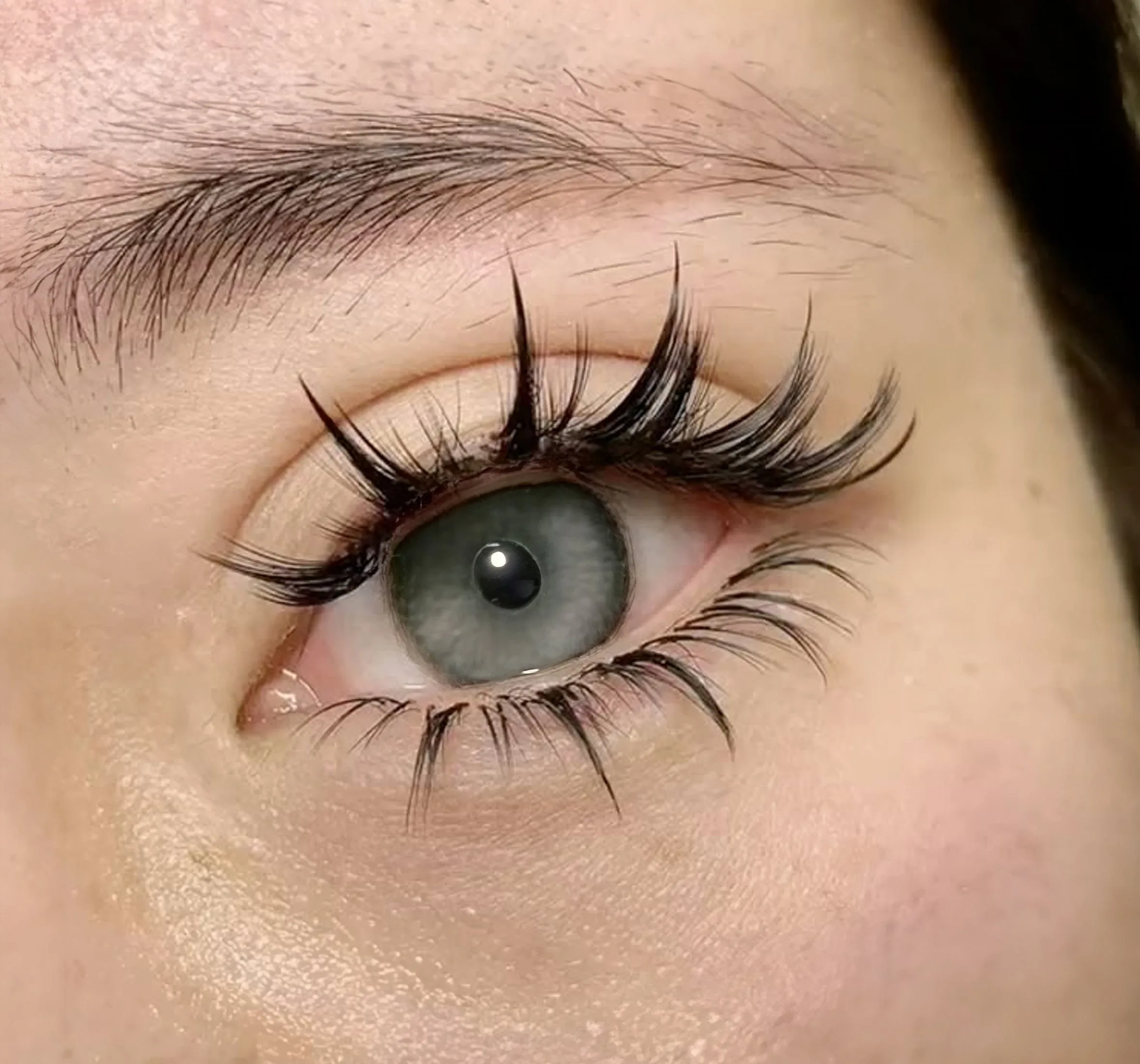
- ShapeWide-set — the eyes are set apart; texture has to work inboard.
- EffectWispy in hybrid: mixed base with closed-fan spikes, all inboard.
- Where everyone strugglesBoth fans and spikes stop before the outer third.
Why Why it is laid out this way
Hybrid is the usual home for a wispy set, because a mixed base is what makes the spikes read as accidents rather than decisions. On this spacing the mix carries a second job: everything interesting has to sit in the inner two-thirds. The outer third is deliberately dull, and the dull part is what does the correcting.
The order the zones go on, and where the fans land
- Set the base curveSingles at every mapped length — full inner start, level peak pair, short tail. Draw the shape before any texture.
- Fill inboard with fansFans between the singles from the inner corner through the peak. That is the half the eye should end on.
- Place closed-fan spikesSpikes made from tightly closed fans, scattered at irregular gaps, all of them before the outer third.
- Vary the spike heightsNot every spike stands the same amount above the base. Equal heights read as a comb.
- Keep the tail plainSingles only past the middle third, dropping to the shortest zone. No fans, no spikes, no interest.
The length curve on wide-set eyes
Two things are drawn on this diagram at once: a length curve that peaks over the pupil and dies at the corner, and a scatter of bright points that stops two-thirds of the way along. The scatter is the part clients see and the part that decides where their eye lands. A perfect length curve with one spike at the corner still reads as wide-set.
Where does a wispy map go wrong on wide-set eyes?
Deep The physics underneath
Three load types on one lid — singles, fans and spikes — and the spikes are in a different league from the other two.
The same map, built four ways
- Classic 1:1
- The singles draw the curve and run the outer third alone. Because the tail is theirs, their lengths are the last line of defence — a long single out there does the same damage a spike would.
- Handmade volume
- Fans give the inner base its softness cheaply, and closed fans give you spikes with the mass split across several fine strands rather than concentrated in one thick one. Both discounts get spent inboard.
- Promade / pre-made fans
- Even coverage, quickly, through the base. Their consistency is a liability in a set whose charm is irregular — use them to fill, never to make a point stand out.
- Woven / clover
- Broad coverage per bond with a repeating outline. In a wispy line the repeat competes with the spikes for attention, and the spikes should win.
Spread angle versus weight
The spikes are fans closed almost to nothing, so their mass sits on the lash's own line at full length — mechanically they behave like heavy singles, not like fans. The soft fans around them are the opposite: less mass, spread off-axis, prone to twisting rather than bending. Keep the spread narrow inboard where the lashes are finest, and remember the spike is the load that actually counts.
What a wide-set lash line can carry
- The spikes are the longest strands on the set and each lands on a single lash. Choosing that lash matters more than choosing the zone, especially on the inner third where the map already asks for a fuller start.
- A soft fan and a closed one of the same length carry the same mass in different places — the closed one all on-axis and at full reach. Budget spikes as singles even though you built them as fans.
- Zones fail at their finest strands, and a scattered line makes that hard to see. Audit the spikes individually; the base will look fine long after the effect has gone.
Where this map fails first
Both failures are spikes, at opposite ends of the textured section. Inboard the map already asks for a fuller start on the eye's finest lashes, so a spike there is the heaviest thing on the weakest anchor and lies down first. Over the peak the spikes are simply the longest on the set and bend under their own reach, and a bent spike points at the corner. The base outlasts both, which is how a wispy set can look full and correct nothing.
FAQ Common questions
Why is hybrid the natural technique for a wispy map?
Because a mixed base makes the spikes look unplanned. A uniform base turns the same spikes into a pattern.
Where does the last spike go?
Roughly two-thirds along, no further. That point is where the client's eye stops, and on wide-set spacing you want it stopping short of the corner.
Should the spikes be even in height?
No. Vary how far each stands above the base, or the line reads as a comb rather than a scatter.
What goes in the outer third?
Plain short singles and nothing else. It is meant to be the least interesting part of the set.
Print this page or save it as PDF — the diagrams are drawn to stay readable in black and white on plain paper. Or download the diagrams below as SVG. No account, no fee, nothing to sign. Every file carries this page’s address, so wherever it ends up it can be traced back here.
Teaching from these? The offer, and how to credit it.
Also in: Wide-Set eyes · Wispy · Hybrid
Read next: what makes a lash map wispy rather than spiky · questions clients ask about lash extensions