Wide-Set Eyes · Wispy · Volume
The wispy lash map for wide-set eyes, built in Volume — zone order, where the length peaks, and the point this one usually goes wrong.
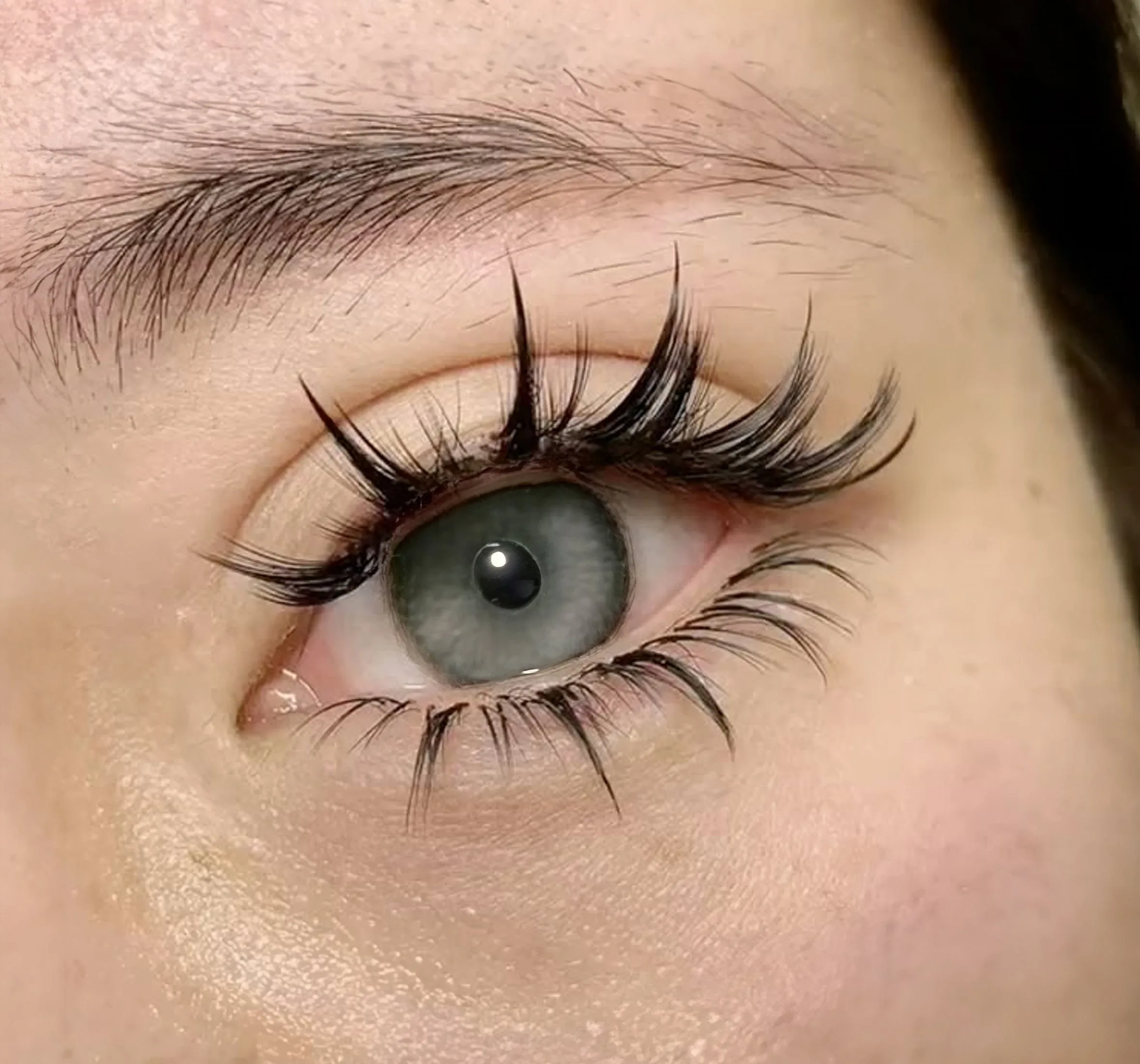
- ShapeWide-set — a wide gap at the bridge; this map answers spacing only.
- EffectWispy in volume: dense inner base with spikes rising out of it.
- Where everyone strugglesA dense outer third erases the effect. Fade it right out.
Why Why it is laid out this way
Volume gives a wispy map a base rich enough that the spikes look like they grew out of it. That richness has to be steered — the density leans inboard with the length and the outer third fades to almost nothing. Get it wrong and the spikes end up sitting on a solid dark band, which on this spacing is the worst finish available.
The order the zones go on, fan by fan
- Fan the whole curveNarrow fans at every mapped length first, including the short outer zones.
- Concentrate the inner halfBuild fullness from the inner corner through the peak pair so the darkness leans the same way the length does.
- Stand the spikes upClosed fans standing a step above the base, scattered irregularly, none of them past the middle third.
- Fade the outer thirdFullness and length both drop away to the corner. Thin and short, no exceptions.
- Break up the baseVary the fan widths slightly across the inner half. A perfectly even base makes the spikes look glued on.
The length curve on wide-set eyes
The length curve leans inward and dies at the corner, and in volume the density has to lean with it — an even dense base under a scattered spike map gives you a dark strip with decorations on it. The spikes give the eye somewhere to land and the density gradient tells it which way to travel. Both point toward the nose or neither does.
Where does a wispy map go wrong on wide-set eyes?
Deep The physics underneath
The most material and the biggest single load, both on one lid. Worth separating the two before deciding how far to push either.
The same map, built four ways
- Classic 1:1
- Singles are still worth keeping in the outer third, where fans look abrupt as they fade. They also make a cleaner short tail than a thinned fan does.
- Handmade volume
- The base is the reason for this cell — fine strands give the inner half its richness for much less mass than lengthening would. The same technique makes the spikes safer, since a closed fan splits a load a thick single would concentrate.
- Promade / pre-made fans
- Fast through a dense base, node mass low on the lever. The fixed spread makes it hard to vary widths across the inner half, and that variation is what keeps the base from looking manufactured.
- Woven / clover
- Excellent coverage per bond with an outline that repeats. Under a spike scatter the repeat competes for attention, and it competes hardest in the outer third where nothing should be asking for any.
Spread angle versus weight
Two spread decisions run in opposite directions on this map. The base fans want a moderate spread inboard, wide enough to read as richness but narrow enough that fine inner lashes do not twist; the spikes want almost no spread at all, which is what makes them behave like heavy singles. Do not let the second setting drift toward the first — a half-open spike is neither bright nor light.
What a wide-set lash line can carry
- Volume buys darkness cheaply and the spikes spend that saving in one place. The base can sit comfortably inside its ceiling while every spike sits right at the edge of one.
- The first thing to go is the spikes, and they go by bending rather than shedding. A set can hold its full density and still stop correcting, because the bright points have lain down and are pointing outward.
- The inner corner carries two demands at once here — a fuller start and the densest base — on the eye's finest lashes. That zone, not the peak, is where the fullness budget runs out first.
Where this map fails first
Two failures, and both leave the set looking full. The inner base carries the map's heaviest density on its finest lashes, so it drops first and the gap beside the nose quietly reopens. The spikes go next, bending under their own reach until they lie along the line pointing at the corner. Neither shows up as sparseness, which is why this map has to be judged on its shape at every fill rather than on how much lash is left.
FAQ Common questions
Does a wispy set need volume at all?
Not always, but volume gives the base enough richness for the spikes to look like they grew out of it. On this spacing it also lets the inner half carry darkness without extra length.
Why do the spikes stop before the outer third?
A spike is the brightest point on the set and the eye stops where the last one sits. On wide-set eyes you want it stopping well short of the corner.
How do I stop the base looking like a solid band?
Let density fall with length toward the tail, and vary the fan widths slightly across the inner half. Even density is what turns a wispy set into a plain one.
Which part fails first on this map?
The spikes, by bending, and the inner base, by sitting low. Both leave the set looking dense while the effect has already gone.
Print this page or save it as PDF — the diagrams are drawn to stay readable in black and white on plain paper. Or download the diagrams below as SVG. No account, no fee, nothing to sign. Every file carries this page’s address, so wherever it ends up it can be traced back here.
Teaching from these? The offer, and how to credit it.
Also in: Wide-Set eyes · Wispy · Volume
Read next: what makes a lash map wispy rather than spiky · questions clients ask about lash extensions