Almond Eyes · Wispy · Classic 1:1
The wispy lash map for almond eyes, built in Classic 1:1 — zone order, where the length peaks, and the point this one usually goes wrong.
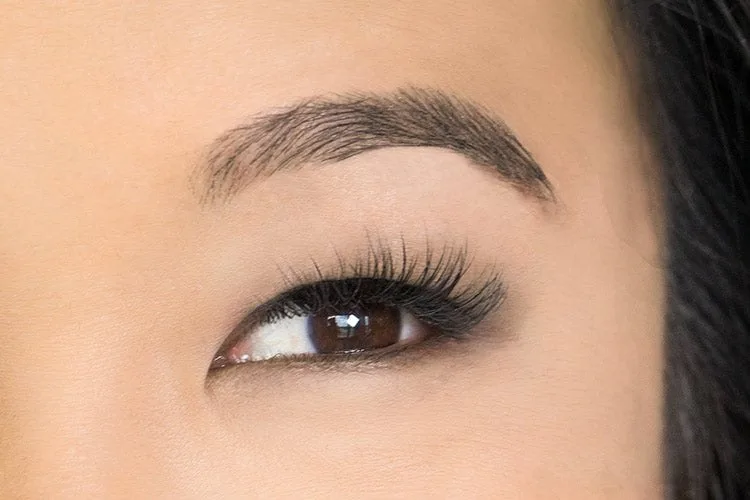
- ShapeAlmond — nothing to correct, so the spikes are the only design on the lid.
- EffectWispy in singles: a soft base with taller strands scattered along it.
- Where everyone strugglesNever space the spikes evenly. Regular spacing reads as a comb, not as wisps.
Why Why it is laid out this way
Wispy is the one effect where the strays are the point, and that makes placement the whole craft rather than length. The base underneath is an ordinary quiet map; everything the client notices comes from where the taller strands land and how often. In classic each spike is a single longer strand on a single lash, which is the most demanding version of the idea and the cleanest.
The order the zones go in
- Lay a quiet base firstBuild the full soft curve, top length held across two zones past centre. Finish it completely before a single spike goes on.
- Place spikes in irregular groupsSomewhere between seven and ten per eye, clustered and gapped rather than counted out. Uneven spacing is what makes it look grown.
- Keep the step above the base smallA spike stands a clear step above the base line and no more. Too far above and it stops looking like her own lash.
- Match the spike to its zoneEvery spike takes its height from the base length beside it, so the ones near the inner corner are noticeably shorter.
- Choose the lash, not the gapPut spikes on strong healthy lashes only. The extra length concentrates the load on one hair, so it needs a hair that can take it.
The length curve on almond eyes
The line above is a gentle base, and wispiness is what happens on top of it — so the base has to be right before any of it makes sense. Almond's even arc offers no natural place for a spike to belong, which means every one of them is your decision and looks like it if the rhythm is wrong. Group them, gap them, and let the height of each one follow the zone it stands in.
Where does a wispy map go wrong on almond eyes?
Deep The physics underneath
Every other map in this shape shares its load along the line. This one concentrates it in a handful of places, which changes the arithmetic.
The same map, built four ways
- Classic 1:1
- A spike here is simply a longer single strand, so all of its mass and all of its reach sit on one natural lash. That is the honest version of the effect and the one that most needs a strong lash under each spike.
- Handmade volume
- Fanning lets the base be full without being heavy, so the spikes have more of a line to stand out from. It does not help the spikes themselves, which want to stay narrow to read as single hairs.
- Promade / pre-made fans
- Useful for filling the base quickly and consistently. Their sameness is a liability on this cell, where the client is paying for the impression that nothing was uniform.
- Woven / clover
- The most repetitive object available, on the least repetitive map in the shape. If it goes anywhere, it goes low in the base where the spikes will distract from it.
Spread angle versus weight
A spike is the narrowest thing you can put on a lash — effectively all its mass on the lash's own line, which is why it does not twist and why it feels safe. What it does instead is spend everything on reach, so the lash beneath it carries the longest lever on the map with no help from its neighbours. Narrow does not mean light here; it means concentrated.
What an almond lash line can carry
- The ceiling shows up one lash at a time. A spiked lash that gives way tips forward and hangs below the base line, and a single drooping spike is more visible than a whole zone sitting slightly low.
- Length is charged twice — heavier and further out at once — and a spike is nothing but extra length. That is the entire reason the step above the base has to stay small.
- Only pick strong lashes to spike, because the rule about a zone being no better than its weakest hairs applies with no averaging at all here. There is no neighbouring lash sharing the load.
Where this map fails first
The spikes fail before the base does, and they take the whole effect with them. Each one is the longest extension on the lid sitting on a single hair, so those hairs shed first, and what remains is a perfectly decent quiet map with nothing distinctive about it. Clients read this as the set having gone plain rather than sparse. At the fill, replace the spikes first and on different lashes from last time.
FAQ Common questions
How many spikes belong on one almond eye?
Roughly seven to ten per eye, placed in uneven groups. The number matters far less than the spacing — count them out at regular intervals and the effect is gone whatever the total.
How far above the base line does a spike sit?
A clear step above it, no more. Enough that it reads as a taller hair in the same line, not enough that it looks like something that escaped.
Can you build a wispy set without fans?
Yes, and this is that version. A spike in classic is just a longer single strand, which gives a lighter, sharper wisp than a closed fan does.
Which lashes should carry the spikes?
The strongest ones you can find in each zone. All the extra reach lands on that one hair, so a spike on a fine or newly grown lash is the fastest way to lose it.
Print this page or save it as PDF — the diagrams are drawn to stay readable in black and white on plain paper. Or download the diagrams below as SVG. No account, no fee, nothing to sign. Every file carries this page’s address, so wherever it ends up it can be traced back here.
Teaching from these? The offer, and how to credit it.
Also in: Almond eyes · Wispy · Classic 1:1
Read next: what makes a lash map wispy rather than spiky · questions clients ask about lash extensions