Almond Eyes · Wispy · Hybrid
The wispy lash map for almond eyes, built in Hybrid — zone order, where the length peaks, and the point this one usually goes wrong.
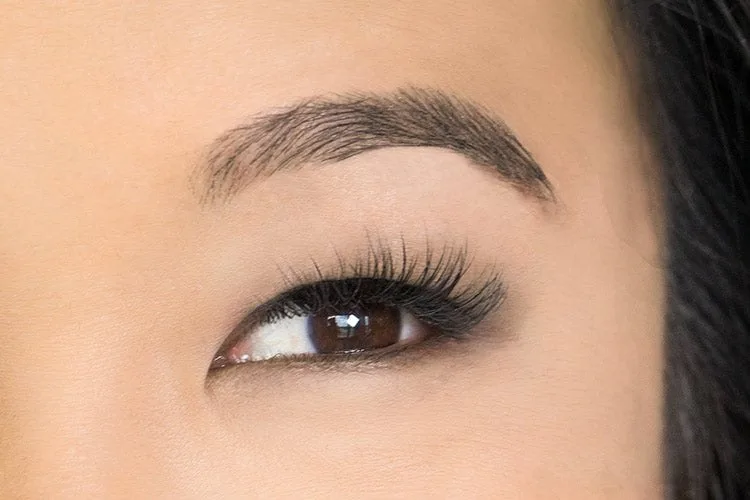
- ShapeAlmond — a balanced lid, so the wisps carry the whole look on their own.
- EffectWispy in a mix: singles and fans in the base, closed fans standing above it.
- Where everyone strugglesA busy base hides the wisps. Texture needs something quiet to stand against.
Why Why it is laid out this way
Hybrid is where this effect is usually built, because a closed fan makes a tidier spike than a single strand and the base can be filled without going heavy. The trap is enthusiasm: once the mix is in your hand it is tempting to texture everything, and a set that is textured everywhere is textured nowhere. Contrast is the mechanism, so half the job is deciding what stays plain.
The order the zones go on, and where the fans land
- Build a calm mixed baseSingles and soft fans at matching lengths, following the gentle curve with its top held across two zones.
- Close a fan for each spikePinch the fan almost shut so it reads as one taller hair. An open fan standing above the line looks like a mistake.
- Spread the spikes end to endGroups near the inner third, groups past the peak, gaps in between. Wisps at one end only look like damage.
- Keep the base widths modestNarrow fans in the base so the spikes have something restrained to rise out of. Contrast is the whole effect.
- Spike strong lashes onlyA closed fan concentrates its mass on one hair the same way a long single does. Choose the lash before you choose the spot.
The length curve on almond eyes
The base curve above is intentionally uneventful, and that is what gives the wisps somewhere to come from. Almond's arc will not do any of this work for you — there is no fold or droop making certain lashes stand out — so contrast has to be manufactured, quiet ground against a scattering of taller marks. Every extra bit of texture you add to the base subtracts from the spikes.
Where does a wispy map go wrong on almond eyes?
Deep The physics underneath
Two jobs, two objects: a base that must stay light and a set of spikes that concentrate load. What follows is how they price differently.
The same map, built four ways
- Classic 1:1
- Singles hold the base lengths honest and make a light, sharp spike when you want one. The cost is that every base lash you fill costs a full strand, so a dense quiet ground gets heavy quickly.
- Handmade volume
- Fans fill the base for less mass than singles would, which leaves headroom for the spikes to be the only heavy thing on the lid. Building them yourself also means the base widths can stay small on purpose.
- Promade / pre-made fans
- Fast for the base and useful when you want the ground genuinely uniform. Their consistency is why they should not be used for the spikes, where the whole value is that no two are alike.
- Woven / clover
- The repeat that hurts other maps hurts this one most, because the client is buying irregularity. Keep it out entirely, or bury it in the base where the spikes will take the attention.
Spread angle versus weight
Closing a fan does not make it lighter; it stacks the same mass along the lash's own line, which is why a spike does not twist and why it feels deceptively safe. All that mass then sits at the far end of the longest lever on the map. In the base, do the opposite and let the fans open just enough to close their gaps, so the ground stays light while the spikes take the load.
What an almond lash line can carry
- This map fails one hair at a time rather than a zone at a time. A spiked lash that gives up leans out of line, and one leaning spike is more noticeable than a whole soft zone sitting low.
- Extra reach costs mass and leverage together, and a spike is pure extra reach with nothing shared with its neighbours. Keep the step above the base modest and the arithmetic stays manageable.
- There is no averaging on a spiked lash — its own strength is the only limit that applies. Pick the hair first and place the spike second, not the other way round.
Where this map fails first
The base goes before the spikes do, and the result is worse than losing them. As the mixed ground thins, the surviving spikes have nothing left to rise out of, so they stop reading as texture and start reading as stray hairs the tech missed. The eye looks patchy rather than soft, usually around the third week. Fill the base first and only then decide whether the spikes still need replacing.
FAQ Common questions
Should a wispy spike be a closed fan or a single strand?
Either works. A closed fan gives a slightly fuller, more visible spike, a single strand gives a finer one — the important part is that it stays narrow enough to read as one hair.
Why do my wispy sets look messy rather than textured?
Usually because the base is textured too. Wisps are only visible against something calm, so pull the variation out of the base and let the spikes do all the work.
Where should the spikes sit along the lash line?
In uneven groups from the inner third right through to past the peak. Concentrating them at the outer corner makes the eye look damaged instead of styled.
Is a hybrid wispy set heavier than a plain one?
It does not have to be. Filling the base with narrow fans instead of singles keeps the overall load down, which leaves room for the spikes to be the only demanding thing on the lid.
Print this page or save it as PDF — the diagrams are drawn to stay readable in black and white on plain paper. Or download the diagrams below as SVG. No account, no fee, nothing to sign. Every file carries this page’s address, so wherever it ends up it can be traced back here.
Teaching from these? The offer, and how to credit it.
Also in: Almond eyes · Wispy · Hybrid
Read next: what makes a lash map wispy rather than spiky · questions clients ask about lash extensions