Almond Eyes · Wispy · Volume
The wispy lash map for almond eyes, built in Volume — zone order, where the length peaks, and the point this one usually goes wrong.
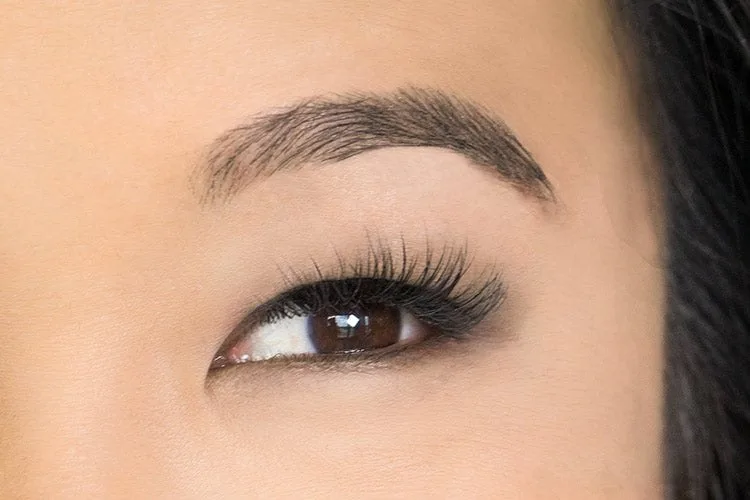
- ShapeAlmond — an even lid, so every bit of the texture here is manufactured.
- EffectWispy in fans: a light layered base with closed fans standing above it.
- Where everyone strugglesThe spikes are your top layer. Add a second full layer as well and the wisps drown.
Why Why it is laid out this way
Of every combination on this shape, this one carries the most material — a fanned base plus a scatter of spikes, each of which puts its whole reach on a single hair. That is manageable if the spikes are counted as the upper layer rather than as an extra on top of one. Texture in the base then has to come from width, because any length variation down there competes with the wisps.
The order the zones go on, fan by fan
- One base layer, shapedBuild the soft curve once, in fans, with the top length running over two zones past centre. Resist stacking a second layer above it.
- Alternate the fan widthsVary how wide each base fan opens while keeping every length on the curve. That is where the base gets its life.
- Treat spikes as the upper layerClosed fans sitting a clear step above the base, in uneven groups. Nothing else goes above the line.
- Keep daylight in the baseLeave visible gaps between base fans. A solid base gives the spikes nothing to be seen against.
- Budget every spikeCount each one as if it were a long single strand, because mechanically it is. Place it on a lash that could carry that.
The length curve on almond eyes
The curve above is the base only — the wisps live above it and are not drawn here, which is worth remembering when you plan the load. Almond gives no lash a natural head start, so the spikes are visible purely because the base stays low and open beneath them. Fill that base in and you have paid for a volume set and a wispy set and got neither.
Where does a wispy map go wrong on almond eyes?
Deep The physics underneath
Coverage per unit of mass is what volume sells, and this map spends part of that saving on spikes that share nothing with anyone.
The same map, built four ways
- Classic 1:1
- Every base lash costs a full strand, which is expensive on a map that also wants spikes. Its virtue is that nothing is hidden — you can see exactly how much is on the lid.
- Handmade volume
- The base belongs to this technique: finer strands cover the same line for less mass, leaving headroom for the spikes. Hand-built fans also let you vary the width lash by lash, which is how the base gets texture without gaining length.
- Promade / pre-made fans
- Even and quick, and evenness is genuinely wanted in this base for once. Do not close them into spikes, though — identical wisps defeat the point of having wisps.
- Woven / clover
- Coverage per bond is excellent and the repeat is fatal here, because the whole map is a claim that nothing repeats. If it appears at all, it belongs low in the base and nowhere near a spike.
Spread angle versus weight
Spread decides the footprint of a fan's mass, and this map wants both extremes at once. In the base, open wide enough to cover and no further, since width closes the gaps that let the spikes show. In the spikes, close almost completely, which puts every bit of their mass on the lash's own line and every bit of their reach on one hair.
What an almond lash line can carry
- The failure looks different in each half: the base sags as a zone, the spikes lean one at a time, and the leaning ones are what anyone notices first.
- Each step of extra reach costs mass and leverage together, and a spike is nothing but reach. Its step above the base is the single number worth being strict about on this map.
- A spiked lash carries alone. However light the base is, the ceiling for a spike is set by the individual hair beneath it, so a set that suits her lash line on average can still be wrong in ten specific places.
Where this map fails first
Outer spikes go first, and they turn before they fall. A closed fan at the end of the lid sits on the finest lashes on the eye, and once one starts to rotate it points away from the line rather than out of it, which looks worse than a missing lash. The base holds on longer because its load is shared. Remove any spike that has turned rather than trying to straighten it, and rebuild on a neighbouring lash.
FAQ Common questions
Is a volume base too heavy for a wispy set?
Not if it stays as one layer with gaps in it. The base should be lighter than a normal volume set precisely because the spikes are the second layer.
How do you give the base texture without hurting the wisps?
Vary the width of the fans, not their length. Keeping every base fan on the curve leaves the height variation to the spikes, which is where the client is meant to see it.
Can you do a wispy volume set on fine lashes?
This is the combination to say no to. A fanned base plus spikes puts shared load along the line and concentrated load on individual hairs, and fine lashes fail at the second part.
Why do my wispy volume sets look like ordinary volume?
The base is too full. Wisps only exist as a contrast, so if the ground has no daylight in it there is nothing for the spikes to stand out from.
Print this page or save it as PDF — the diagrams are drawn to stay readable in black and white on plain paper. Or download the diagrams below as SVG. No account, no fee, nothing to sign. Every file carries this page’s address, so wherever it ends up it can be traced back here.
Teaching from these? The offer, and how to credit it.
Also in: Almond eyes · Wispy · Volume
Read next: what makes a lash map wispy rather than spiky · questions clients ask about lash extensions