Close-Set Eyes · Wispy · Classic 1:1
The wispy lash map for close-set eyes, built in Classic 1:1 — zone order, where the length peaks, and the point this one usually goes wrong.
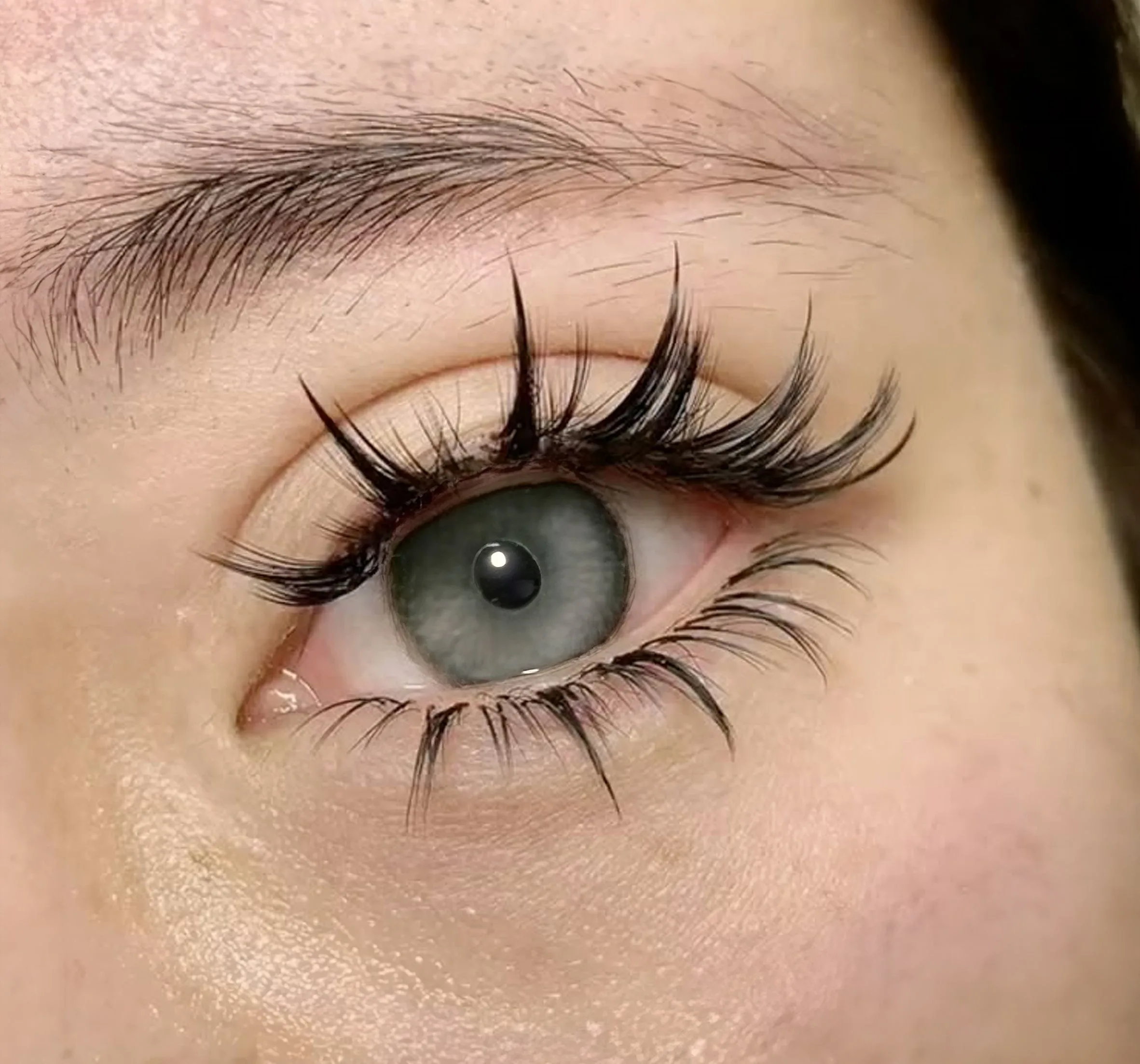
- ShapeClose-set — the inner corners sit close together over a short bridge.
- EffectWispy in singles: a quiet base with longer strands standing out past the iris.
- Where everyone strugglesNo spikes on the inner half. One beside the nose cancels the rest of the map.
Why Why it is laid out this way
Wispy is a scatter of bright points on a quiet base, and on this spacing where those points land is the entire map. In a classic set the spikes are simply longer single strands standing above their neighbours — easy to place, and heavy for what they are. Every one of them belongs in the outer third.
The order the zones go in
- Quiet base at the nose endThe inner half is short, even and unremarkable. Nothing stands above the line near the bridge.
- Climb toward the outer thirdStep the base length up gradually so the spikes have something to rise out of when you reach them.
- Spike past the outer irisLonger single strands standing clear of their neighbours, all of them outboard of the outer iris.
- Space them unevenlyVary the gaps. Evenly spaced points read as a comb rather than as stray lashes.
- Keep the corner occupiedCarry the base nearly full to the tail so the spikes are not standing on an empty edge.
The length curve on close-set eyes
A wispy set is read as a handful of highlights, and a face treats highlights the way it treats length — as where the eye is aimed. Placed past the outer iris they make the pair look further apart; placed near the nose, one of them undoes everything else on the lid. The base under them only has to be quiet enough that the spikes are the only things above the line.
Where does a wispy map go wrong on close-set eyes?
Deep The physics underneath
A spike in a classic set is a long single strand with nothing to share its load. That makes this map heavier in places than it looks.
The same map, built four ways
- Classic 1:1
- Base and spikes are both single strands here, so the spikes end up the longest and heaviest things on the lid with no fan discount anywhere on the set. Where they go is a weight decision as much as a design one.
- Handmade volume
- Fans let a spike be tall without being one thick strand, which is the trade the volume wispy build makes. In classic the height comes straight out of the natural lash's budget.
- Promade / pre-made fans
- Consistent, and consistency is the enemy of an effect that has to look accidental. Their genuine use is in the quiet base, where nothing is meant to catch anyone's eye.
- Woven / clover
- A repeating spread produces exactly the comb this map is trying to avoid. If it goes anywhere it goes inboard, where the base is doing nothing but existing.
Spread angle versus weight
Nothing is fanned here, so the only spacing you control is the gap between one spike and the next — and that gap does the job spread does elsewhere. It decides whether the outer third reads as scattered lashes or as a tidy edge with tall bits stuck in it, and it costs the lash line nothing at all. Vary it, then vary it again: an eye finds a regular interval faster than it finds a length error.
What a close-set lash line can carry
- Every spike is a long single on one natural lash and it sets its own ceiling. The zone average tells you nothing here, because a spike is not an average object.
- Length charges twice over, so a spike standing well above its neighbours costs far more than the modest difference in length suggests. Two shorter spikes usually read better than one very long one.
- The lash under a spike has to be among the strongest in the outer third, which is the part of the lid where strong lashes are hardest to find. That contradiction is the real limit on how wispy this shape can go.
Where this map fails first
The spikes go first and the effect goes with them, because in a classic set they are long singles hanging off the finest lashes out there. They rarely shed — they settle until they sit level with the base, and a wispy set with nothing above the line is just a short natural one. The second failure is not mechanical at all: a spike placed inboard is wrong on the day it goes on and stays wrong for the whole cycle. At fills, replace the spikes before you touch the base.
FAQ Common questions
Why can there be no spikes at the inner corner?
A spike is the brightest point on the set and the inner corner is the closest point to the nose. One there pulls the eyes together harder than any length error further out.
How many spikes should a wispy set have?
Enough to read as a scatter, few enough to count. Spacing matters more than the number — uneven gaps look like lashes, even gaps look like a comb.
How much longer than the base should a spike be?
Enough to stand clear of it and no more. In classic a spike is one strand on one lash, so every extra bit of height is paid straight out of what that lash can hold.
Does the base still need a peak?
Yes. The base follows the same outward-shifted curve as a natural close-set map, and the spikes decorate that shift rather than replace it.
Print this page or save it as PDF — the diagrams are drawn to stay readable in black and white on plain paper. Or download the diagrams below as SVG. No account, no fee, nothing to sign. Every file carries this page’s address, so wherever it ends up it can be traced back here.
Teaching from these? The offer, and how to credit it.
Also in: Close-Set eyes · Wispy · Classic 1:1
Read next: what makes a lash map wispy rather than spiky · questions clients ask about lash extensions