Close-Set Eyes · Wispy · Hybrid
The wispy lash map for close-set eyes, built in Hybrid — zone order, where the length peaks, and the point this one usually goes wrong.
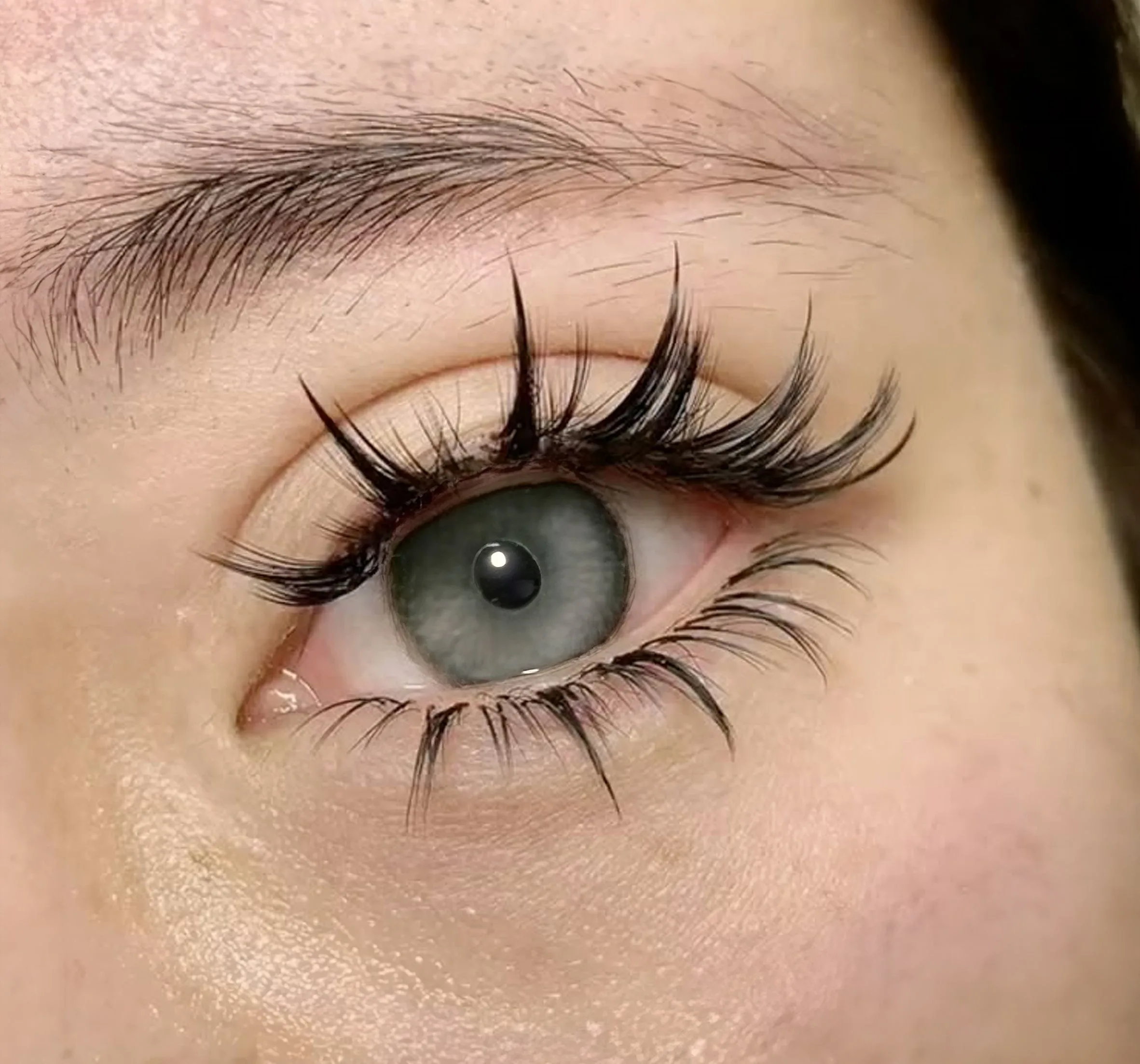
- ShapeClose-set — a short gap at the bridge, so the loud work stays outboard.
- EffectWispy done the usual way: closed-fan spikes over a base of singles and fans.
- Where everyone strugglesDon't add a spike near the nose for symmetry. It is the loudest error here.
Why Why it is laid out this way
This is the usual way a wispy set is built: closed fans standing above a mixed base of singles and soft fans. Because a closed fan can be tall without being thick, the spikes reach further than a classic set's would, which lets the outer third carry more of the interest. The inner half still gets nothing that stands out from the line.
The order the zones go on, and where the fans land
- Plain short inner baseSingles across the first two zones, shortest on the lid, no fans and nothing tall.
- Mix the base from mid-lidFrom the third zone, fill between the singles with soft fans sitting just under their length.
- Spike the outer thirdClosed fans standing above the base, all past the outer iris, tucked into the line rather than perched on top of it.
- Group them, don't space themLet the spikes fall in loose groups with irregular gaps. Grouping is what makes them look like her own lashes.
- Hold the base to the cornerKeep filling to the tail so there is body underneath the spikes at the outer edge.
The length curve on close-set eyes
The base runs the outward-shifted curve — short at the nose, peak in the outer third, tail carried — and the spikes concentrate attention on top of it. Two signals in the same direction make this one of the stronger corrections available on this spacing, provided the spikes land where they should. A single spike on the inner half sends the opposite signal, and it is louder than anything else on the eye.
Where does a wispy map go wrong on close-set eyes?
Deep The physics underneath
A closed fan is a spike you can weigh. That is the whole difference from the classic build, and it decides how far the outer third can be pushed.
The same map, built four ways
- Classic 1:1
- Singles keep the base readable and hold the length curve under the texture. They are also the honest choice for a spike when the natural lash beneath is strong enough to take one.
- Handmade volume
- Closing a fan down to a point gives a spike whose weight you chose, made of fine strands instead of one thick one. That control is why this is the standard way to build wispy.
- Promade / pre-made fans
- Quick and even for the base fill through the middle zones. Used as spikes they arrive at a fixed weight, which removes the one adjustment this map needs most at the corner.
- Woven / clover
- A wide repeating unit is the opposite of a scatter. Its place, if it has one, is low in the base where the line only needs to be present.
Spread angle versus weight
A closed fan carries all its strands along one line, so it behaves like a single thick strand and should be budgeted as one. The open fans in the base want the least width that meets their neighbours: width there closes the gaps between spikes, and those gaps are what make the set read wispy instead of solid.
What a close-set lash line can carry
- The outer third holds the base peak, the densest fill and every spike on the set at once. Whatever the weakest lash out there can hold is the real ceiling for the whole effect.
- A closed fan weighs what its strands weigh, and it sits at the longest length on the map. Being able to make it fine is what buys the height — it does not make the height free.
- Spikes are chosen lash by lash, never zone by zone. Pick the lash first and the spike second, and skip the spot altogether if nothing there will hold one.
Where this map fails first
Spikes turn before anything sheds, and a turned closed fan is instantly readable as a stray hair. The base under them thins at the same time, so the gaps that used to look like texture start looking like fallout. Both of those live in the outer third, which means this map ages in exactly the zone it exists to emphasise. Fills that replace spikes and top up the outer base are what keep it looking deliberate.
FAQ Common questions
What makes a hybrid spike different from a classic one?
It is a fan closed down to a point, so its weight is your choice. That lets a spike stand taller for less load than a single strand of the same length would put on the lash.
Where do the spikes go on close-set eyes?
Outboard of the outer iris and nowhere else. Spikes are the loudest thing on the set, and the inner half is the one stretch of lid that has to stay quiet.
Should the spikes be evenly spread out?
No — group them loosely with irregular gaps. Regular spacing reads as a strip and walks the eye along the lid instead of out past the corner.
Does the base still need the outward shift if there are spikes?
Yes, and it does most of the work. The spikes point at where the base already peaks, so a flat base leaves them decorating nothing.
Print this page or save it as PDF — the diagrams are drawn to stay readable in black and white on plain paper. Or download the diagrams below as SVG. No account, no fee, nothing to sign. Every file carries this page’s address, so wherever it ends up it can be traced back here.
Teaching from these? The offer, and how to credit it.
Also in: Close-Set eyes · Wispy · Hybrid
Read next: what makes a lash map wispy rather than spiky · questions clients ask about lash extensions