Close-Set Eyes · Wispy · Volume
The wispy lash map for close-set eyes, built in Volume — zone order, where the length peaks, and the point this one usually goes wrong.
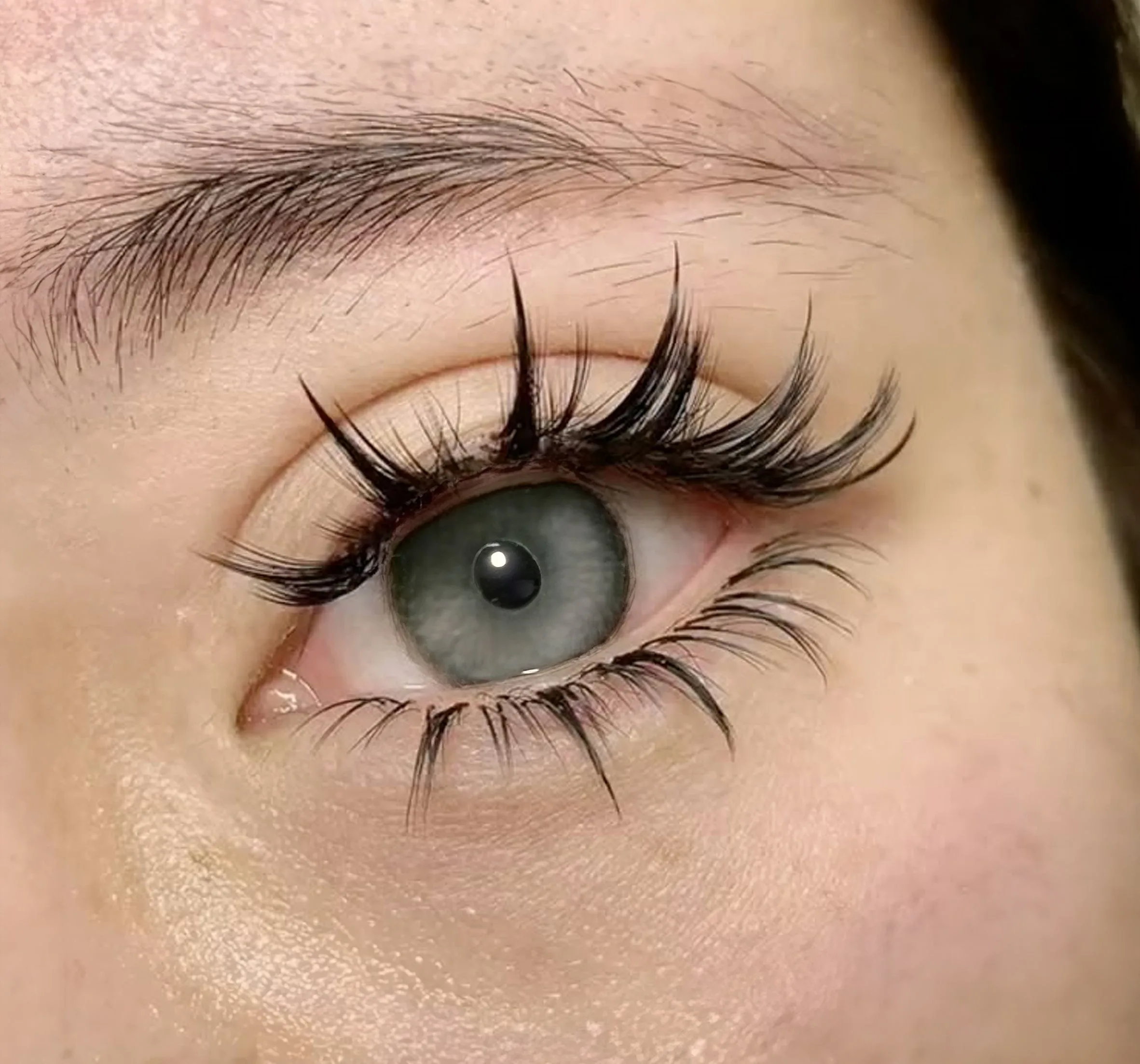
- ShapeClose-set — a narrow bridge, so both length and density belong outboard.
- EffectWispy in fans: a dense graded base with spikes standing out of the outer third.
- Where everyone strugglesDon't fill every lash. Without gaps there is nothing for the spikes to clear.
Why Why it is laid out this way
In volume the base is dense enough to be a look on its own, which changes what the spikes have to do: they must clear a fuller line before anyone sees them. That tempts you into longer spikes, and long spikes on this spacing are only safe in one place. The other risk is the base itself, because a dense inner corner puts weight beside the nose before a single spike goes on.
The order the zones go on, fan by fan
- Fewest strands at the noseNarrow fans or plain singles across the first two zones, kept short. Density here is weight beside the bridge.
- Grow the base outwardWiden the fans and raise the lengths together on the way to the peak in the outer third.
- Leave gaps to spike intoDo not fill every lash out there. Wispy is made of the spaces as much as of the spikes.
- Spike the reserved lashesClosed fans standing above the base on the lashes you left, all of them outboard of the outer iris.
- Keep the tail denseThe corner stays full, so the spikes sit inside a line rather than hanging off the end of one.
The length curve on close-set eyes
Volume makes the base solid, and a solid base swallows texture — so the gaps have to be left in on purpose and the spikes dropped into them. Everything is loaded into the outer third: widest fans, longest base lengths and every spike, which puts the busiest and darkest part of the eye at its furthest point from the nose. Inboard the line is short and thin at once, which is two corrections for the price of one.
Where does a wispy map go wrong on close-set eyes?
Deep The physics underneath
A dense base and the tallest objects in the library, sharing one third of the lid. Below is how that third gets budgeted.
The same map, built four ways
- Classic 1:1
- Single strands in the base give you natural gaps for free and a far lighter set. What they cannot give is the depth this cell was chosen for, and depth is why she asked for volume.
- Handmade volume
- Both halves of this map come from one technique: fans open for the base, fans closed for the spikes. Building both from fine strands is what keeps a dense wispy set affordable to the lash line.
- Promade / pre-made fans
- Quick for the base through the middle zones. In the outer third their fixed spread makes it harder to leave the deliberate gaps this effect is built out of.
- Woven / clover
- Broad coverage from one bond, which closes gaps rather than leaving them. On the one map in this shape that needs its gaps, that is the wrong instinct.
Spread angle versus weight
Spread is doing two opposite jobs on this map. Open fans in the base decide how solid the line looks; closed fans on the spikes decide how far above it the texture stands — so extra width in the base closes the very gaps the spikes need. Run the outer-third base fans narrower than you would on a plain volume set and let the spacing do the work.
What a close-set lash line can carry
- The outer third carries the deepest fill and every spike, making it both the heaviest and the shallowest part of this map. That combination is the ceiling, and there is no way to move it inboard.
- Fine strands split across a lash drop mass faster than they drop coverage, and this cell spends that discount twice — once on a dense base, once on the spikes above it. Spending it twice does not double it.
- Reserved lashes have to be strong lashes. If the one you saved turns out to be fine, spike a different lash and fill that one instead of forcing the spike you planned.
Where this map fails first
Here the failure is the texture disappearing rather than the set thinning. Spikes settle toward the base, the base is dense enough to absorb them, and what remains is a full natural set she did not ask for. The inner corner drifts the other way across fills, gaining fans until the lid is dark all the way to the bridge. Re-reading the map before every fill is what stops both — this is not a set anyone can top up on autopilot.
FAQ Common questions
Why leave lashes unfilled in a volume wispy set?
The texture needs somewhere to be. If the base takes every lash, the spikes have nothing to stand out from and the whole thing reads as a dense natural set.
Can the base be dark at the inner corner if the spikes are outboard?
No. Density near the nose is weight near the nose whether or not a spike sits on it, and on this spacing it works against the map before the texture is even placed.
Should the spikes be longer here than in a hybrid set?
No, and that temptation is the trap. Fix visibility by thinning the base around them, not by adding length to the finest lashes on the lid.
Is volume wispy too heavy for close-set eyes?
Weight is not the spacing question; placement is. It is heavy for the lash line, so judge it on her outer third — on the spacing itself, a graded outward-loaded volume wispy corrects well.
Print this page or save it as PDF — the diagrams are drawn to stay readable in black and white on plain paper. Or download the diagrams below as SVG. No account, no fee, nothing to sign. Every file carries this page’s address, so wherever it ends up it can be traced back here.
Teaching from these? The offer, and how to credit it.
Also in: Close-Set eyes · Wispy · Volume
Read next: what makes a lash map wispy rather than spiky · questions clients ask about lash extensions