Deep-Set Eyes · Doll / Open-Eye · Volume
The doll lash map for deep-set eyes, built in Volume — zone order, where the length peaks, and the point this one usually goes wrong.
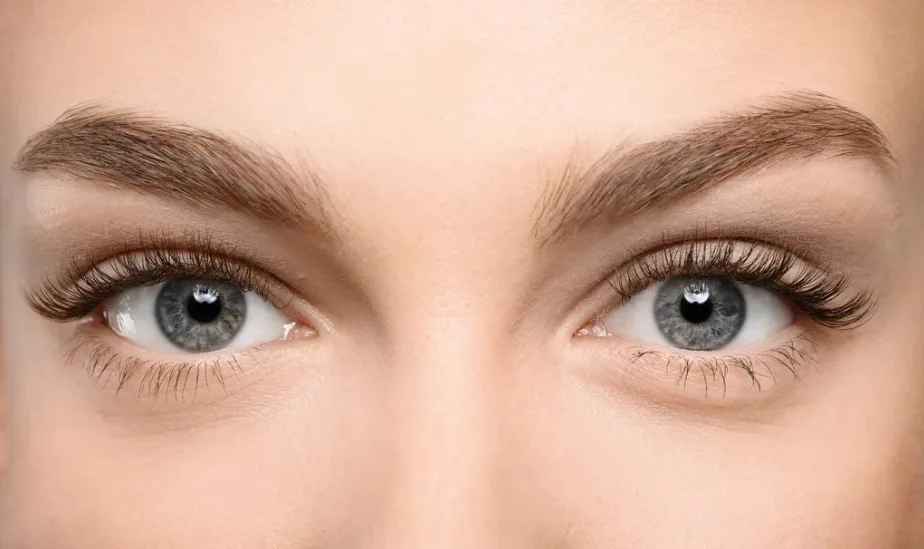
- ShapeDeep-set — the lid sits back, so only its middle really faces the front.
- EffectDoll, in fans: a centre peak with a second layer that covers the middle only.
- Where everyone strugglesLayer where the eye reaches forward. A second layer at the corners is weight in the dark.
Why Why it is laid out this way
Fans exist to give height and body for less material than a single strand of the same look, and that trade is worth more on a recessed eye than almost anywhere else. The centre peak still does all the work; volume just lets it be taller, or lighter, or both. What changes with fans is where the second layer is allowed to go.
The order the zones go on, fan by fan
- Map the outline in one layerBuild the whole hill first — centre high, both ends dropped low — in a single spaced layer of fans.
- Keep every fan narrow at the topThe centre carries the longest work, so those fans stay the tightest on the set.
- Add the top layer over the middle third onlyThe second layer starts and stops well inside the corners. Outside that band it buys nothing.
- Match the top layer's length, not exceed itThe upper fans sit at the mapped length of their zone. They add separation and body, never a new height.
- Take both corners down to one thin layerThe last zone at each end stays single-layered, short, and the narrowest fans you make.
The length curve on deep-set eyes
The line rises steadily to a single centre high point and then drops away hard at both ends. That shape follows the eye itself: the middle of a deep-set lid projects, the ends retreat under bone, and length is only visible where it has clear air ahead of it. Fans let you reach that centre height on strands fine enough that the lash line still reads as lashes rather than as a dark edge.
Where does a doll map go wrong on deep-set eyes?
Deep The physics underneath
Fans change the arithmetic of weight, not the arithmetic of leverage. Here is what each build asks of the lash underneath it.
The same map, built four ways
- Classic 1:1
- Simple to keep light and the easiest way to learn where this map's peak belongs. Its ceiling is that a fuller centre can only be bought with a thicker strand, and thickness is the one thing this shape refuses.
- Handmade volume
- The point of this cell. Several fine strands weigh far less than one strand thick enough to look the same, so the peak gets its height on a budget the natural lash can actually meet.
- Promade / pre-made fans
- They keep the two layers even over a long set, which is exactly the thing that drifts by the second eye. In exchange you cannot tighten a single fan for the centre or shrink one for the last corner zone.
- Woven / clover
- Big coverage per bond, laid sideways. On a map whose ends are meant to be minimal and whose centre is meant to reach forward, sideways coverage is the wrong axis in both places.
Spread angle versus weight
Opening a fan spreads the same mass wider without moving it any further forward, which on this map is a straight loss — the peak needs to project, not to broaden. It costs twice over, because the off-axis legs twist the lash and the centre carries the longest fans on the set. Tight fans in the middle, a little more spread on the way down to each corner where the lengths are short.
What a deep-set lash line can carry
- The lash gives way by bending first, and on a deep-set lid a small bend is a total failure: the peak's tips move from in front of the brow line to behind it, which is the difference between an opened eye and a tired one.
- Every increment of length at the peak costs mass and lever together, so a slightly shorter centre built from finer strands often survives the whole cycle where a bolder one sags in a fortnight.
- Two layers do not share a load. Each fan hangs on its own natural lash and the peak's real limit is set by the weakest lash in that zone, not by how full it looked the day you finished it.
Where this map fails first
Two spots, two unrelated causes. At the centre the fans simply settle: the longest work leans a few degrees, both layers move together, and the hill flattens. At the inner corner the problem is crowding rather than length, because the lid is narrowest there and a fan base that touches skin lifts early. Keeping the inner zone to one thin layer of narrow fans is the fix for the second and gives the first nothing to catch on.
FAQ Common questions
Why does the top layer stop before the corners?
Because the corners of a deep-set eye sit behind the brow bone. A second layer there adds weight and darkness to two zones the viewer barely sees, so the layer earns its place only across the middle.
Does volume make this map fuller or lighter?
Whichever you choose, and on this shape choose lighter. Fine strands fanned give the same silhouette as a thicker single for less mass, so spend the saving on holding the peak rather than on density.
How narrow should the centre fans be?
Narrower than everywhere else on the set. The centre holds the longest fans, so it is where a wide spread twists soonest and where the eye most needs reach rather than width.
Can I run a fuller set if her natural lashes are strong?
A little, but strength is not the constraint that bites here — visibility is. Even a lash line that could carry more will look heavier and further back once the line stops reading as separate lashes.
Print this page or save it as PDF — the diagrams are drawn to stay readable in black and white on plain paper. Or download the diagrams below as SVG. No account, no fee, nothing to sign. Every file carries this page’s address, so wherever it ends up it can be traced back here.
Teaching from these? The offer, and how to credit it.
Also in: Deep-Set eyes · Doll / Open-Eye · Volume
Read next: open eye versus doll — one family, two intents · questions clients ask about lash extensions