Deep-Set Eyes · Natural · Hybrid
The natural lash map for deep-set eyes, built in Hybrid — zone order, where the length peaks, and the point this one usually goes wrong.
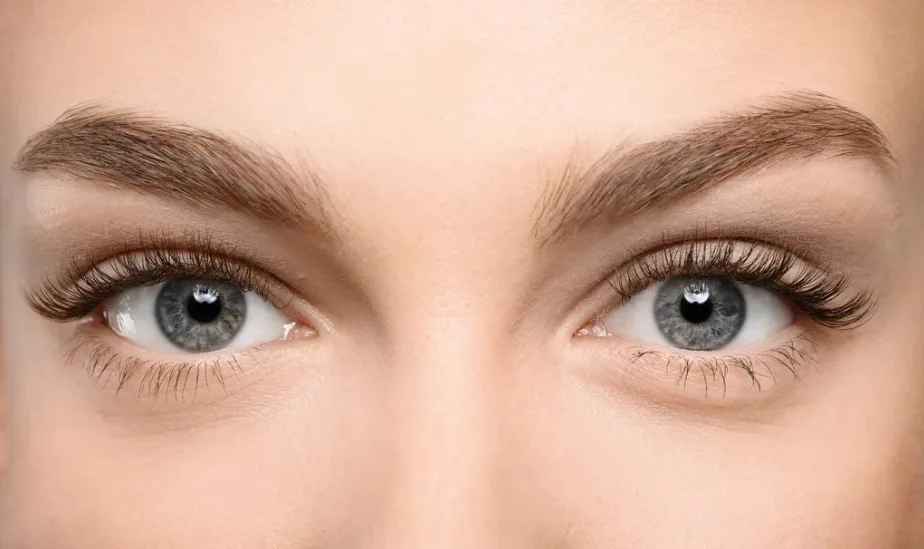
- ShapeDeep-set — the lash line sits back under bone, so it always looks darker than it is.
- EffectNatural, mixed: a wide soft peak with texture fine enough that nobody names it.
- Where everyone strugglesNo spikes on this one. Vary neighbours by a hair; anything sharper stops being natural.
Why Why it is laid out this way
Mixing singles and fans on a natural map is not about adding drama, it is about keeping a recessed lash line from setting into one dark strip. Separation is what makes a line read as lashes, and separation is exactly what the shade takes away. So the texture here is small enough that a client would call it good lashes rather than a style.
The order the zones go on, and where the fans land
- Lay the outline in singlesShort at the inner end, three even steps up, the top length held over two middle zones, then an easier fall outward.
- Fill with soft fansFans go between the singles at the same mapped length, closing gaps without changing the outline.
- Vary neighbours by a hairWithin a zone, let single and fan differ very slightly in length. That tiny inconsistency is the whole texture.
- Leave no spikes anywhereA closed fan is a long heavy strand and it announces itself. It belongs on a wispy map, not this one.
- Keep the outer end aliveThe outer taper finishes longer than the inner. That is what stops a natural set closing the eye up.
- Look from the front before you finishEyes open, straight on. Anything you added that reads as a dark patch rather than a lash comes back out.
The length curve on deep-set eyes
A wide low peak across the two middle zones, a very short inner end and a softer outer taper — the shape follows the lid's own room rather than imposing anything on it. On a deep-set eye the risk is not that the set looks too small, it is that it looks like a line drawn on. Mixing fans in at the mapped length adds body while the slight length differences between neighbours keep the line broken up.
Where does a natural map go wrong on deep-set eyes?
Deep The physics underneath
Small texture, ordinary physics. What follows is what each element is really costing the lash it sits on.
The same map, built four ways
- Classic 1:1
- The singles hold the outline and therefore the whole map. They are also the element you can judge at a glance, which is why the shape lives in them and not in the fill.
- Handmade volume
- Fans do the closing-up between singles, and being able to narrow one by hand is what keeps them from turning a broken line into a continuous one. Fine strands mean the fill costs a fraction of what a second single would.
- Promade / pre-made fans
- Even fill, quickly, which suits a map with no drama in it. The trade is a base you did not shape, and on a plain build an inconsistent root is the one flaw with nothing to hide behind.
- Woven / clover
- Wide coverage from one bond, repeated at identical spacing. On a map whose texture is deliberately irregular, a regular pattern cancels the only thing the hybrid was added for.
Spread angle versus weight
Across the two peak zones, a wider fan lays more material along the line without moving anything further forward, and forward is the direction this shape is short of. It also asks the lash to resist a twist, which shows up as fans lying sideways well before anything sheds. Narrow fans at the top, a slightly wider spread on the short inner steps where the load is small.
What a deep-set lash line can carry
- The ceiling here is reached quietly: a peak lash bends a few degrees, its tip drops behind the brow line, and the set looks like it has faded rather than moved.
- Length is the costly variable because it adds weight and moves that weight further from the root at once — which is why a natural map on this shape holds its top length flat instead of chasing one long zone.
- In a mixed build the weakest lash decides the look of its whole neighbourhood. A fan on a frail lash sits slightly low, and next to a single at full height that small difference is the first thing the client sees.
Where this map fails first
The outer-middle band thins first, and in a hybrid it thins unevenly. Fans and singles shed on different schedules, so instead of a set that gets gradually lighter you get one that develops holes on one side of the peak. Because the texture depends on small differences between neighbours, losing a few lashes changes the pattern rather than the density. Filling that band first at every refill is what keeps the effect intact.
FAQ Common questions
Can I add spikes to a deep-set natural map?
Not on this one. A closed fan is long and heavy, and on a shaded lash line it reads as a dark post rather than a highlight. Save them for a map built around texture.
How much should the fans and singles differ in length?
Barely. A hair either way within a zone is enough to break the line up, and anything larger stops looking natural and starts looking like an unfinished map.
Why not just fill every gap?
Because a fully closed line on a recessed eye becomes a solid dark edge, and a solid edge makes the eye look further back. The gaps are doing visible work.
Should the fans use the same curl as the singles?
Yes. Different curls within a zone sit at different heights, and under a brow bone the higher of the two ends up in shade, so half your work stops showing.
Print this page or save it as PDF — the diagrams are drawn to stay readable in black and white on plain paper. Or download the diagrams below as SVG. No account, no fee, nothing to sign. Every file carries this page’s address, so wherever it ends up it can be traced back here.
Teaching from these? The offer, and how to credit it.
Also in: Deep-Set eyes · Natural · Hybrid
Read next: questions clients ask about lash extensions