Downturned Eyes · Cat-Eye · Classic 1:1
The cat-eye lash map for downturned eyes, built in Classic 1:1 — zone order, where the length peaks, and the point this one usually goes wrong.
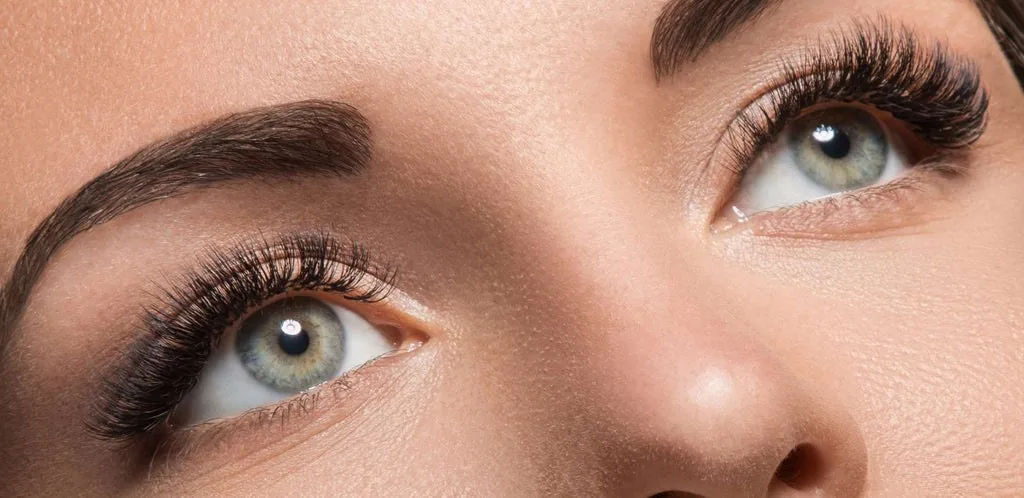
- ShapeDownturned — the outer end of the lash line sits lower than the inner.
- EffectCat-eye, one strand per lash — with the length stopping before the tail.
- Where everyone strugglesLength on the tail follows the tail. Rebuild the tail with curl instead.
Why Why it is laid out this way
A cat-eye is a client request, not a diagnosis. On a lid whose outer end already sits low, the textbook version puts its longest strands exactly where the line is falling, and single-strand work gives you nothing to hide that with. This map keeps the stretch and moves the load off the falling end.
The order the zones go in
- Start short at the headInnermost zone is the shortest and finest on the lid. A heavy head shuts the eye and kills the stretch before it starts.
- Climb a hair per zoneWork outward in even steps through the first four zones so the rise reads as one line rather than a set of stairs.
- Top out inside the archThe longest strands go one zone in from the tail, on lid that is still rising. This is the whole trick of the map.
- Drop the tail away fastPast the top, cut back hard — the last zone lands at roughly half the longest. The size of that drop is the effect.
- Hand the job to curlEach zone after the top takes a stronger curl than the one before. Past the top, height comes from angle, not from reach.
The length curve on downturned eyes
Read the curve as a hill that deliberately stops short of the edge. Everything before the top does the elongating; everything after it is what keeps the eye from reading tired. From arm's length a line that stays flat to the corner and a line that grows to the corner look the same on this shape — both look like the eye is closing.
Where does a cat-eye map go wrong on downturned eyes?
Deep The physics underneath
Layout is settled above. Below is why the outer end of this lid argues with everything you put on it.
The same map, built four ways
- Classic 1:1
- This cell. One strand on one lash means length is your only dial, and length is the one thing the tail cannot take. All the drama has to be bought before the drop.
- Handmade volume
- The useful comparison: fans would let the outer zones stay visible while getting shorter, because width reads at a distance that length no longer has to. Working in singles, you have no such substitute.
- Promade / pre-made fans
- They are fast, and speed is what tempts you to keep filling past the top zone. On this map the outer zones are supposed to shrink, so nothing here rewards being quick.
- Woven / clover
- A fixed wide spread lies across the lash line rather than up it, and this shape's entire complaint is vertical. Keep them inboard of the top zone if you use them at all.
Spread angle versus weight
In singles there is no spread to tune, which is what makes this the most exposed cell in the cat row. The top zone can only be tall, never wide, so every bit of the effect is bought with reach on one strand. Push that zone one step taller than the natural lash can hold and the peak rounds over, and a rounded peak on a falling line is just a slower droop.
What a downturned lash line can carry
- The ceiling on the top zone is deflection, not shedding: when one strand's mass and reach outrun the host lash's stiffness, the high point settles and the elongation stops reading while every extension is still attached.
- Reach is charged twice on this line — it adds mass and moves the balance point outward in the same move, and on a downturned lid outward is also downward.
- The weakest strands in a zone set what that zone can hold, and on the outer half of this shape those weakest strands are also the ones already pointing down the steepest.
Where this map fails first
The top zone goes first here, not the corner, because the corner was mapped light on purpose. That zone carries the longest single strands on the set and sits where the lid has begun to curve away, so the bond wraps less than it does mid-lid. When it settles, the hill flattens toward the tail and the map turns into the thing it was built to avoid. If a client returns with the shape gone but the lashes present, that is this.
FAQ Common questions
Why not just put the longest lashes at the outer corner?
Because on this shape the corner is already the low point of the line. Adding reach there extends the line in the direction it is falling, so the eye reads more closed, not more lifted.
Can classic 1:1 give enough drama for a cat-eye request?
Yes, if the drama comes from the size of the step between the top zone and the tail. Contrast does the work that a corner-loaded map tries to do with sheer length.
How steep should the drop after the top zone be?
Steep enough to be obvious in the mirror — the last zone sits near half the longest. Anything gentler flattens into a straight line and the lift is lost.
The client insists on a full corner-loaded cat. What now?
Show her the two shapes side by side on her own eye before you glue anything. This is one of the few cases where the mapping consensus has no dissent, and it is worth the extra five minutes of consultation.
Print this page or save it as PDF — the diagrams are drawn to stay readable in black and white on plain paper. Or download the diagrams below as SVG. No account, no fee, nothing to sign. Every file carries this page’s address, so wherever it ends up it can be traced back here.
Teaching from these? The offer, and how to credit it.
Also in: Downturned eyes · Cat-Eye · Classic 1:1
Read next: what a cat eye lash map actually is · questions clients ask about lash extensions