Downturned Eyes · Cat-Eye · Volume
The cat-eye lash map for downturned eyes, built in Volume — zone order, where the length peaks, and the point this one usually goes wrong.
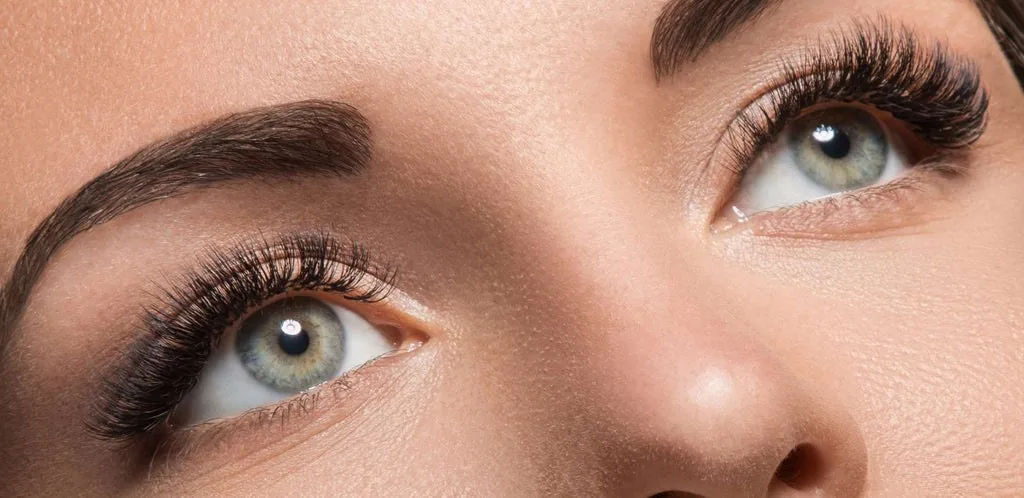
- ShapeDownturned — the tail end of the lash line finishes lower than the head.
- EffectCat-eye in fans: the longest zone sits inboard, width carries the rest.
- Where everyone strugglesDense fans on the tail look like weight, not lift. Thin them as you go out.
Why Why it is laid out this way
Fans give this effect something singles never had: a way to keep the outer zones visible while making them shorter. That matters here, because on this lid every extra step of reach at the tail is a step downhill. Volume also brings the risk that ends the set early — total mass, spent in the wrong half.
The order the zones go on, fan by fan
- Set the head lightNarrow fans, shortest length, fewest strands per fan at the inner zone. This corner sets how open the eye reads.
- Build width before lengthThrough the middle zones, widen the fans a step at a time while length climbs gently. Width is the cheaper of the two.
- Peak one zone inLongest and widest fans sit a zone short of the tail. Everything you want the client to notice happens here.
- Shrink both dials outwardPast the peak, take length and fan width down together so the outer zones get lighter as well as shorter.
- Finish the tail narrowThe last zone is a narrow fan on a strong curl. It should look like a tapering point, not a full stop.
The length curve on downturned eyes
The curve above is asymmetric on purpose: a long climb, then a fall that is roughly twice as fast. On a lid that already tilts down, the speed of that fall is what the eye reads as lift — a gentle taper reads as a straight droopy line no matter how good the fans are. Fan width lets the falling half stay dense enough to look finished at a length that would look bald in singles.
Where does a cat-eye map go wrong on downturned eyes?
Deep The physics underneath
The layout above is a shape. What follows is the material cost of holding that shape on a line that slopes away from you.
The same map, built four ways
- Classic 1:1
- Used inside a volume set, single strands make good spine lashes through the peak zone — predictable, all mass on one axis. They are a poor choice for the outer zones, where the only way they stay visible is by getting longer.
- Handmade volume
- The reason to pick this cell. Splitting the same coverage across finer strands lets the falling half stay visibly dense while it shortens, which is the exact trade this shape needs. Tune the spread zone by zone rather than fanning everything alike.
- Promade / pre-made fans
- Consistent width, quick to place, and a slightly bulkier bond at the root. Root mass is the cheapest kind, so they are fine here — the discipline is choosing a narrower one for the outer zones instead of running one width across the lid.
- Woven / clover
- Good coverage per bond, but the spread repeats, and a repeating pattern along a line that is already sloping reads as a stripe rather than a shape. If they appear at all, keep them under the peak where the eye is not tracking the edge.
Spread angle versus weight
Spread is the dial that makes this cell work: it changes where the mass sits, not how much of it there is. In the peak zone, open the fan enough to close the gaps and no further, because an over-opened fan puts its outer legs off the lash's axis and starts twisting. Past the peak, close the spread down step by step — a narrow fan on a strong curl reads as height, while a wide one on the same lash reads as width across a line you are trying to lift.
What a downturned lash line can carry
- The honest ceiling here is the peak zone bending: fans are lighter per unit of coverage, not weightless, and when the longest zone starts to sit low the cat shape blurs into a soft line while every fan is still attached.
- Reach is the expensive dial on this map — a longer fan is both heavier and further out from the root, and on this lid the far end of that lever is also the low end of the eye.
- Fanning does not raise what a natural lash can hold. A weak lash in the peak zone should get a smaller fan, not the standard one, even if the neighbours can take it.
Where this map fails first
Two different failures on the same set. In the peak zone the widest fans start to turn on their own axis, and once they lie flat the highest point of the map loses its height while looking perfectly full. At the tail the loss is ordinary shedding, made obvious because the client's own eye finishes there. Mapping the tail narrow means there is less to notice going missing.
FAQ Common questions
Does volume make a cat-eye safer on downturned eyes?
Safer in one specific way: fan width lets the outer zones stay dense while getting shorter, so you can build contrast without hanging length off the low corner. It does not make a corner-loaded map acceptable.
Should fan width stay the same across the map?
No. Width should rise into the peak zone and come back down after it, so density falls at the same rate length does. One width across the lid is what makes an outer corner look heavy.
Where do I put the strongest curl?
On the zones after the peak. As length steps down, a stronger curl angle keeps the tips pointing up so the outer end still reads as lifted.
The set looks flat by the third week. What am I doing wrong?
Check whether the peak fans have rotated rather than assuming they fell out. Narrow that zone's spread slightly and keep the bases light — flatness there costs the whole shape.
Print this page or save it as PDF — the diagrams are drawn to stay readable in black and white on plain paper. Or download the diagrams below as SVG. No account, no fee, nothing to sign. Every file carries this page’s address, so wherever it ends up it can be traced back here.
Teaching from these? The offer, and how to credit it.
Also in: Downturned eyes · Cat-Eye · Volume
Read next: what a cat eye lash map actually is · questions clients ask about lash extensions