Downturned Eyes · Doll / Open-Eye · Hybrid
The doll lash map for downturned eyes, built in Hybrid — zone order, where the length peaks, and the point this one usually goes wrong.
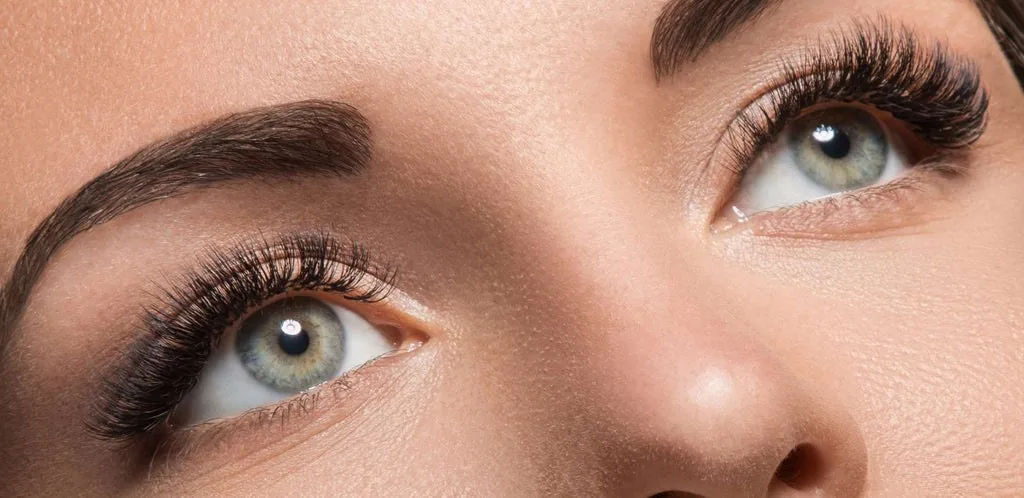
- ShapeDownturned — the lash line finishes lower than it starts, so rest reads as tired.
- EffectOpen-eye lift with mixed texture: height over the middle, softness at the edges.
- Where everyone strugglesTexture belongs inboard. Anything long and spiky near the corner points downhill.
Why Why it is laid out this way
Mixing strands and fans on a centre-lifted map buys a softer edge than either technique gives alone. The catch is that texture is visual noise, and a doll map depends on a clean round top — the noise has to sit where it will not dent the curve. On this eye shape there is a second rule: the noise also has to stay away from the corner.
The order the zones go on, and where the fans land
- Lay the round base firstMap lengths zone by zone as if the whole set were single strands. Get the shape right before any fan touches the lid.
- Alternate through the middleAcross the two zones either side of the crown, swap between single strands and soft fans every few lashes for an uneven edge.
- Keep the crown deliberateThe very top of the curve is not the place to improvise. Pick one texture for the highest lashes and hold it.
- Quieten the outer thirdPast the crown, drop back toward plain single strands as length falls. A busy tail reads as mess on a falling line.
- Lift the last zones with curlThe final two zones stay short, plain and strongly curled. That is the whole outer strategy on this shape.
The length curve on downturned eyes
The diagram shows a quick rise to a single high point over the middle of the eye, then three even steps down. Texture does not appear in that curve at all, which is the point — the mixed strands and fans change how the edge feels, not where the top is. If the texture starts moving lengths around, the map stops being a doll map and starts being decoration.
Where does a doll map go wrong on downturned eyes?
Deep The physics underneath
The layout is above. What follows is what each way of building a lash costs you on a curve that has to stay round.
The same map, built four ways
- Classic 1:1
- Singles are the honest part of this mix — mass on the lash's own axis, behaviour you can predict. They earn the crown and the last two zones, the places where this map cannot afford a surprise.
- Handmade volume
- Fans supply the softness between the singles, and because they are made of finer strands they add coverage without adding much to the load over the middle. Keep them modest either side of the crown and let the singles set the height.
- Promade / pre-made fans
- Even width, quick placement, slightly more material at the root. On a mixed map their sameness is a liability — a run of identical fans through the texture zones reads as a stripe and kills the unevenness you were buying.
- Woven / clover
- Wide, repeating, and horizontal in effect. Over a crown that is meant to look domed, they lay the top flat; if they appear here, keep them inboard of the third zone where the climb has not started.
Spread angle versus weight
The crown is where spread matters most on this map, because the top of the curve has to look like one continuous line rather than a row of separate fans. Open the fans only far enough to touch their neighbours' edges — wider than that and the tips separate visibly at the highest point, which reads as gaps in the roundness. In the outer zones the answer is simpler: go narrow, or use singles and skip the question.
What a downturned lash line can carry
- The limit here shows as sag in the mixed zones: a fan and a strand of the same length do not weigh the same, and when the heavier one starts to lean the texture stops looking intentional and starts looking uneven.
- Length is still the expensive dial. A textured lash that is longer than its neighbours pays twice — more material, further from the root — which is why the spikier lashes belong inboard where the lid is not sloping away.
- Match what you place to the host lash, not to the pattern you are making. If the next lash in the rotation is a weak one, it gets a single strand or a smaller fan, whatever the rhythm said.
Where this map fails first
This map ages in two places. The mixed zones either side of the crown lose fans faster than singles, so the balance of the texture shifts and the edge starts reading patchy rather than soft. The tail is the ordinary story — small lashes, a lid curving away, and a bond that wraps less than it did mid-lid. Because the outer zones were mapped short and plain, their loss costs the shape less than it would on a corner-weighted map.
FAQ Common questions
How much texture is too much on a downturned doll map?
If the round top of the curve is no longer obvious from a metre away, you have overdone it. Texture is meant to soften the edge, not to redraw the shape.
Where do the fans go in a hybrid open-eye map?
Mainly in the two zones flanking the crown, alternated with single strands. The crown itself and the outer two zones are better kept in one texture so the shape stays legible.
Can I add spiky lashes for a wispier finish?
Only inboard of the crown, and only a few. Near the outer corner a long spike is an arrow along the droop, which is the one direction this map exists to counteract.
Is hybrid heavier than classic on the same map?
Not necessarily — fans made of finer strands can weigh less than the single they replace. The problem is mismatched weights sitting next to each other, which shows as an uneven edge long before anything sheds.
Print this page or save it as PDF — the diagrams are drawn to stay readable in black and white on plain paper. Or download the diagrams below as SVG. No account, no fee, nothing to sign. Every file carries this page’s address, so wherever it ends up it can be traced back here.
Teaching from these? The offer, and how to credit it.
Also in: Downturned eyes · Doll / Open-Eye · Hybrid
Read next: open eye versus doll — one family, two intents · questions clients ask about lash extensions