Downturned Eyes · Doll / Open-Eye · Volume
The doll lash map for downturned eyes, built in Volume — zone order, where the length peaks, and the point this one usually goes wrong.
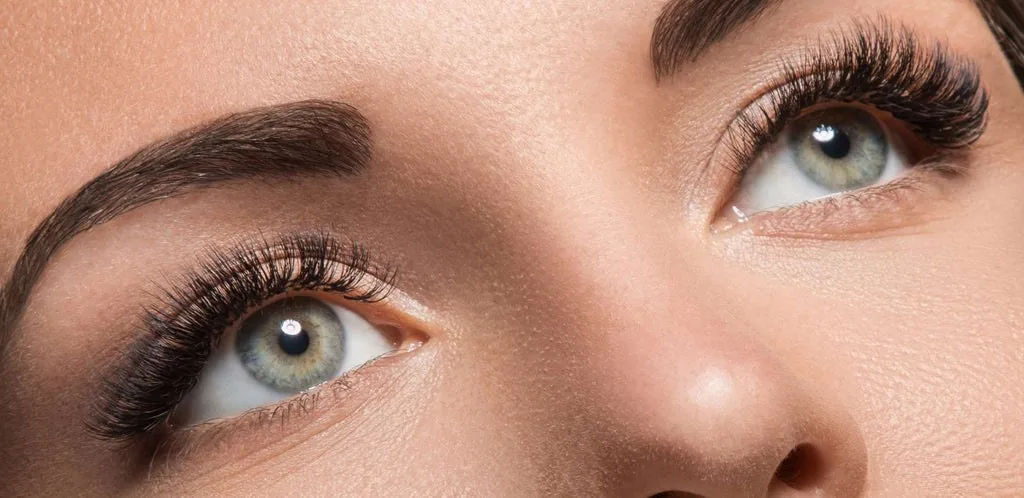
- ShapeDownturned — the outer end of the lid slopes away, so the eye reads soft at rest.
- EffectOpen-eye, in fans: the densest and tallest zone sits over the middle of the eye.
- Where everyone strugglesDensity has to fall on the way out, not just length. Equal density outward reads as a shadow.
Why Why it is laid out this way
Fans let a centre-lifted map be full as well as tall, which is what most clients mean when they ask to look more awake. All that fullness has to be spent over the middle of the eye, though, because on this lid the outer half is where extra material shows up as tiredness rather than glamour. Volume also puts the most mass this library ever maps directly over the pupil, so the crown has to be earned.
The order the zones go on, fan by fan
- Survey the centre lashesLook at what is actually growing over the pupil before choosing a crown height. This map stands or falls on those lashes.
- Open the eye in two stepsRise gently through the second zone, then jump into the third. The size of that jump is what the client sees as opening.
- Crown it wide and tallOver the middle, longest length and widest spread together. Everything else on the lid is measured down from here.
- Close the fans going outEach zone past the crown gets both shorter and narrower, so the outer half thins as it drops.
- Point the last zones upNarrow fans, short length, the strongest curl on the set. The corner is lifted by angle only.
The length curve on downturned eyes
The curve rises fast, peaks over the middle and then steps down at an even pace to a tail sitting under half the crown. In fans, that same curve has a second dimension the diagram cannot show: spread. Read every zone as carrying two numbers that move together — where the line is high the fans are wide, and where it falls they close up.
Where does a doll map go wrong on downturned eyes?
Deep The physics underneath
Layout above, physics below. On this shape the interesting question is not how much a fan weighs but where on the lid you are allowed to spend it.
The same map, built four ways
- Classic 1:1
- Inside a volume set, singles are useful as a check: place one at the crown height and see whether the natural lash holds it before you commit the zone to something wider. As a whole technique here it buys height but not the fullness this effect is asking for.
- Handmade volume
- The core of this cell. Several fine strands give the crown its presence at a fraction of the load a single thick strand would drop over the pupil, and you can taper the spread zone by zone as the map falls away.
- Promade / pre-made fans
- Speed and repeatable width, at the cost of a firmer base and no per-zone control. They suit the crown, where you want every fan alike, and they are the wrong instinct for the outer zones that need to be closing down.
- Woven / clover
- Coverage per bond is excellent and the spread is fixed, which makes them a base-layer tool. Over the crown they widen a shape that is supposed to be gaining height, and near the corner they simply add darkness where you want less.
Spread angle versus weight
In the crown zone, spread is doing half the work of the effect: a wider fan there fills the top of the curve so it reads as one solid arc rather than a comb. Push it too far and the outer legs of each fan sit well off the lash's axis, carrying a twist that shows up weeks later as fans lying sideways at the highest point on the map. The rule of thumb for this cell is to open the crown until the gaps close, then stop, and to close the spread by a step in every zone after it.
What a downturned lash line can carry
- The ceiling on this cell is the crown zone bending under a load it agreed to carry: fans buy coverage cheaply, but the tallest, widest ones on the set still sit on ordinary lashes, and when they lean the eye stops looking open.
- Height costs more than width here. A wider fan adds coverage near the root, while a longer one adds material at the far end of the lever — which is why the crown gets its presence from spread first and length second.
- The crown's weakest lashes decide how far you can go, not its best ones. One over-fanned lash in the middle of the arc leaves a visible dip when it gives up, and that dip is on the part of the map everybody looks at.
Where this map fails first
The crown fails first and it fails quietly. Those fans carry the most material on the set, and their first move is not to fall off but to rotate flat, so the arc loses height while the lash line still looks dense. From the client's side the set does not look damaged, it looks less awake — which is exactly the complaint she came in with. Check rotation at the middle of the lid at every refill before topping up anything else.
FAQ Common questions
Can downturned eyes take a full volume set?
Yes, if the mass is spent over the middle. What this shape cannot take is even density all the way to the corner, which reads as heaviness on the part of the eye that already falls.
How do I layer a volume doll map?
Build upward over the crown rather than outward toward the tail. Any second layer should add height and coverage over the middle, and the outer zones should be getting simpler, not busier.
Why do my fans go flat over the middle of the eye?
That zone is carrying the widest and longest fans on the map, so it is the first place spread turns into twist. Narrow the crown a step and check that the bases are not over-dipped.
Should the outer corner get a wider fan for coverage?
No. Those lashes are the smallest and steepest on the lid, and extra width there shows up as a dark patch at the low end of the eye rather than as fullness.
Print this page or save it as PDF — the diagrams are drawn to stay readable in black and white on plain paper. Or download the diagrams below as SVG. No account, no fee, nothing to sign. Every file carries this page’s address, so wherever it ends up it can be traced back here.
Teaching from these? The offer, and how to credit it.
Also in: Downturned eyes · Doll / Open-Eye · Volume
Read next: open eye versus doll — one family, two intents · questions clients ask about lash extensions