Downturned Eyes · Natural · Classic 1:1
The natural lash map for downturned eyes, built in Classic 1:1 — zone order, where the length peaks, and the point this one usually goes wrong.
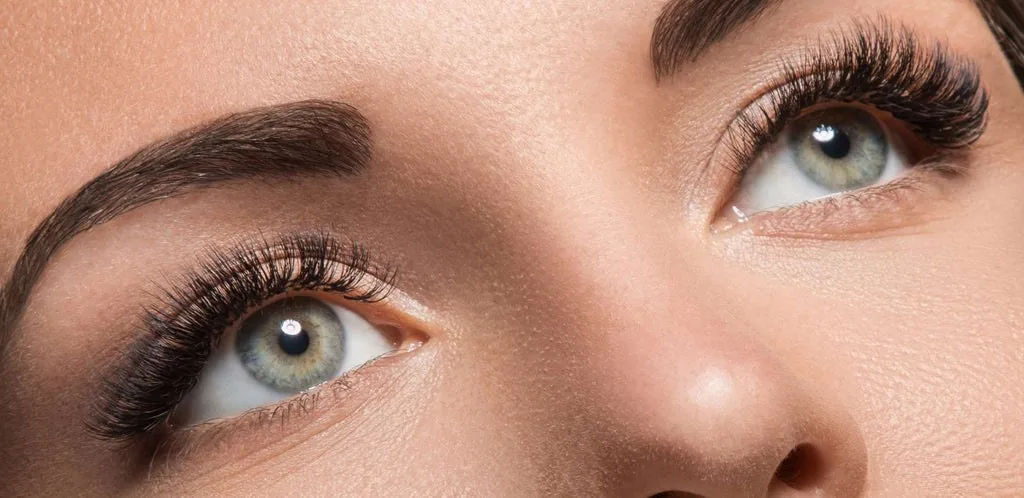
- ShapeDownturned — the lash line ends lower than it begins, by a little or a lot.
- EffectNatural: a wide, low top through the middle, nothing that announces itself.
- Where everyone strugglesThe correction lives in the curl. If it shows up as outer length, you have mapped it wrong.
Why Why it is laid out this way
Every other map on this shape corrects loudly. This one has to correct while looking like nothing happened, which makes it the hardest brief in the row and the most requested. The length chart barely moves — the work is done by a curl that gets stronger as the lid slopes away.
The order the zones go in
- Keep the head fineShortest, thinnest strands at the inner zone, stepping up gently. Anything blunt here is the first thing that looks fake.
- Hold a wide topTwo neighbouring zones share the longest length. A single sharp high point is what makes a natural set look mapped.
- Walk down both sidesFall away at the same modest rate inward and outward. No zone should be an obvious step from its neighbour.
- Climb the curl outwardAs the length steps down past the top, the curl steps up. This is the only place the correction lives.
- Stop the tail shortThe last zone is close to the length of the second, not the fifth. Short and strongly curled beats long and hopeful.
The length curve on downturned eyes
The diagram is deliberately undramatic: a slow rise, a flat top two zones wide, a slow fall. What it cannot show is the second chart running alongside it, where curl rises from soft at the inner corner to its strongest at the tail. On this shape the visible length curve is the disguise and the invisible curl curve is the correction.
Where does a natural map go wrong on downturned eyes?
Deep The physics underneath
The map is above. Below is why curl is the cheap tool here and length is the expensive one.
The same map, built four ways
- Classic 1:1
- This cell. One strand per lash keeps the set honest and keeps the weight predictable, which matters when the whole effect depends on the outer strands actually standing where you curled them.
- Handmade volume
- Fans are usually more than a natural brief wants, but a very fine, narrow fan on the two top zones is a way to add presence without adding length. Use it as a substitute for reach, never as an addition to it.
- Promade / pre-made fans
- The consistency works against you here. A set that looks natural needs slight irregularity, and identical fans in every zone read as a strip along the lash line even when the lengths are right.
- Woven / clover
- Built for coverage, and coverage is not this cell's problem. On the outer zones especially they add width to lashes whose job is to be small, curled and out of the way.
Spread angle versus weight
There is no spread to argue about in singles, so the top zones are set by length and curl alone — and on this map they are the only two zones where you have real freedom. Because the top is two zones wide rather than one, the load is shared across more lashes than on a peaked map, which is why a natural set can survive on a lash line that would not hold a doll or a cat. Keep both top zones the same and let the curl do the differentiating.
What a downturned lash line can carry
- The failure to watch for on a quiet map is not a bent lash but a straightened one: an extension that is slightly too long for its host relaxes its curl angle as it settles, and on this cell that angle was the entire correction.
- Length here is charged in look as well as load. Every step you add to the outer zones both loads the smallest lashes on the lid and undoes the lift, so it is the one direction with two penalties and no upside.
- The outer zones contain the finest strands on this eye. Map them to what the thinnest of them can hold, because on a natural set a few sagging outer lashes are the entire visible difference between lifted and tired.
Where this map fails first
This map does not usually fail by shedding, it fails by softening. The strongly curled outer strands are the smallest on the set, and as their host lashes grow out the whole extension rotates forward, taking its angle with it. Nothing looks wrong in the mirror and the client just says she looks tired again. A refill that resets the outer zones' curl restores more than a refill that adds density anywhere else.
FAQ Common questions
Can a natural map actually fix downturned eyes?
It can soften a mild tilt, mostly through curl. A strong droop needs a mapped correction with a real high point, and a natural brief does not leave room for one.
Why does the length stay flat over two zones?
Because a single tall zone reads as a styled set. A wide top mimics how lashes actually grow across the middle of the lid, which is what keeps the map invisible.
How much stronger should the outer curl be?
Enough to hold the tips clearly above the line of the lid, stepped up gradually so no two neighbouring zones look different. A jump in curl shows just as badly as a jump in length.
My client says it looks nice but nothing changed. What do I adjust?
Usually the curl was left flat across the lid. Keep the same lengths, step the outer zones up in curl, and the same map starts reading as lifted.
Print this page or save it as PDF — the diagrams are drawn to stay readable in black and white on plain paper. Or download the diagrams below as SVG. No account, no fee, nothing to sign. Every file carries this page’s address, so wherever it ends up it can be traced back here.
Teaching from these? The offer, and how to credit it.
Also in: Downturned eyes · Natural · Classic 1:1
Read next: questions clients ask about lash extensions