Downturned Eyes · Natural · Hybrid
The natural lash map for downturned eyes, built in Hybrid — zone order, where the length peaks, and the point this one usually goes wrong.
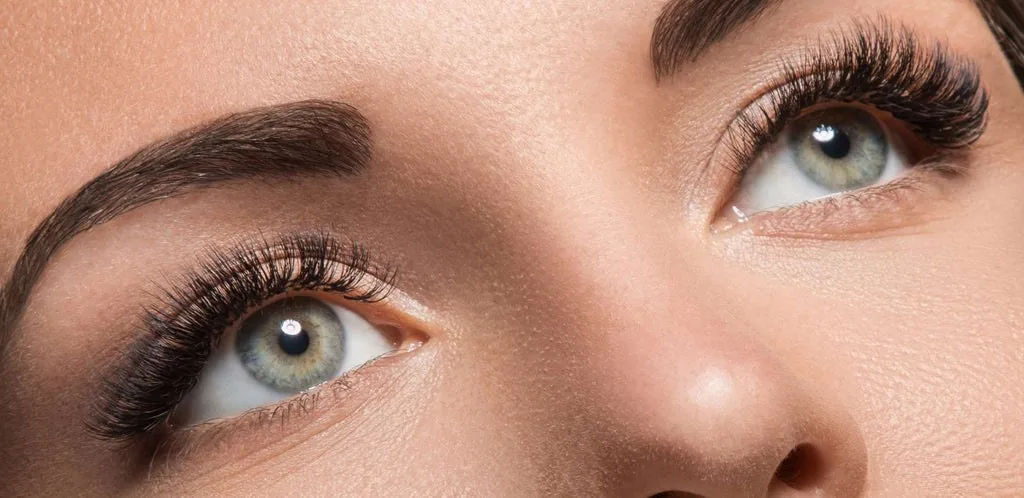
- ShapeDownturned — outer end of the lid sits below the inner, mildly or otherwise.
- EffectNatural with mixed texture: fans fill the gaps, lengths stay modest.
- Where everyone strugglesFans are for closing gaps here, not for making the outer corner darker.
Why Why it is laid out this way
Mixing strands and fans on a natural brief is not about texture for its own sake. It is a way to make a sparse lash line look complete without asking any zone to get longer — and on a lid that slopes down, not getting longer is the whole game. Think of the fans as patching, and the single strands as the map.
The order the zones go on, and where the fans land
- Find the thin patchesComb through and note where her own lashes leave gaps. Those spots get fans; the rest can stay single.
- Map lengths first, texture secondDecide every zone's length before deciding what kind of lash goes there. Texture must never move a length.
- Share the top across two zonesThe longest length runs flat over two neighbouring zones so nothing peaks. This is what keeps it reading as natural.
- Keep fans narrow throughoutJust enough spread to close a gap. A wide fan on a natural map turns quietly into a volume set.
- Curl up as length comes downPast the top, lengths fall and curl strengthens. Outer zones stay small, curled and mostly single.
The length curve on downturned eyes
The curve is low, wide-topped and almost symmetrical — a shape chosen to be unremarkable. Mixed texture does not change any point on it; what it changes is how solid the line looks between the points. On a downturned lid that distinction is the difference between a set that quietly lifts and one that has been made longer to look fuller.
Where does a natural map go wrong on downturned eyes?
Deep The physics underneath
Everything above is placement. Below is why filling a gap and adding a length are not the same purchase, especially on a falling line.
The same map, built four ways
- Classic 1:1
- The backbone of this cell. Singles set every length on the map and take the outer zones outright, because a small curled strand is the most predictable thing to leave on the part of the lid that slopes away.
- Handmade volume
- Used here as a patch rather than a style: a couple of fine strands opened just enough to bridge a gap, sitting at the same length as the singles around it. Made this way it adds continuity, not mass.
- Promade / pre-made fans
- They come at a fixed width, which is the wrong instinct for gap-filling since every gap is a different size. Their consistency also flattens the small irregularities that make a natural set convincing.
- Woven / clover
- Wide coverage from one bond, which is a lot of answer for a map that is mostly asking for a little. Nothing on this cell needs that much width, least of all the outer zones.
Spread angle versus weight
Spread is the dial that decides whether this stays a natural set or turns into a volume one wearing a natural map. Open a fan only until it touches the gap it was placed to close, because past that point the extra width shows as darkness rather than as continuity, and darkness sinking toward the outer corner is what makes a downturned eye look heavy. The two top zones can take slightly more spread than anywhere else, since that is where the eye expects density anyway.
What a downturned lash line can carry
- The visible ceiling on this map is a mismatch, not a collapse: when a fan is heavier than the strand beside it, it settles a fraction lower, and a natural set is judged precisely on whether the line looks even.
- Because the map keeps every length modest, the load is unusually low for its coverage — the risk shifts from bending to placing too many patches, so count fans per zone rather than trusting the lengths to protect you.
- Gap-filling tempts you onto the weakest lashes, since those are the ones with space around them. Match the fan to the host you are actually on, and leave a gap unfilled rather than overload a fine lash near the corner.
Where this map fails first
Two slow failures, neither dramatic. The patched gaps reopen first, because fans placed on the thinner lashes in a sparse area are on the shortest cycle, and the line goes back to looking uneven while the lengths are all still right. Later the outer strands rotate forward as their hosts grow, giving back the curl that was holding the tail up. Both are refill work rather than mapping errors, but a client who books late will read the second one as the set never having worked.
FAQ Common questions
Why use fans at all on a natural map?
To close gaps without lengthening anything. On downturned eyes that matters, since the usual way techs make a sparse line look fuller is by adding length, and length is what deepens the droop.
How wide should the fans be here?
Narrow — just enough to bridge the space beside the lash they sit on. Wide fans read as density, and density is what separates a volume look from a natural one.
Can I put fans at the outer corner for coverage?
Better not. Those lashes are small and steeply angled, and extra coverage there shows up as a dark wedge at the low end of the eye rather than as fullness.
Is a hybrid natural set heavier than a classic one?
Not if the fans are fine and narrow — a fan of two thin strands can weigh less than one thicker single. The trouble comes from fans built at volume width on a natural map.
Print this page or save it as PDF — the diagrams are drawn to stay readable in black and white on plain paper. Or download the diagrams below as SVG. No account, no fee, nothing to sign. Every file carries this page’s address, so wherever it ends up it can be traced back here.
Teaching from these? The offer, and how to credit it.
Also in: Downturned eyes · Natural · Hybrid
Read next: questions clients ask about lash extensions