Hooded Eyes · Cat-Eye · Hybrid
The cat-eye lash map for hooded eyes, built in Hybrid — zone order, where the length peaks, and the point this one usually goes wrong.
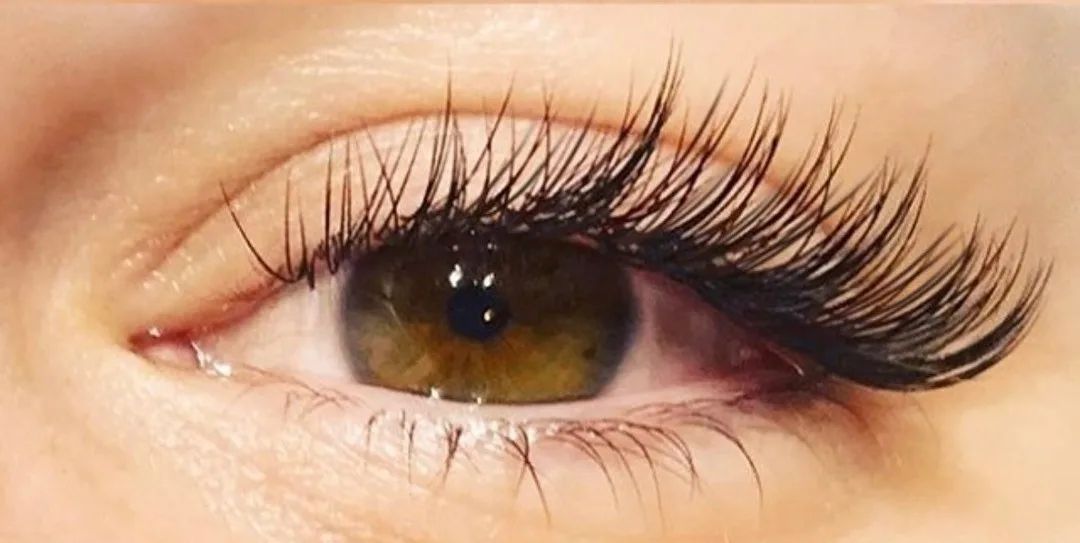
- ShapeHooded — part of the lash line is under lid skin whenever she is awake.
- EffectCat-eye with texture: singles and fans mixed on a line rising outward.
- Where everyone strugglesPut the spikes where the eye stays open, not in the covered band.
Why Why it is laid out this way
Mixing single lashes and fans buys a hooded cat something it badly needs: an edge you can actually see. A solid dark strip sitting half under lid skin reads as a shadow, while a broken one reads as lashes. Texture changes the surface of this map, never its destination — the rise still ends a zone before the corner.
The order the zones go on, and where the fans land
- Find the covered bandUpright, eyes relaxed, note the band of lash line the lid hides. Nothing placed inside it will be seen.
- Lay the single-strand spineSingles set the rising line, short at the inner end and stepping out evenly. This is the shape; everything after is surface.
- Fill between with soft fansFans sit between the spine strands for density, kept a shade under them so they never outrun the line.
- Spike above the cover onlyThe tallest spikes go in the zones that stay open. A spike under lid skin is weight that buys no picture.
- Return the last zoneSpine and texture both come back a hair in the final zone, together, so the tail thins as one edge.
The length curve on hooded eyes
The curve climbs to the second-to-last zone and then eases, which keeps the longest thing on the set off the most covered lashes. Texture rides that curve without altering it: broken tips give the top edge contrast exactly where lid skin flattens everything into one tone. Push the peak one zone further out and the shape and the texture vanish in the same movement.
Where does a cat-eye map go wrong on hooded eyes?
Deep The physics underneath
A hybrid is two different objects hanging off one lash line. Below is how they divide the work on a rising map.
The same map, built four ways
- Classic 1:1
- The spine, and the only part of this map that decides its shape. Singles hold the angle because a single strand keeps its mass on the lash's own line rather than out to the sides.
- Handmade volume
- The filler between the spine strands, and the reason the line looks full without getting heavy at the top of the rise. You also get to tune the width zone by zone, which matters as the map climbs into the covered band.
- Promade / pre-made fans
- Fast filler with consistent width, useful across the flat inner half of this curve. Out at the peak the stiffer base does not wrap a lash the lid is already pressing on, so keep them inboard.
- Woven / clover
- Wide, repeating coverage per bond, and the repeat is the problem — this map's whole point is a broken irregular edge. Using it here undoes the texture you mixed the set for.
Spread angle versus weight
Widen the fans as the line rises and you gain surface without adding much material, but the outer legs of a wide fan sit off the lash's axis and take a twisting load. Under a lid that presses sideways all day, that twist shows up as fans lying flat within a couple of weeks. Wide is fine in the low inner zones; at the peak keep them narrow so the height reads as height.
What a hooded lash line can carry
- The peak zone here carries two objects at once: the longest spine strand and the fans packed either side of it. Count the demand per natural lash, not per zone, or the crowding hides how much you have loaded.
- A spike is a fan closed to almost nothing — mechanically a single thick strand, and the longest item on the set. Budget each one as a single lash, never as texture that comes free.
- The zone with the finest naturals sets the limit for the whole rise, not the average across the lid. On a hooded eye that zone is usually the one you cannot see properly while you work.
Where this map fails first
Two different failures on one map. At the peak the spikes go first, and they rotate rather than shed — the tallest, heaviest items on the set sitting where lid skin rests, so the broken edge quietly turns into a flat line. Out at the tail it is ordinary thinning, faster because those lashes are the shortest and finest on the lid. The set does not look sparse when it fails; it looks smooth, which is the opposite of what she booked.
FAQ Common questions
Why hybrid rather than pure classic for a hooded cat-eye?
Because lid skin kills contrast. A mixed edge with visible gaps still reads as separate lashes under a fold, where a solid classic line can flatten into one dark band.
How many spikes does a hooded cat need?
Fewer than you think, and all of them in the open zones. Spikes are the heaviest single items on the set, so spending them where the lid covers is pure cost.
Should the fans or the singles be longer?
Singles. The spine has to sit proud of the filler or the rising line goes soft, and a soft line on a hooded eye is the same as no line.
Does the tail step-down apply to the texture too?
Yes, spine and fans together. If only the singles come back, the fans become the longest thing in the most covered zone.
Print this page or save it as PDF — the diagrams are drawn to stay readable in black and white on plain paper. Or download the diagrams below as SVG. No account, no fee, nothing to sign. Every file carries this page’s address, so wherever it ends up it can be traced back here.
Teaching from these? The offer, and how to credit it.
Also in: Hooded eyes · Cat-Eye · Hybrid
Read next: what a cat eye lash map actually is · questions clients ask about lash extensions