Hooded Eyes · Cat-Eye · Volume
The cat-eye lash map for hooded eyes, built in Volume — zone order, where the length peaks, and the point this one usually goes wrong.
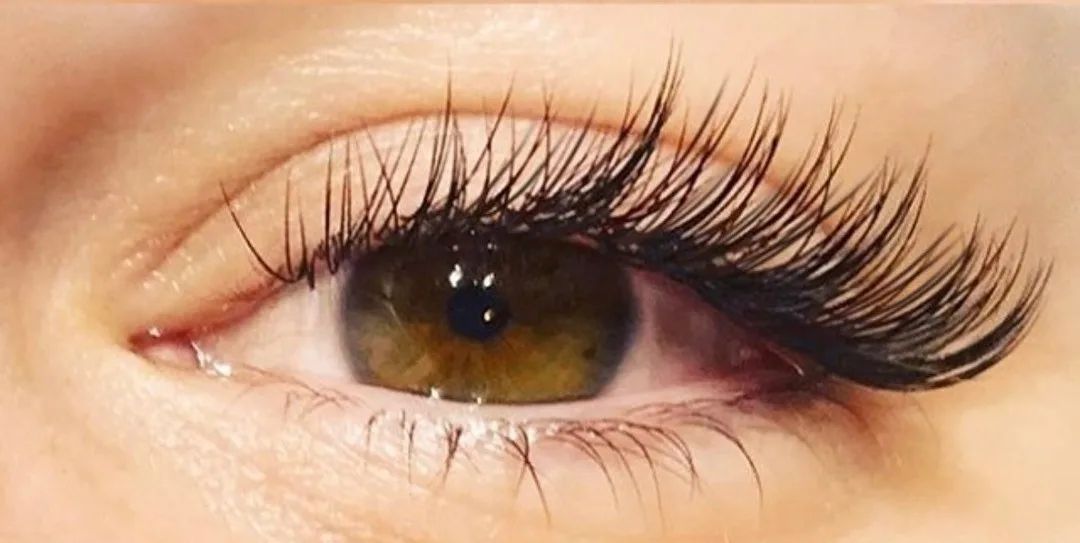
- ShapeHooded — a covered strip of lash line that only shows itself when she looks straight ahead.
- EffectCat-eye in fans: the climb runs outward and stops short of the end.
- Where everyone strugglesLet length do the climbing. Widening the fans as you go builds a block, not a line.
Why Why it is laid out this way
Fans give a hooded cat what single strands struggle to deliver — a dark, continuous rise that survives being half-covered. The trap is that fans invite two variables at once, length and width, and a climb built from both stops looking like elongation. Hold width steady and let the map's own curve carry the effect out to the second-to-last zone.
The order the zones go on, fan by fan
- Read the lid firstEyes open, chin level. The strip of lash line the skin hides is the strip your map has to work around.
- Set the width you will keepChoose one fan width for the whole climb and hold it. Consistency is what makes the rise legible.
- Build the base layer outwardStep length up a hair per zone across the base layer, inner to outer, before you add anything on top.
- Top layer over the open zonesA second, narrower directional layer only where the eye stays open. Under skin it is invisible weight.
- Peak, then come backLongest fans in the second-to-last zone, then a step back for the corner in both layers.
The length curve on hooded eyes
The line climbs six zones and gives one back, and every zone of that climb is bought with length rather than density. Density is flat across the map on purpose: it makes the top edge one continuous rising line instead of a dark wedge that gets heavier toward the corner. The step at the end lifts the outer corner out of the load, which is the zone with the least behind it and the most skin on top of it.
Where does a cat-eye map go wrong on hooded eyes?
Deep The physics underneath
Volume is a bargain about material, not a licence for size. Here is what the bargain buys on a map that climbs.
The same map, built four ways
- Classic 1:1
- Singles can draw this climb, but only by adding length, and length at the outer end is the costliest thing on a hooded lid. Reach for it when her lashes are strong and you want the least possible hardware on the corner.
- Handmade volume
- This cell. Several fine strands give you a dark rising edge for less material than one thick strand would cost, and you set the width yourself so the climb stays even. That control is the reason to do this by hand rather than out of a tray.
- Promade / pre-made fans
- The obvious shortcut on a dense set, and genuinely good across the low inner zones. At the top of the climb the ready-made base is stiffer and thicker, and a lid pressing down on a stiff base is where lifting starts.
- Woven / clover
- Coverage per bond is excellent, which is tempting on a map that wants a solid rise. But it repeats identically, and a repeating pattern on a rising line makes the rise look printed rather than grown.
Spread angle versus weight
Opening a fan moves material sideways; it does not remove any. On this map the peak zone is already the deepest point of the climb, so a wide fan there adds off-axis load to the lashes doing the most work and gains nothing the length has not already given you. Keep the peak narrow, save the width for the flat inner zones where the map asks for very little.
What a hooded lash line can carry
- Each natural lash gets one fan and one anchor. Dividing the same material across more strands makes the fan look softer, but the demand on that single follicle has not moved.
- Going one zone longer at the peak charges you twice: the fan weighs more and its balance point moves further from the root. On a climbing map that is the step everyone takes without noticing.
- The outer zones on a hooded eye are thin, steeply angled and under constant skin contact. What they can hold, not what mid-lid can hold, is the ceiling for the whole rise.
Where this map fails first
Failure lands on the peak rather than the corner because the corner was mapped light on purpose. Those peak fans are the longest and the most layered on the set, and lid skin rests on them for every waking hour. They turn before they fall — the fan rolls, the top edge loses its rise, and the set reads as a slightly heavy natural. If she reports that the effect faded rather than thinned, this is the zone to look at.
FAQ Common questions
Should fan width increase toward the outer corner?
No. Hold one width and let length draw the climb, or the outer third reads as a heavy wedge instead of an elongated line.
Is volume too heavy for a hooded cat-eye?
Not if the fans stay fine. Volume's advantage is coverage for less material, and on a hooded lid that advantage is spent on visible height, not on making the set bigger.
Where does the second layer stop?
At the edge of the covered band. Doubling up on lashes the lid hides costs retention and buys nothing you can see.
Why does the last zone come back down?
It is the most covered and least supported zone on the map. Stepping back keeps the elongation while taking the load off the lashes that give out first.
Print this page or save it as PDF — the diagrams are drawn to stay readable in black and white on plain paper. Or download the diagrams below as SVG. No account, no fee, nothing to sign. Every file carries this page’s address, so wherever it ends up it can be traced back here.
Teaching from these? The offer, and how to credit it.
Also in: Hooded eyes · Cat-Eye · Volume
Read next: what a cat eye lash map actually is · questions clients ask about lash extensions