Hooded Eyes · Doll / Open-Eye · Hybrid
The doll lash map for hooded eyes, built in Hybrid — zone order, where the length peaks, and the point this one usually goes wrong.
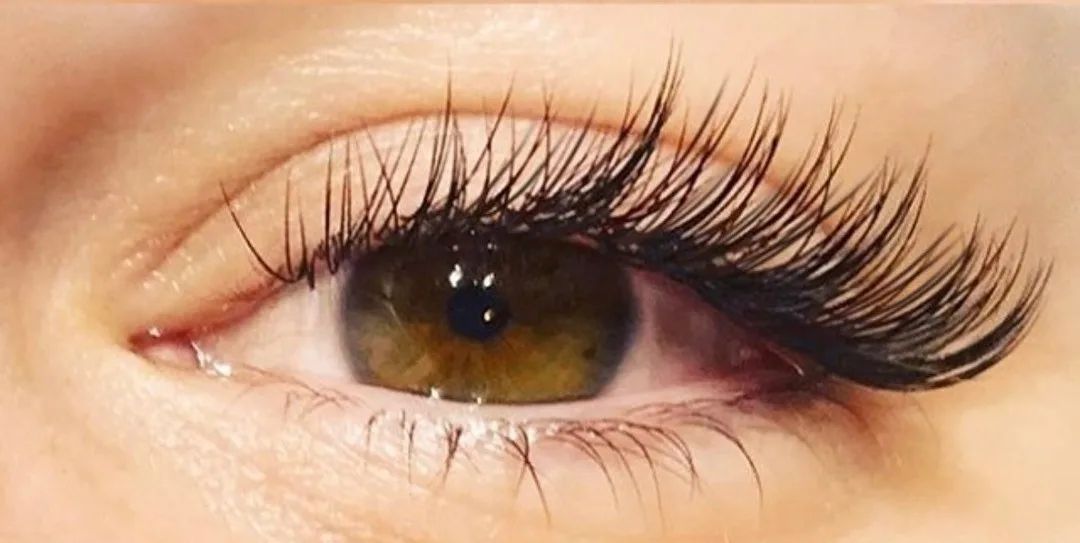
- ShapeHooded — a covered strip at the lash line that changes with every blink.
- EffectDoll with texture: a centred arch built from mixed singles and fans.
- Where everyone strugglesKeep light coming through the middle. A solid crown closes a hooded eye.
Why Why it is laid out this way
A doll arch concentrates everything in the middle of the lid, and on a hooded eye a solid middle is precisely what makes it look smaller. Mixing singles with fans breaks the crown into separate tips with air between them, so the eye reads open rather than covered. The arch itself does not change — only what it is made of.
The order the zones go on, and where the fans land
- Check the middle with her uprightStraight-ahead gaze, relaxed. Only proceed if the centre of the lash line is genuinely visible.
- Set the arch in singlesSingle strands draw the rise and fall first, corners short, longest in the middle. They are the tips people see.
- Fan the shoulders, not the crownFans go into the zones either side of centre for body. The very top stays mostly single so it keeps its edges.
- Space the crown deliberatelyLeave visible air between the tallest tips. That gap is what stops the middle turning into one dark shape.
- Drop both ends togetherInner and outer zones finish equally short, in texture as well as length, so neither side pulls the arch over.
The length curve on hooded eyes
The curve is a tall symmetrical arch, and on a hooded lid that arch has less room above it than it would anywhere else. Because the room is tight, what matters is not just how high the middle goes but how much daylight is left between the tips — a crown you can see through looks taller than a solid one of the same height. The corners stay low to keep every bit of that contrast working.
Where does a doll map go wrong on hooded eyes?
Deep The physics underneath
Two kinds of object share one arch here. What each is really costing the lid is worth knowing before you choose the ratio.
The same map, built four ways
- Classic 1:1
- The tips at the top of the arch, and the reason the crown keeps its separate edges. Singles are also the lightest thing you can stand up in the middle of a lid where headroom is short.
- Handmade volume
- Body for the shoulders of the arch, where the map needs fullness but not height. Making them yourself lets you keep them narrow near the crown and open them up as the curve falls away.
- Promade / pre-made fans
- Even and quick through the shoulder zones, which are the least demanding part of this map. Their thicker bonded root is worth avoiding at the crown, where every bit of bulk eats the gap you are protecting.
- Woven / clover
- Broad coverage from one bond, and on an arch that wants daylight through it that is the wrong currency. It fills exactly the spaces this map is designed to leave open.
Spread angle versus weight
Spread here is a visual decision before it is a mechanical one. Open the fans at the crown and they close the gaps between the single tips, so the middle gains darkness and loses apparent height on a lid that has none to spare. Run them narrow in the top zones and wider on the way down, where extra width has skin above it rather than beside it.
What a hooded lash line can carry
- The crown lashes hold the longest items on the map and get no help from their neighbours, because the map deliberately keeps the neighbours short.
- Adding length at the top of an arch adds weight and reach together, and on this curve there is nowhere for that load to be shared — the shape is the load path.
- Mixed sets hide their own weight. A lash carrying a fan and a lash carrying a single look identical from above, so judge each zone by the weakest natural in it rather than by how the row looks.
Where this map fails first
The middle goes first and it goes quietly. Shed a few of the tallest single tips and the fans either side stay put, so the crown does not thin — it fills in, the gaps disappear, and the arch becomes the solid block this map was built to avoid. Clients describe it as the set getting heavier, which is the opposite of what has happened. Replace tips at the crown before you touch anything else.
FAQ Common questions
Why does a hooded doll set need texture at all?
Because a solid crown reads as a covered eye. Broken tips with air between them let the middle look taller than the same height built as one dense mass.
Where do the fans go on a doll hybrid?
Either side of the crown, in the shoulder zones. They add body where the map wants fullness, while the top keeps single tips for definition.
Should the corners have any texture?
Barely. The whole effect rests on the ends staying quiet, and a spike at a corner pulls the eye away from the middle.
Is this map still doll if the crown has gaps?
Yes. Doll is about where the height sits, not about density — a centred arch with visible tips is still a centred arch.
Print this page or save it as PDF — the diagrams are drawn to stay readable in black and white on plain paper. Or download the diagrams below as SVG. No account, no fee, nothing to sign. Every file carries this page’s address, so wherever it ends up it can be traced back here.
Teaching from these? The offer, and how to credit it.
Also in: Hooded eyes · Doll / Open-Eye · Hybrid
Read next: open eye versus doll — one family, two intents · questions clients ask about lash extensions