Hooded Eyes · Doll / Open-Eye · Volume
The doll lash map for hooded eyes, built in Volume — zone order, where the length peaks, and the point this one usually goes wrong.
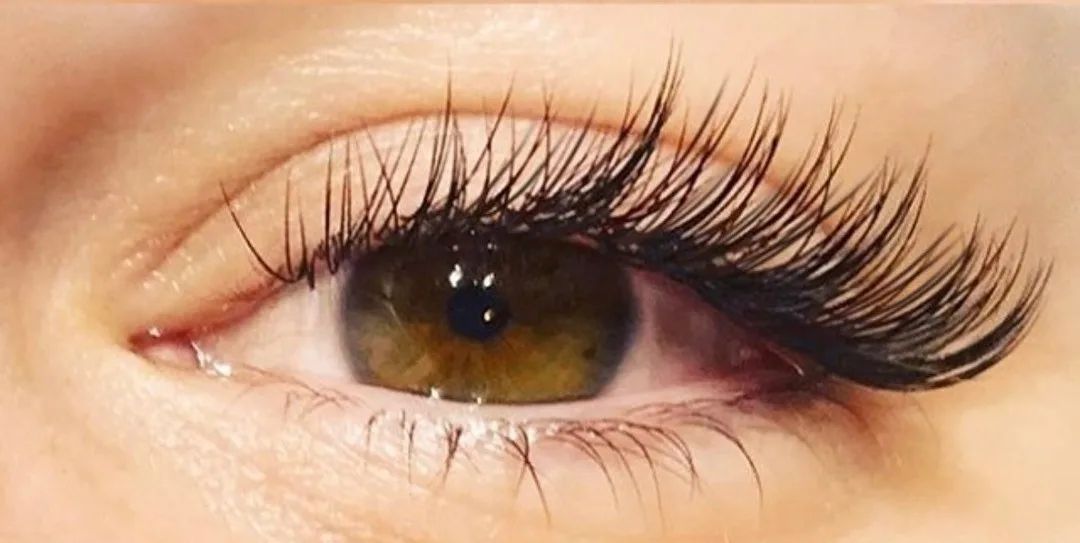
- ShapeHooded — lid skin overlaps the lash line, more on some days than others.
- EffectDoll in fans: a full centred arch, with both ends kept deliberately bare.
- Where everyone strugglesSpend the fans on height in the middle. Width in the middle closes the eye.
Why Why it is laid out this way
This is the densest thing in the hooded library and the one with the least margin: a fan-built arch placed on the part of the lid that has skin closest to it. It is worth doing when the hooding is light and she wants the eye to look rounder rather than longer. Everything then depends on treating volume as a way to buy height cheaply, not as a way to buy size.
The order the zones go on, fan by fan
- Confirm the headroomUpright, straight ahead, relaxed. You need to see clear lash line through the middle before you commit to this build.
- Bare both ends firstMap the inner and outer zones as short and sparse, and stick to it once the fans come out.
- Base layer up to the middleA steady base layer climbing to the centre, fans held narrow through the top three zones.
- Stack height at the crownAdd the top layer only over the centre band, aiming it up rather than out. This is where the whole budget goes.
- Match the two sidesCheck the fall on each side matches the climb — in length and in fan width. An arch is judged on symmetry.
The length curve on hooded eyes
The curve puts almost all its height in three zones and asks the other four to stay out of the way. That concentration is what makes an eye look round, and on a hooded lid it also means your entire material budget lands where the skin is closest — so those three zones have to be built up, not out. Read the diagram as a height chart, and treat every millimetre of width you add there as height you did not get.
Where does a doll map go wrong on hooded eyes?
Deep The physics underneath
Concentrating a set into three zones changes the arithmetic. This is what those zones are actually being asked to hold.
The same map, built four ways
- Classic 1:1
- Singles give the arch its height for the least possible bulk, which is why many techs build a hooded doll this way instead. What they give up is fullness, and fullness is what the client usually came for.
- Handmade volume
- This cell. Several fine strands buy the same crown height for less material than one thick strand, and you control the width fan by fan as the arch rises and falls. That control is the only reason this build is safe here.
- Promade / pre-made fans
- Even width helps a lot when you are trying to mirror two sides of an arch. The bonded root is bulkier, though, and bulk at the root on the centre of a hooded lid shows more than anywhere else on the eye.
- Woven / clover
- Serious coverage per bond, which reads as a very full middle. On this map that is the failure mode rather than the goal, so if you use it at all, use it on the way down and never at the top.
Spread angle versus weight
On a symmetrical map, fan width is a second curve running alongside the length curve, and it has to mirror just as neatly. Wide fans on one shoulder and narrow on the other read as a crooked arch even when the lengths are identical. Keep the top three zones narrow, open up gently as you descend, and make the two sides match step for step.
What a hooded lash line can carry
- Sagging arrives long before shedding does. Once a crown fan bends under its own load, the arch loses height while every extension is still attached, and the effect is gone with nothing visibly wrong.
- Height at the crown is bought at a rising price: each step longer adds material and moves the balance point further from the root, on the exact lashes with the least room above them.
- There is no borrowing between zones here. The corners are mapped bare on purpose, so the centre band's own thinnest lashes set the ceiling for the entire set.
Where this map fails first
The centre gives way, and it does it slowly enough that nobody catches the moment. Crown fans carry the most material on the map under skin that touches them all day, so they lean rather than fall — the top of the arch settles a fraction and the round effect softens toward a plain full set. Because the corners were never doing much, they still look exactly as they did on day one, which makes the middle look like it aged twice as fast. It did.
FAQ Common questions
Is volume ever right for a hooded doll map?
On mild hooding, yes, provided the fans stay narrow and fine. The point is to reach the height cheaply, not to make the middle bigger.
Why keep fans narrow at the crown but wider lower down?
Width in the middle eats the visible gap between lash line and skin. Lower down there is space beside the lashes rather than above them, so width costs nothing there.
How bare should the corners be on a volume doll set?
Genuinely bare — short and light at both ends. The round look comes from the difference between the middle and the ends, and fans at the ends erase it.
The set looked open on day one and closed by week two. Why?
The crown has settled. Long fans under constant lid contact lean before they shed, so the height goes while the density stays.
Print this page or save it as PDF — the diagrams are drawn to stay readable in black and white on plain paper. Or download the diagrams below as SVG. No account, no fee, nothing to sign. Every file carries this page’s address, so wherever it ends up it can be traced back here.
Teaching from these? The offer, and how to credit it.
Also in: Hooded eyes · Doll / Open-Eye · Volume
Read next: open eye versus doll — one family, two intents · questions clients ask about lash extensions