Hooded Eyes · Natural · Classic 1:1
The natural lash map for hooded eyes, built in Classic 1:1 — zone order, where the length peaks, and the point this one usually goes wrong.
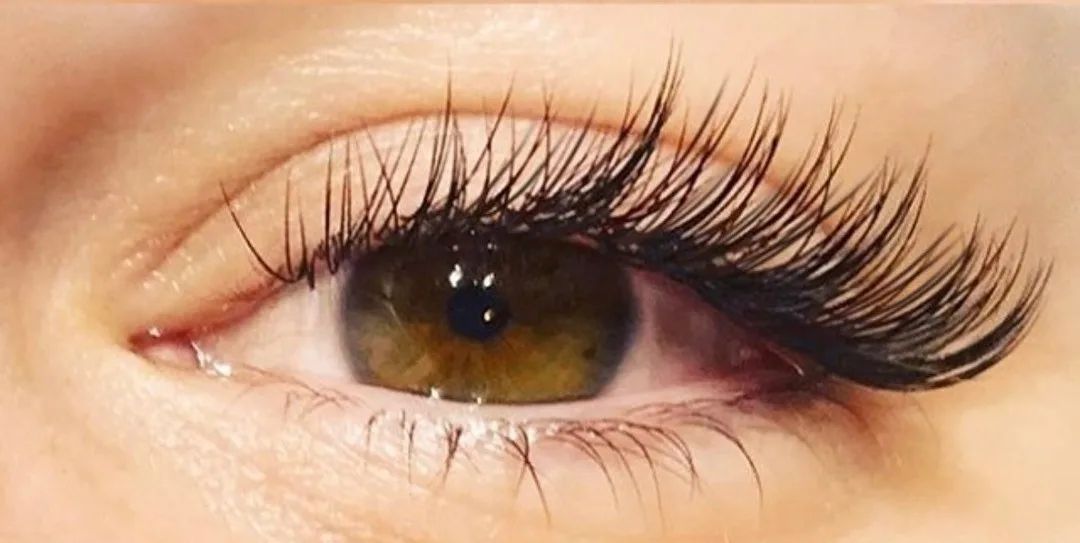
- ShapeHooded — skin overlaps the lash line, so part of every set is out of sight.
- EffectNatural: the length sits across two middle zones, not on one sharp point.
- Where everyone strugglesNever walk one length across the lid. Flat means heavy, not natural.
Why Why it is laid out this way
Natural is the map clients ask for when they want to look rested, and on a hooded eye that is harder than it sounds. There is no drama to hide behind, so the only thing keeping the set visible is putting length where the lid is not covering it — the centre and outer-centre, and nowhere else. Classic strips the job down to length placement alone.
The order the zones go in
- Look before you mapEyes open, chin level, relaxed. Where the skin falls on her decides everything below, and it lands differently on every client.
- Keep the inner tinyInnermost zone is the shortest on the map by a wide margin. It is the most covered part of the lash line and the least worth feeding.
- Step up in two movesTwo even steps take you from the inner corner to full length. Both are big, and both should look deliberate.
- Hold the top across two zonesCentre and outer-centre carry the same length. A flat top rather than a point is what makes it read as natural.
- Soften, don't stopEase down after the top pair and leave the tail a little longer than the inner corner. A hard stop looks cut.
The length curve on hooded eyes
The diagram has no single high point — it has a pair of zones sharing the top, which is why the set reads as her own lashes on a good day. Those two zones are chosen because they sit above where lid skin usually falls, so the length that costs you something is the length that shows. Both ends drop away, with the inner falling further because it is the most covered and the finest part of her line.
Where does a natural map go wrong on hooded eyes?
Deep The physics underneath
One strand, one lash, and a flat top spread over two zones. That flat top is the part worth understanding mechanically.
The same map, built four ways
- Classic 1:1
- This cell. Sharing the top across two zones means the demand is spread over more natural lashes than a pointed map puts it on, which is the quiet reason this build is so forgiving. It is also why an error in placement, not in weight, is the usual way it fails.
- Handmade volume
- Fans would let the top pair look fuller without the strands getting thicker. On a natural brief that fullness is often more than the client wanted, so the technique is fighting the effect rather than helping it.
- Promade / pre-made fans
- Consistent and quick, and a natural map is flat enough that consistency is easy to achieve. The bonded root adds a little bulk exactly where a hooded lid rests, and a natural set has no drama to earn that back.
- Woven / clover
- Repeating width across a two-zone flat top makes the top look printed on. The whole point of the effect is that nobody can tell where the map is.
Spread angle versus weight
With no fans on this map, the equivalent variable is how closely the strands sit along the top pair. Two zones at equal length invite you to fill them densely, and a densely filled flat top stops looking natural and starts looking like a strip of liner. Leave the spacing a little open across the top and let the taper at both ends do the softening.
What a hooded lash line can carry
- Sharing the top across two zones lowers the ceiling problem rather than raising the limit: no single lash is asked for the extreme, so the set bends less and holds its line longer.
- The taper is not decoration. Each step down cuts both the weight and how far it sits from the root, which is why a natural map survives on lash lines that cannot hold a shaped one.
- The inner corner still sets its own limit. Those lashes are the finest on the eye and the map gives them the least, which is the correct answer and not a lack of ambition.
Where this map fails first
The outer half of the top pair goes first. Both zones carry the same length, but the outer one sits on lashes that are already beginning to thin and it is where lid skin settles when the face relaxes. When it drops, the flat top tilts and the set stops looking level — clients call this looking uneven rather than looking sparse. Rebuild from that zone inward at the fill and the shape comes straight back.
FAQ Common questions
Why does a hooded natural map use two equal zones instead of one peak?
Because a point reads as a style and this effect is meant to read as her own lashes. Two zones sharing the top also spread the load over more lashes, so the line stays level for longer.
How short is the inner corner supposed to be?
Much shorter than the top. It is the most covered part of a hooded lash line, so length there is spent on something nobody will ever see.
Will a natural set even show on a hooded eye?
Modestly, and only if the top pair clears the skin. If she wants an obvious change, this is the wrong effect rather than the wrong technique.
Should the outer corner match the inner corner?
No. The tail stays a little longer than the inner so the line eases out instead of stopping, which is what stops the set looking trimmed.
Print this page or save it as PDF — the diagrams are drawn to stay readable in black and white on plain paper. Or download the diagrams below as SVG. No account, no fee, nothing to sign. Every file carries this page’s address, so wherever it ends up it can be traced back here.
Teaching from these? The offer, and how to credit it.
Also in: Hooded eyes · Natural · Classic 1:1
Read next: questions clients ask about lash extensions