Hooded Eyes · Natural · Volume
The natural lash map for hooded eyes, built in Volume — zone order, where the length peaks, and the point this one usually goes wrong.
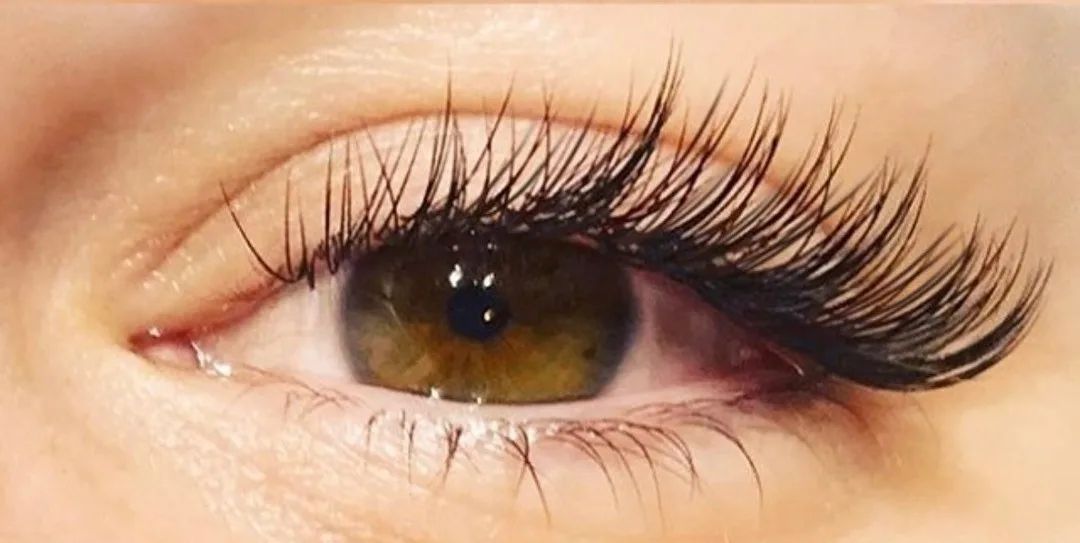
- ShapeHooded — the skin above the lash line hides whatever does not stand clear of it.
- EffectNatural in fans: fullness across two level top zones, no shape drawn on top.
- Where everyone strugglesFill gaps, don't stack layers. A dense top on a covered lid reads as liner.
Why Why it is laid out this way
Most clients asking for a natural set on a hooded eye are asking for fullness, not for length — they want the line to look complete, not longer. That is exactly what fans are good at, and exactly where a hooded lid punishes over-enthusiasm. The map stays modest; the technique does the work.
The order the zones go on, fan by fan
- Watch her blinkA hooded lid moves. Watch a few blinks before mapping so you know which zones stay clear and which come and go.
- First pass, wide spacingLay fine fans across the whole map at generous spacing, following the length curve. Do not aim for density yet.
- Second pass fills the gapsGo back and place into the spaces, at the same height. This is an infill, not a layer stacked on top of the first.
- Keep the top two zones levelCentre and outer-centre share one length. Resist letting the denser zone creep longer than its neighbour.
- Thin out toward both endsFewer fans and shorter lengths at both corners, with the inner end the barest part of the set.
The length curve on hooded eyes
The curve is deliberately dull: a level pair of zones through the middle, falling away at both ends, with nothing to catch the eye as a shape. On a hooded lid that flatness is the safety margin — the fans only have to clear the skin, not perform above it. Density is the variable you are actually adjusting, and the diagram exists to stop density turning into length while you work.
Where does a natural map go wrong on hooded eyes?
Deep The physics underneath
Fullness is bought with material, and material on a hooded lid is spent under pressure. Here is where it goes on a flat map.
The same map, built four ways
- Classic 1:1
- Singles can only add fullness by getting thicker, and a thicker strand on a covered lash line sits lower rather than fuller. That limit is the whole argument for doing a natural hooded set in fans.
- Handmade volume
- This cell. Splitting the same material across several fine strands gives coverage the lid barely notices, which is the only honest way to make a natural line look complete. Keep the fans narrow and let the infill pass do the filling.
- Promade / pre-made fans
- Tempting on a flat map because every zone wants the same thing, and they are genuinely quick here. Their thicker base is the cost, and on a set this modest there is no drama to justify it.
- Woven / clover
- One bond, wide cover, and a pattern that repeats along a level line where there is nothing else to look at. On the dullest map in the hooded set, a visible repeat is the only thing that could give it away.
Spread angle versus weight
Across a level top, fan width decides whether the client sees lashes or sees a line. Open the fans until their edges touch and the two top zones merge into one dark stripe — height unchanged, the eye reading it as makeup rather than lashes. Keep each fan narrow enough to leave a sliver of daylight beside it and the same density reads as a full natural line.
What a hooded lash line can carry
- This is the easiest map in the hooded set to overload, because nothing about it looks ambitious while you are building it. Density has a ceiling even when length does not go anywhere near one.
- The top pair is where mass and reach are both highest, and it is also where you will be tempted to add the most fans. Count what each lash there is holding rather than judging the row by eye.
- Infill is where the weakest lashes get found. The gaps you go back to fill are frequently gaps because the lash there is fine or young, so that pass needs your lightest fans, not your leftovers.
Where this map fails first
The tail thins before anything else, and it takes the flatness with it. Those outer zones carry fans on the shortest, finest lashes on the lid, so they let go earliest, and what is left is a dense level top pair with nothing easing away from it. The set then looks like a block sitting in the middle of her eye, which is the fault this map spent all its discipline avoiding. Refill the taper first, not the middle.
FAQ Common questions
Why an infill pass instead of a second layer?
Because stacking makes a solid edge, and a solid edge under a hooded lid reads as liner. Filling the spaces at the same height gives fullness without darkening the line into a stripe.
Can a volume set really look natural on a hooded eye?
Yes, if the fans stay narrow and fine and the map stays level. What gives volume away is width and darkness, not the fact of using fans.
The two top zones look uneven once it is full. What went wrong?
Density crept into length. When one zone fills up faster it starts to look short, and a step longer there breaks the level pair the map depends on.
How light should the inner corner be on this map?
The barest part of the set, in density as well as length. It is the most covered zone on a hooded eye and fans there are simply not seen.
Print this page or save it as PDF — the diagrams are drawn to stay readable in black and white on plain paper. Or download the diagrams below as SVG. No account, no fee, nothing to sign. Every file carries this page’s address, so wherever it ends up it can be traced back here.
Teaching from these? The offer, and how to credit it.
Also in: Hooded eyes · Natural · Volume
Read next: questions clients ask about lash extensions