Hooded Eyes · Squirrel · Hybrid
The squirrel lash map for hooded eyes, built in Hybrid — zone order, where the length peaks, and the point this one usually goes wrong.
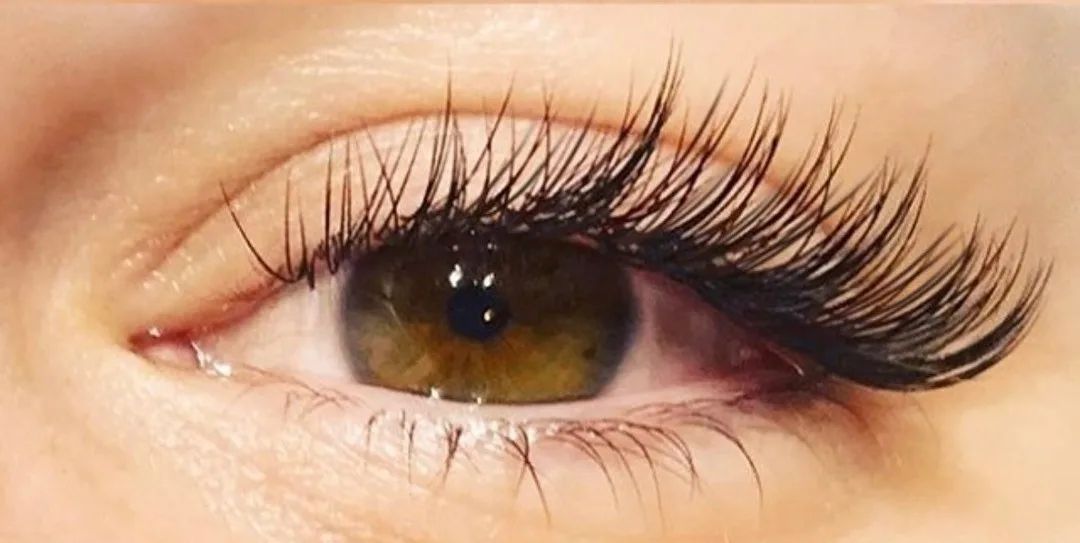
- ShapeHooded — a strip of lash line lives under skin from the moment she opens her eyes.
- EffectSquirrel with texture: a fanned gradient rising to a pointed lift under the arch.
- Where everyone strugglesA point is a heavy object. Count each one as a long single, not as free texture.
Why Why it is laid out this way
The hybrid version of this map hands the two jobs to two different things: fans build the gradient underneath, and a handful of closed-fan points mark the top of the lift. That split is useful on a hooded eye because a point can reach above the skin line without dragging a whole zone of length up with it. It is also how the map gets overloaded, since points do not feel heavy while you are placing them.
The order the zones go on, and where the fans land
- Set your two marksUpright and relaxed, find where the skin stops and where the brow arch peaks. The lift belongs in the gap between them.
- Fan the gradient firstSoft fans carry the whole rising line, low through the inner zones and climbing to the lift. Finish this before any points go on.
- Point the lift, count themA few closed-fan points at the top of the rise, spaced out. Count them as you place them and stop at the number you decided on.
- Nothing pointed inboardThe inner zones stay soft and short. A point under skin costs the same as one on show and returns nothing.
- Bring the fall down twiceStep down after the lift, then again, so the tail ends clearly below the top and above the inner corner.
The length curve on hooded eyes
The gradient in the diagram is doing the work of a slope, and the lift at the fifth zone is doing the work of a mark. Fans make good slopes because you can adjust them a fraction at a time; points make good marks because they read at a glance even through the shadow a fold casts. Keep the two jobs separate and you can lift the eye without the covered half of the map carrying anything it does not need.
Where does a squirrel map go wrong on hooded eyes?
Deep The physics underneath
Two different objects, two different bills. The one that looks like decoration is the expensive one.
The same map, built four ways
- Classic 1:1
- Single strands do turn up here, but usually as the shortest things in the inner zones where a fan would be more than the lash needs. They are the cheap end of this build, not the structural end.
- Handmade volume
- The gradient, and the reason this map can rise at all without loading the covered zones. Making them by hand lets you close them right down as the line climbs into the zone the lid presses on.
- Promade / pre-made fans
- Good for the low inner zones where every fan wants to be the same. Up at the lift their firmer base does not conform to a lash that skin is already leaning on, so it perches and lifts away early.
- Closed fans — points
- A point is a fan squeezed to almost no width, so mechanically it is one thick strand carrying all its mass on the lash's own line — and it is the longest item on the set. Price each one as a long single lash and place a countable number.
Spread angle versus weight
This map wants two different spreads in two different places. Through the rising zones the fans want to be nearly closed, because open fans there widen the line rather than raising it and the skin above flattens the extra width into shadow. At the lift, spread drops to almost nothing by definition — which is exactly why those points weigh what they weigh.
What a hooded lash line can carry
- A closed fan does not carry a lighter load than a thick single; it carries the same load with more bond area. That helps retention and does nothing at all for how far the lash bends.
- Points are placed at the top of the rise, so they combine the greatest length with the greatest reach from the root. Two of them on neighbouring lashes will droop where one on its own would have held.
- The gradient hides its own arithmetic. Fans, points and singles all sit in the same rows here, so check what each individual lash is holding rather than judging the zone as a whole.
Where this map fails first
The points go first and they lean rather than fall. They are the longest, heaviest objects on the map, sitting in the zone where lid skin rests when her face relaxes, so they slowly tip toward the lash line and the mark at the top of the lift rounds off. The gradient underneath survives, which is what makes this confusing at a fill — everything is still attached and the set no longer lifts. Replace points at every visit and treat them as consumable.
FAQ Common questions
Are points on a hooded map worth the weight?
Only above the skin line. A point is the heaviest single item you will place, so it has to be somewhere the client can actually see it.
Why do fans carry the gradient instead of single strands?
Because a gradient wants small adjustments and fans give you them without a jump in length. It also keeps the covered inner zones light while the visible zones climb.
How many points does a hooded squirrel lift need?
Few, and decided before you start. Counting them is the only reliable way to stop the lift turning into a whole textured zone.
Should the points be spaced evenly?
No. Irregular spacing is what makes texture look grown rather than placed, and a regular run of points reads as a comb.
Print this page or save it as PDF — the diagrams are drawn to stay readable in black and white on plain paper. Or download the diagrams below as SVG. No account, no fee, nothing to sign. Every file carries this page’s address, so wherever it ends up it can be traced back here.
Teaching from these? The offer, and how to credit it.
Also in: Hooded eyes · Squirrel / Fox · Hybrid
Read next: fox eye and squirrel lash mapping, and how they differ · questions clients ask about lash extensions