Hooded Eyes · Squirrel · Volume
The squirrel lash map for hooded eyes, built in Volume — zone order, where the length peaks, and the point this one usually goes wrong.
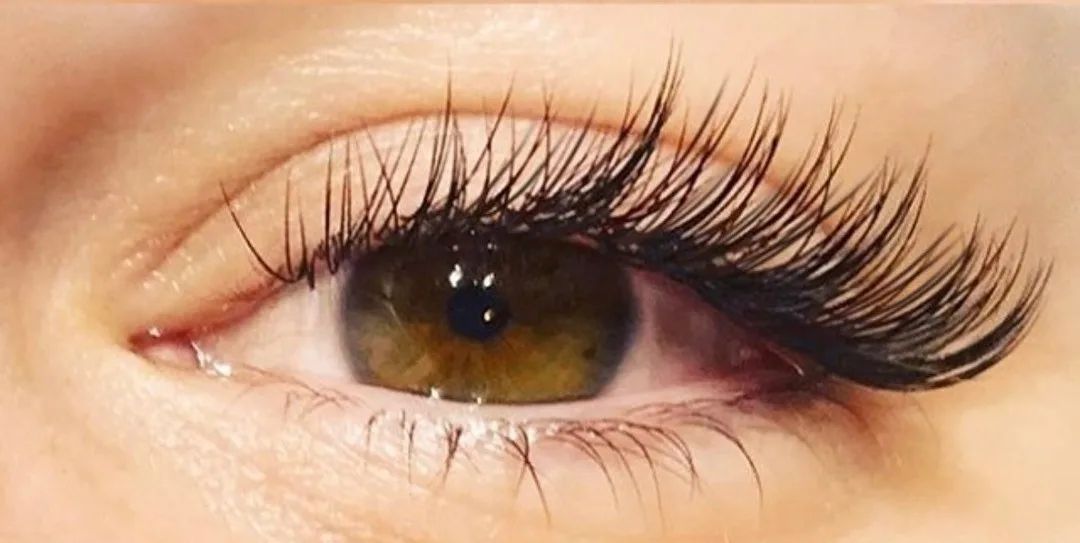
- ShapeHooded — a fold of lid skin covers part of the lash line when the eye opens.
- EffectSquirrel, in volume: the peak sits high under the brow arch, above the fold.
- Where everyone strugglesCheck the fold with her eyes open before you map. A peak below it vanishes.
Why Why it is laid out this way
A hood is a flap of lid skin that eats length when the eye opens — a set that stuns on a closed eye can vanish on an open one. The squirrel map lifts its peak up under the arch, clear of the fold, then falls to the tail. In volume, that shape is built from fans, so layering discipline matters.
The order the zones go on, fan by fan
- Read the fold firstEyes open, relaxed. See where the hood lands — there is no universal hooded map.
- Peak above the fold, under the archLongest fans high on the lid, below the brow arch — above where the hood covers.
- Layer, don't flattenDense wider-fan base first, then a narrower directional top layer. Two widths give lift; one flat layer reads dull.
- Inner corners short and airyInner zones stay shortest and lightest — inner weight is what a hood punishes hardest.
- Taper the tail after the peakEase length back down to the outer corner so it reads as lift, not corner drag.
The length curve on hooded eyes
The hooded problem is visibility, not length. The fold hides whatever sits below it, so only the length above the fold counts — the map spends its height there and wastes none at the covered inner corner. Volume earns its place by building that peak from light fans: density to clear the fold without the dead weight a heavy single lash would drop on a crowded lid.
Where does a squirrel map go wrong on hooded eyes?
Deep The physics underneath
The hood doesn't just hide lashes. It rests on them, all day, sideways — which changes what every technique is worth.
The same map, built four ways
- Classic 1:1
- To clear a fold with single strands you have one variable: length — the costly one, adding mass and lever together. Doable on a strong lash line; no margin.
- Handmade volume
- The reason this cell exists. Buy the height with several fine strands, not one thick one — same silhouette, less mass on a lid already pressing back. And you tune spread zone by zone.
- Promade / pre-made fans
- Consistency and speed across a dense set. The trade is a stiffer, bulkier base — and a hood is exactly where a stiff base perches instead of wrapping, then lifts first.
- Woven / clover
- Fixed lateral spread buys width, but the hood's problem is vertical — you gain width at the same height and the fold eats it. Base layer only, never the peak.
Spread angle versus weight
On this shape, spread is the lever you control. A wide fan covers more per unit mass but its outer legs sit off the axis, carrying torsion — and under a fold already pressing sideways, that becomes visible twist within days. A narrow fan tracks the axis and reads as height, not width. That is the case for the two-layer build: wide base where the fold doesn't reach, narrow top where it does.
What a hooded lash line can carry
- Volume's licence is coverage per unit mass — splitting one strand into several cuts mass faster than coverage. Spend the discount on height, not more material.
- A fan is still one object on one natural lash. Fanning does not move the lash's ceiling.
- The fold adds a load nobody weighs: a small, continuous sideways force, all day, on a bond built to resist downward pull. Two lashes with identical extensions don't share a fate if one lives under the fold.
Where this map fails first
Under the peak, not the tail — the opposite of most maps. Under the arch you put the longest, densest fans, and it is where the fold settles when the eye relaxes: highest load meets continuous sideways pressure. The first symptom is rotation, not shedding — fans turn flat, the peak drops, and the set slides back toward mapped-flat.
FAQ Common questions
Why is the squirrel map the go-to for hooded eyes?
Its peak sits high under the brow arch, above the lid fold — the one placement that stays visible when a hooded eye opens.
Where does the length go on a hooded squirrel map?
Into the centre and outer-centre zones, high enough to clear the fold. The inner corner stays short and light; length eases down after the peak.
How is a volume squirrel map layered?
Two stacked layers of different fan widths — a denser wider-fan base with a narrower directional layer on top. Varying the width gives the lift a single flat layer can't.
Is stronger curl better for clearing a hood?
No. Placement clears the hood; over-curling pushes the fan's arc into the lid and hurts look and retention both.
Print this page or save it as PDF — the diagrams are drawn to stay readable in black and white on plain paper. Or download the diagrams below as SVG. No account, no fee, nothing to sign. Every file carries this page’s address, so wherever it ends up it can be traced back here.
Teaching from these? The offer, and how to credit it.
Also in: Hooded eyes · Squirrel / Fox · Volume
Read next: fox eye and squirrel lash mapping, and how they differ · questions clients ask about lash extensions