Monolid Eyes · Wispy · Volume
The wispy lash map for monolid eyes, built in Volume — zone order, where the length peaks, and the point this one usually goes wrong.
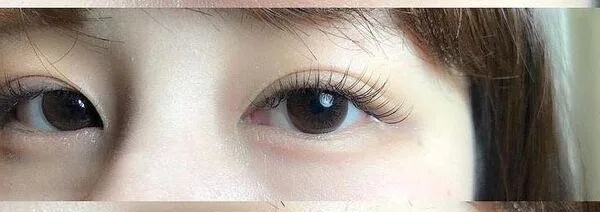
- ShapeMonolid — flat lid plane; oil travels straight along the lash roots.
- EffectWispy in fans: an open worked line, level through the middle, spiked at intervals.
- Where everyone strugglesThere is a hard weight cap here. Heavy volume on a flat lid does not hold.
Why Why it is laid out this way
The warning comes before the method on this one: a flat lid transfers oil along the lash line more readily than a creased one, so the bond is already working against something before a single fan goes on, and the heaviest grades of volume have no business on this shape. Inside that cap there is a good set to be had — a light, open worked line with closed fans standing out of it at intervals. Think of the finished line as something you can see through, not as a fabric.
The order the zones go on, fan by fan
- Fix the weight cap firstDecide the heaviest fan you will use on this client before you start, and hold to it. On this lid the limit is set by the bond, not by the look.
- Keep the fans narrow and openSmall fans with light between them across the level middle and both falls. Light passing through the line is what makes the set read as wispy rather than as full.
- Close a fan to make a spikeBring a fan almost shut and place it a step above its zone. A properly closed fan behaves like one strand; a half-closed one opens up on the lid.
- Match both fallsStep down at the same rate on either side of the level top. This map is symmetrical and an uneven fall is obvious from the front.
- Scatter the spikes without a rhythmVary spacing and vary height. Regularity is the failure this effect notices first.
- Prep and cleanse honestlyClean lash roots, then tell her plainly that this build depends on her cleansing. On a flat lid it is the difference between three weeks and one.
The length curve on monolid eyes
The shape is a wide level top with matching falls, and volume changes only how that line is filled. Fine fans let you fill it with cover instead of with thickness, so the spikes above it still have something plain and light to stand against. Fill it any further and the map stops being an open worked line and becomes a solid one with a few points on top.
Where does a wispy map go wrong on monolid eyes?
Deep The physics underneath
Fans buy cover per unit of mass. What they do not buy is bond area, and on this lid bond area is the constraint that actually binds.
The same map, built four ways
- Classic 1:1
- One strand, one lash, the simplest bond on the lid — which is why a classic spike outlasts a fan-built one here. Worth keeping singles for the spikes even when the rest of the set is fanned.
- Handmade volume
- This cell. Narrow fans give the line depth for almost no weight and let you tune every one of them, which is the only way to stay under the cap this lid imposes.
- Promade / pre-made fans
- Quick and even, on a base that is firmer and thicker than a hand-made fan's. That base sits exposed at the roots on a monolid and takes the oil first, which is a poor trade in the one cell where retention is the headline.
- Woven / clover
- Broad cover for one bond, which sounds efficient and closes the open line this effect depends on. It is the wrong tool for a set whose selling point is that you can see through it.
Spread angle versus weight
Two spreads are in play here and they pull in opposite directions: the bed's fans want to be narrow so the line stays open, and the spikes want to be shut completely so they behave like single strands. Anything in between — a half-open fan carrying its material off the lash's line — drifts and blurs, which on this effect is the difference between texture and mess. If a fan will not close, use a single strand for that spike instead.
What a monolid lash line can carry
- Retention is the ceiling in this cell rather than droop: the lash line sits out in the open on a flat plane, oil reaches the roots easily, and fan bases give up before any strand bends under its load.
- A closed fan used as a spike carries the map's longest reach on one follicle, so it is both the heaviest and the most exposed thing you will place. Count them rather than scattering them.
- Bed fans go on the middling lashes, spikes on the stoutest, and the fine ones are left bare. Bare lashes cost nothing here — the gaps are part of the effect, so the weakest strands can simply be left out of the set.
Where this map fails first
This cell fails through its bonds rather than through its shape. Spike fans that were not fully closed ease open first and the points go soft, which reads as the set getting fuzzy. Then the bed loses bases along the falls, where the lashes are shortest and the lid takes the most contact from a pillow and a towel. The map keeps its outline the whole way through, which is why clients often describe it as still fine when it has actually lost half its texture.
FAQ Common questions
Is volume safe on monolid eyes for a wispy set?
Light volume is. The heavier grades are not, because a flat lid carries oil along the lash roots and fan bases there have the least margin of anything you could place.
Should spikes be closed fans or single strands?
Either, as long as a fan spike is fully closed. A partly open one drifts wider over the following week and the point turns into a blur.
How open should the line be?
Open enough to see light through it. The moment the fans meet each other across the middle zones, the spikes lose their contrast and the effect goes with it.
Why do both sides need to fall at the same rate?
Because this map is symmetrical, and a symmetrical shape shows any imbalance immediately from the front — which on a monolid is the only view that counts.
Print this page or save it as PDF — the diagrams are drawn to stay readable in black and white on plain paper. Or download the diagrams below as SVG. No account, no fee, nothing to sign. Every file carries this page’s address, so wherever it ends up it can be traced back here.
Teaching from these? The offer, and how to credit it.
Also in: Monolid eyes · Wispy · Volume
Read next: what makes a lash map wispy rather than spiky · questions clients ask about lash extensions