Round Eyes · Cat-Eye · Classic 1:1
The cat-eye lash map for round eyes, built in Classic 1:1 — zone order, where the length peaks, and the point this one usually goes wrong.
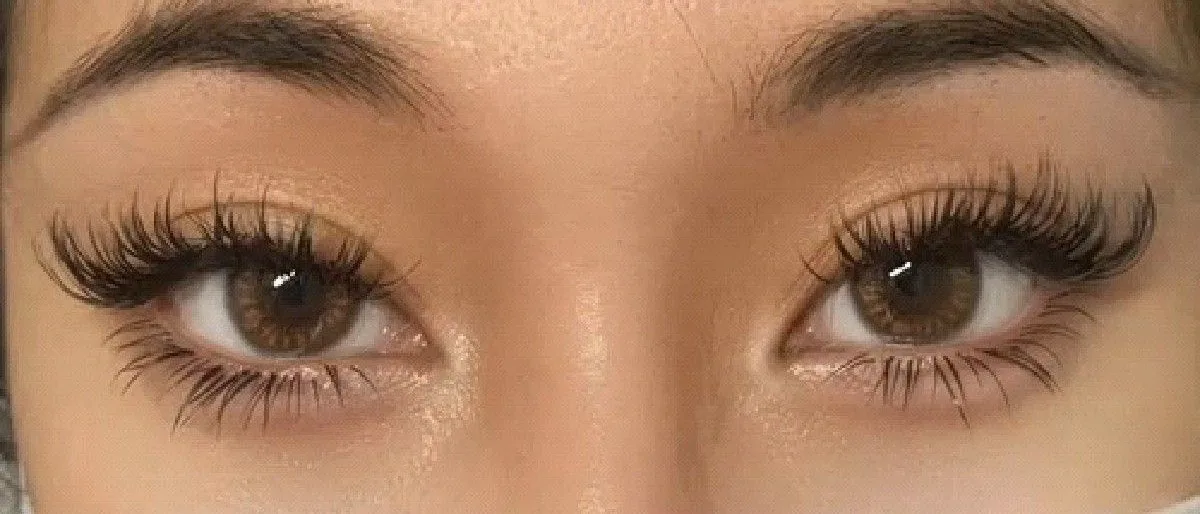
- ShapeRound — as tall as it is long, with the whole iris on show.
- EffectCat-eye, one lash on one: the longest zone is the last one.
- Where everyone strugglesNo height over the middle. Length belongs at the outer edge.
Why Why it is laid out this way
A round eye is already open, so nothing on this map is trying to open it further. The job is length carried sideways: the line climbs from a short inner corner and finishes longest at the outer edge, which stretches a circle toward an oval. Classic 1:1 does that with one strand per lash, so the climb has to be built out of length alone.
The order the zones go in
- Start the inner corner lowShortest, finest lashes in the first zone — around a third of what the outer edge will carry.
- Climb one step per zoneAdd the same small increment each zone. An even ramp reads as elongation; an uneven one reads as an error.
- Save the biggest step for lastThe two outermost zones take the widest jump on this map. That is where the stretch is actually made.
- Keep curl soft until the outer thirdOne gentle open curl through the inner and centre zones. A stronger curl belongs in the last zones only.
- Finish at the corner, no taperThe final zone stays the longest on the lid. Easing back at the end turns the cat into a plain natural set.
The length curve on round eyes
The curve above is a straight ramp — no hump, no plateau, just a rise that ends where the lash line ends. It works because a round eye needs width rather than height, and every zone that stays low in the middle keeps the arc from growing taller. Read it left to right and the longest lash is the last thing you reach, which is exactly where the eye should travel.
Where does a cat-eye map go wrong on round eyes?
Deep The physics underneath
Above is where the length goes. Below is whether the corner lashes can hold it.
The same map, built four ways
- Classic 1:1
- One strand per lash means the climb is made of length alone, and length is the expensive variable — mass and reach grow together. On this map the whole expense lands at the outer edge, where the natural lashes are finest. That is the difficulty of the cell and the reason it teaches restraint.
- Handmade volume
- Fans would let the last zones look fuller without one thick strand doing the work, because coverage falls off slower than weight when you split a strand. Inside a classic set that discount is not available; here fullness is bought at full price.
- Promade / pre-made fans
- The bonded node sits at the root, the cheapest point on the lever, so a ready fan is a light way to thicken a corner. The catch on a climbing map is that a fixed fan hands you the same spread in every zone, and this map needs the outer zones to differ from the inner ones.
- Woven / clover
- A woven bond covers a lot of lash line per join, useful across the long quiet inner run. At the outer edge the repeating spread starts to read as pattern, and the last zone of a cat-eye is the one everybody looks at.
Spread angle versus weight
A single strand is the zero-spread case: all its mass sits on the lash's own line, which makes classic the most predictable thing to hang off the last zone. Anything wider puts weight off that line and the lash turns to relieve the twist. On a map whose longest zone is also its weakest anchor, staying on-axis is worth more than coverage.
What a round lash line can carry
- Deflection arrives before shedding. Once the extension's mass and reach beat the corner lash's stiffness, that lash sits low, the ramp flattens, and the elongation is gone while everything is still attached.
- Length charges twice: a longer extension weighs more and holds that weight further from the root. This map asks for its longest strands in the one zone where the lever is already longest.
- A zone's ceiling comes from its weakest strands, not its average — and the outer corner is where the fine, half-grown lashes live. One overloaded strand there shows more than ten comfortable ones.
Where this map fails first
The last zone, for two reasons at once. It carries the longest extensions on the map and it grows the shortest, finest natural lashes on the lid. Add the lid curving away at the corner, so the bond wraps less than it does mid-lid, and this is where the set thins first. When it thins the map does not merely get sparser — the climb loses its top and the cat-eye stops existing.
FAQ Common questions
Is a cat-eye safe on round eyes when it is risky on downturned ones?
Yes. A round outer corner is not already falling, so length there stretches the eye instead of dragging it. The caution on this shape is mechanical rather than cosmetic: fine corner lashes have to carry the longest extensions.
Where exactly does the longest zone sit?
At the very outer edge, the last zone on the lid. Unlike most maps there is no taper after the peak — the climb ends where the lash line ends.
Why keep the middle short if she wants drama?
Height over the pupil makes a round eye rounder and reads as surprise. On this shape drama comes from the gap between the two ends, so keeping the middle down is what makes the corner look long.
Can classic 1:1 carry enough impact for a cat-eye?
It can, because the effect is a shape rather than a density. A clean ramp in single strands reads sharper than a fuller set with a muddled length curve.
Print this page or save it as PDF — the diagrams are drawn to stay readable in black and white on plain paper. Or download the diagrams below as SVG. No account, no fee, nothing to sign. Every file carries this page’s address, so wherever it ends up it can be traced back here.
Teaching from these? The offer, and how to credit it.
Also in: Round eyes · Cat-Eye · Classic 1:1
Read next: what a cat eye lash map actually is · questions clients ask about lash extensions