Round Eyes · Cat-Eye · Volume
The cat-eye lash map for round eyes, built in Volume — zone order, where the length peaks, and the point this one usually goes wrong.
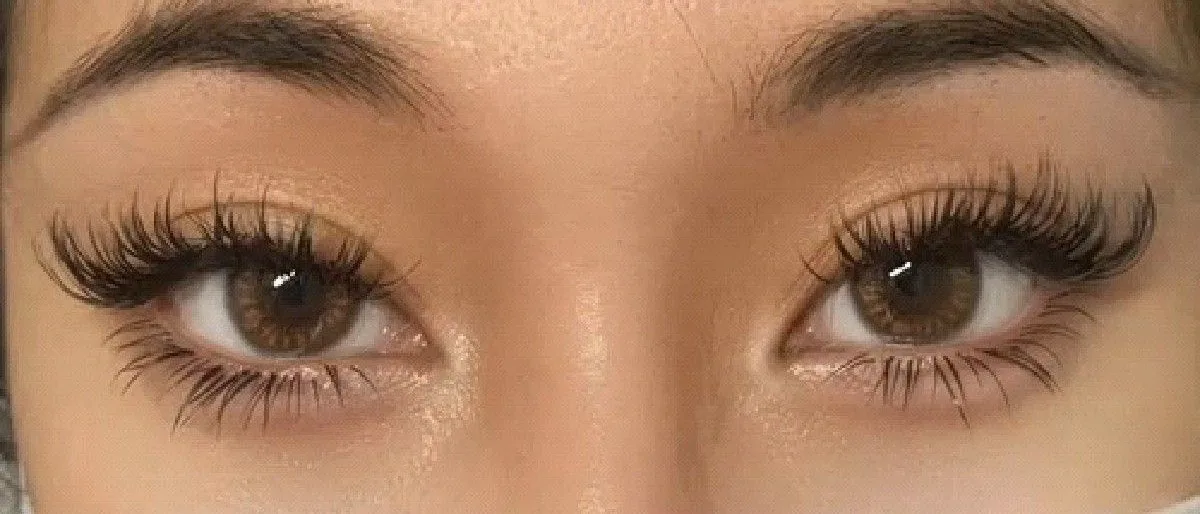
- ShapeRound — height and width run about even, so the eye reads circular.
- EffectCat-eye in fans: density everywhere, length saved for the outer edge.
- Where everyone strugglesDensity is not the effect. Even fullness kills the stretch.
Why Why it is laid out this way
Volume gives you fullness cheaply in weight terms, and on this map the temptation is to spend it evenly. Even density is the enemy of a climbing line: the eye stops reading a rise and starts reading a solid band. Spend the fullness where the lengths are short, and let the last zones be long rather than thick.
The order the zones go on, fan by fan
- Build the gradient before the densitySet your length per zone first and treat fan width as a second, separate decision.
- Wide fans inboardOpen the fans across the short inner and centre zones. They fill the lash line where the lengths cannot.
- Narrow the fans as you climbEvery zone outward, close the spread a little. Narrow fans read as length, wide fans read as width.
- Layer without lifting the centreStack layers front to back, not high to low. A second layer sitting above the middle zones puts height where this shape wants none.
- Longest and lightest at the tailThe final zone gets the longest fans on the set built from the finest strands you have.
The length curve on round eyes
The diagram is a rise with its steepest section at the end, and volume does nothing to change it — fans follow the same lengths a classic set would. What fans change is what happens between the lengths: the gaps close, so the climb reads as one continuous line rather than a row of separate strands. Fullness is the surface; the rise is still the effect.
Where does a cat-eye map go wrong on round eyes?
Deep The physics underneath
Fans buy coverage per unit of weight. This map decides where that discount is worth spending.
The same map, built four ways
- Classic 1:1
- Single strands remain the reference the fans are measured against, and on this map they are still the safest thing to place in the final zone. If the corner lashes are borderline, dropping the last zone back to singles costs less than you would expect.
- Handmade volume
- The reason to build this cell in fans at all: you choose a different width for every zone, so the map can be full at the inner corner and lean at the tail. That per-zone control is what turns volume from a density into a shape.
- Promade / pre-made fans
- Consistent, fast, and fine across the short inner zones where all you want is fill. Toward the outer edge their fixed width fights the narrowing you are trying to build, and their stiffer base perches on a lash that is already angled away.
- Woven / clover
- Sharing a bond across neighbours spreads the load, which is genuinely useful over the long middle stretch. It also locks a repeating footprint onto the lash line, and the outer zones of this map need to stay independent so each one can carry its own length.
Spread angle versus weight
Opening a fan does not add weight, it moves the same weight off the lash's line, and the lash answers by rotating. That rotation is survivable in the short inner zones and unaffordable in the last one, where the arm is longest and the anchor is finest. So the widths on this map should shrink in step with the lengths growing.
What a round lash line can carry
- Splitting one strand into several drops weight faster than it drops coverage. That discount is the licence for this map — but spend it on reaching further out, not on making the tail bulkier.
- The final zone stacks every penalty on one lash: the greatest length, the longest arm, the finest natural strand, and the least bond wrap where the lid turns. Nothing else on the lid is asked for as much.
- Judge each zone by its poorest strands. A round lid has a run of short, new growth near the outer corner, and those are the ones that decide whether the tail holds its shape.
Where this map fails first
Two ends, two different failures. At the tail the load is mechanical: longest fans on finest lashes, so they deflect, the top of the climb drops, and the set flattens into something shapeless. At the inner corner the failure is craft — over-wide fans in a crowded, short zone touch their neighbours and stick, and stuck lashes come out in pairs. Neither shows up in the chair; both show at the two-week check.
FAQ Common questions
Should the fans get wider or narrower toward the outer corner?
Narrower. Width reads as thickness and length reads as stretch, and this shape is being stretched. Narrow fans also keep the weight on the lash's own line where the lever is longest.
How do I keep a volume set from looking heavy on a round eye?
Keep the middle zones short and let their fullness come from spread rather than length. A round eye looks heavy the moment the centre gets tall, however light the material is.
Is a second layer allowed on this map?
Yes, if it stacks front to back rather than adding height. A layer that sits above the centre zones rebuilds the roundness the whole map is working against.
Why does the effect vanish before the lashes do?
Because the outer fans bend before they shed. Once the longest zone sits low, the gradient is gone and the client sees a full but shapeless set while everything is still attached.
Print this page or save it as PDF — the diagrams are drawn to stay readable in black and white on plain paper. Or download the diagrams below as SVG. No account, no fee, nothing to sign. Every file carries this page’s address, so wherever it ends up it can be traced back here.
Teaching from these? The offer, and how to credit it.
Also in: Round eyes · Cat-Eye · Volume
Read next: what a cat eye lash map actually is · questions clients ask about lash extensions