Round Eyes · Natural · Hybrid
The natural lash map for round eyes, built in Hybrid — zone order, where the length peaks, and the point this one usually goes wrong.
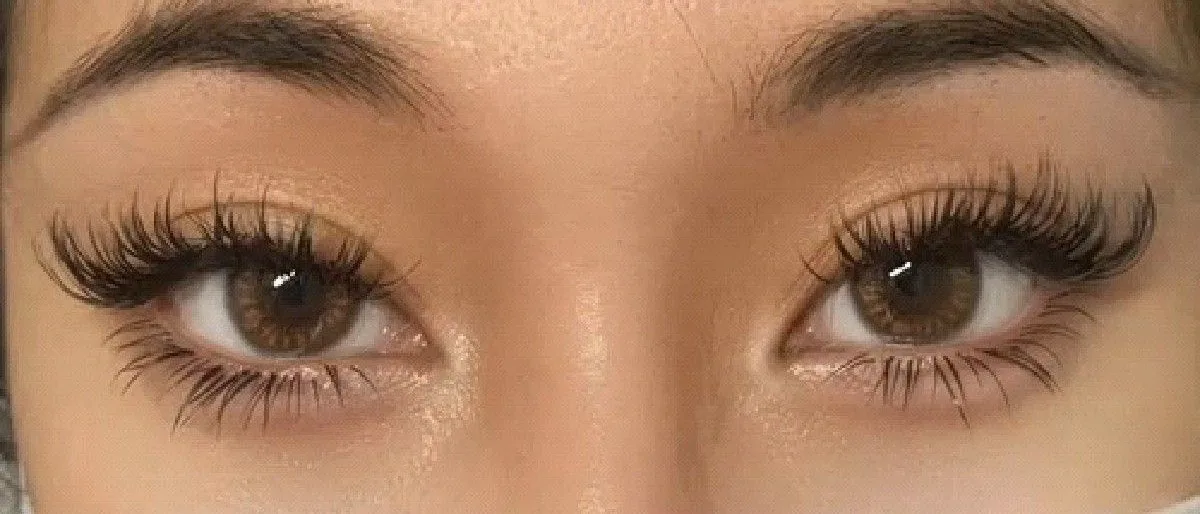
- ShapeRound — wide-awake by default, so nothing here needs opening up.
- EffectNatural with a mixed edge: soft variation, one high point past the middle.
- Where everyone strugglesVariation runs sideways, not upward. No strand may beat the high point.
Why Why it is laid out this way
Real lashes are not the same length as their neighbours, and that is the argument for building a natural set as a mix. Small fans and single strands together give the slightly uneven, hand-knitted edge a perfectly graded classic set never has. The shape rule does not change: the longest point still sits past the middle, because a round eye gains nothing from height over the pupil.
The order the zones go on, and where the fans land
- Grade the lengths firstWalk the lengths up from a short inside to a high point in the outer third, then give one step back.
- Small fans through the low zonesNarrow fans across the inner and mid zones close the gaps without making anything longer.
- Vary by a whisker, not a stepLet neighbouring strands differ by the smallest amount you can control. Big differences stop reading as natural growth.
- Singles for the high pointSet the longest zone in single strands so its length stays exact and its weight stays predictable.
- Soften the last zonesMix a few shorter strands into the tail so the line fades rather than stopping.
The length curve on round eyes
The graph rises in even steps to a late high point and gives back one step — the shape is deliberately dull, because the interest on this map comes from texture rather than from the profile. Putting the high point beyond the arch is what stops a round eye reading as startled, and hybrid does nothing to change that placement. The mix works underneath the curve, not on it.
Where does a natural map go wrong on round eyes?
Deep The physics underneath
Two build methods on one quiet line means two different weights sitting next to each other. It only works if the difference stays invisible.
The same map, built four ways
- Classic 1:1
- Singles hold the high point and the last zones, where an exact length matters more than fill. They are also the strands the client's own lashes most closely resemble, which is the standard this map is judged against.
- Handmade volume
- Narrow handmade fans are the filler of choice through the low inner zones, because you can keep them tight enough that nobody sees a fan. Widen them and the map stops being natural at the exact moment the spread becomes visible.
- Promade / pre-made fans
- Even width and even weight are a poor fit for an edge that is supposed to look grown rather than set out. If you use them at all, keep them below the high point where a uniform footprint is hidden by shorter lengths.
- Woven / clover
- The join covers several lashes at once, which is efficient and unmistakably manufactured up close. On a set whose success is measured by nobody asking about it, that is a poor trade.
Spread angle versus weight
Spread is the tell on a natural map: a fan wide enough to be seen as a fan has already broken the effect, whatever the length is doing. In the high-point zone keep to single strands or the tightest fans you make, since that is the zone the eye lands on. Anything wider belongs in the short inner zones where the shorter lengths hide the footprint.
What a round lash line can carry
- The mix disguises weight from you as well as from the client. A narrow fan and a single strand look alike on the lid but do not weigh the same, so check the finest natural lashes before deciding which zones get which.
- The high point has the longest reach on the map and sits where the lashes have started to thin. That combination sets the ceiling for the whole cell, even though it is the least dramatic map in the shape's set.
- One weak strand carrying a fan in a quiet zone will droop below its neighbours and read as an error, because a natural map has no texture loud enough to cover it.
Where this map fails first
Loss shows at the high point, and it shows early. That zone carries the longest objects on a stretch of lash line already tapering toward the corner, and the smooth gradient either side means a single gap has nothing to hide behind. On a mixed edge the first thing to go is usually a fan, which leaves a wider hole than a single strand would. Keep the fans in that zone narrow and the map ages evenly.
FAQ Common questions
Why mix textures on a natural set at all?
Because natural lashes are not uniform. A perfectly graded line of identical strands can look more artificial than a slightly uneven one, and the mix supplies that unevenness on purpose.
How much variation is too much?
If someone can see the pattern from across a table, it is too much. The differences should be small enough that the effect registers as softness rather than as texture.
Where does the longest zone go on a round eye?
Out in the outer third, past the highest part of the lid arch. Placed over the middle it lifts an eye that is already open and the result reads as surprise.
Should the tail fade or stop?
Fade. A few shorter strands blended into the last zones let the line end gradually, which suits an effect built on not being noticed.
Print this page or save it as PDF — the diagrams are drawn to stay readable in black and white on plain paper. Or download the diagrams below as SVG. No account, no fee, nothing to sign. Every file carries this page’s address, so wherever it ends up it can be traced back here.
Teaching from these? The offer, and how to credit it.
Also in: Round eyes · Natural · Hybrid
Read next: questions clients ask about lash extensions