Round Eyes · Natural · Volume
The natural lash map for round eyes, built in Volume — zone order, where the length peaks, and the point this one usually goes wrong.
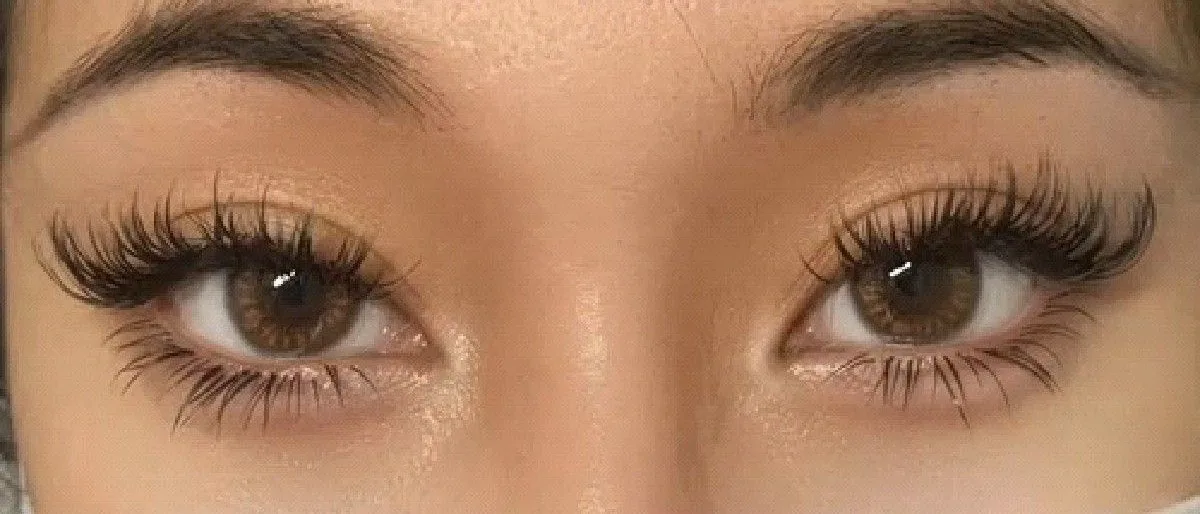
- ShapeRound — a circle rather than an oval, so length is what is missing.
- EffectNatural in fans: quiet fullness, one gentle high point past the middle.
- Where everyone strugglesFullness in the middle zones lifts a round eye. Keep the density soft there.
Why Why it is laid out this way
Fans on a natural map are there to make a thin line look like a healthy one, not to announce anything. Held to that job they work beautifully on round eyes, because they add body at a length the shape can afford. Let them get dense over the middle and the softness turns into a band across the roundest part of the eye.
The order the zones go on, fan by fan
- Set the profile before the fansEven steps up to a high point in the outer third, one step back at the end. Density is decided afterwards.
- Fine strands, modest countBuild the fans from the finest material you can handle. On a natural map the fan should read as one soft lash.
- Keep the middle airyLeave a little space between fans across the centre zones. Air there is what keeps a round eye from looking banded.
- Fullest at the high pointIf any zone gets your densest work, it is the long one past the middle, where fullness pulls attention outward.
- Fade the last zoneFewer, lighter fans at the very corner so the line ends in a haze rather than a hard stop.
The length curve on round eyes
The profile above is the same quiet rise a classic natural set would use — volume adds nothing to it and must not appear to. What fans change is the base of the line: the roots look continuous, so the eye reads a healthy lash line instead of a graded row of strands. The high point stays out past the arch for the same reason as always, since density does not excuse height in the middle.
Where does a natural map go wrong on round eyes?
Deep The physics underneath
Volume's advantage is coverage per unit of weight. The whole question on this cell is whether the client can tell you used it.
The same map, built four ways
- Classic 1:1
- The set this map is imitating. Single strands give a truthful line but cannot fill a thin one, and the moment gaps appear the effect fails for a reason volume can solve.
- Handmade volume
- Making the fan yourself is what lets it stay small — a couple of very fine strands opened barely at all. That is the version of volume that disappears on a natural map, and it is the only version worth using here.
- Promade / pre-made fans
- Reliable and quick, with a base slightly bulkier than a hand-made equivalent. On a map whose whole claim is that the root line looks like her own, that base is the detail people notice first.
- Woven / clover
- High coverage from a single bond, and a footprint that repeats down the lid. Repetition is exactly what a natural set cannot afford, however good the coverage is.
Spread angle versus weight
Spread decides whether a fan reads as a fan. Held nearly closed it behaves like one soft strand and the eye reads a lash line; opened up, it becomes a visible triangle and the middle zones of a round eye turn into a solid band. The high point out past the arch is where you can afford your widest spread, and even there it should stay modest.
What a round lash line can carry
- Splitting one strand into two or three finer ones costs less weight than the coverage it buys, and on this map that saving should be banked rather than spent — the fans stay small and the natural lashes stay comfortable.
- The longest fans sit past the middle where the natural lashes have begun to taper, so the ceiling is set out there, not in the strong centre where the material is heaviest by eye.
- Every fan is one object on one lash, and a weak lash carrying a fan droops earlier than a weak lash carrying a strand. On a line with no texture to hide behind, that droop is the visible failure.
Where this map fails first
Two quiet failures, neither dramatic. Past the middle the fans are longest on lashes that are already narrowing, so they bend first and the gentle rise flattens into a straight line. At the inner corner the lashes are short and close together, and a fan that is a touch too wide there bridges to its neighbour and takes it out at the next growth cycle. Both problems reach the client as thinning rather than as a broken effect.
FAQ Common questions
Can a volume set look genuinely natural?
Yes, if the fans stay tiny and barely open. What gives volume away is the width of the fan and the darkness at the root, not the fact that it is a fan.
Where should the fullest zone be on a round eye?
Out past the middle, level with the high point. Fullness draws the eye, so it should be doing the same job as the length.
Why keep the centre less dense?
Because density reads like height on this shape. A dark band across the roundest part of the eye makes it look wider open, which is the failure this map is built to avoid.
Is volume worth it on a client with decent natural lashes?
Often not. If her line is already full, single strands give a cleaner result and volume only adds weight and visible depth she did not need.
Print this page or save it as PDF — the diagrams are drawn to stay readable in black and white on plain paper. Or download the diagrams below as SVG. No account, no fee, nothing to sign. Every file carries this page’s address, so wherever it ends up it can be traced back here.
Teaching from these? The offer, and how to credit it.
Also in: Round eyes · Natural · Volume
Read next: questions clients ask about lash extensions