Upturned Eyes · Cat-Eye · Hybrid
The cat-eye lash map for upturned eyes, built in Hybrid — zone order, where the length peaks, and the point this one usually goes wrong.
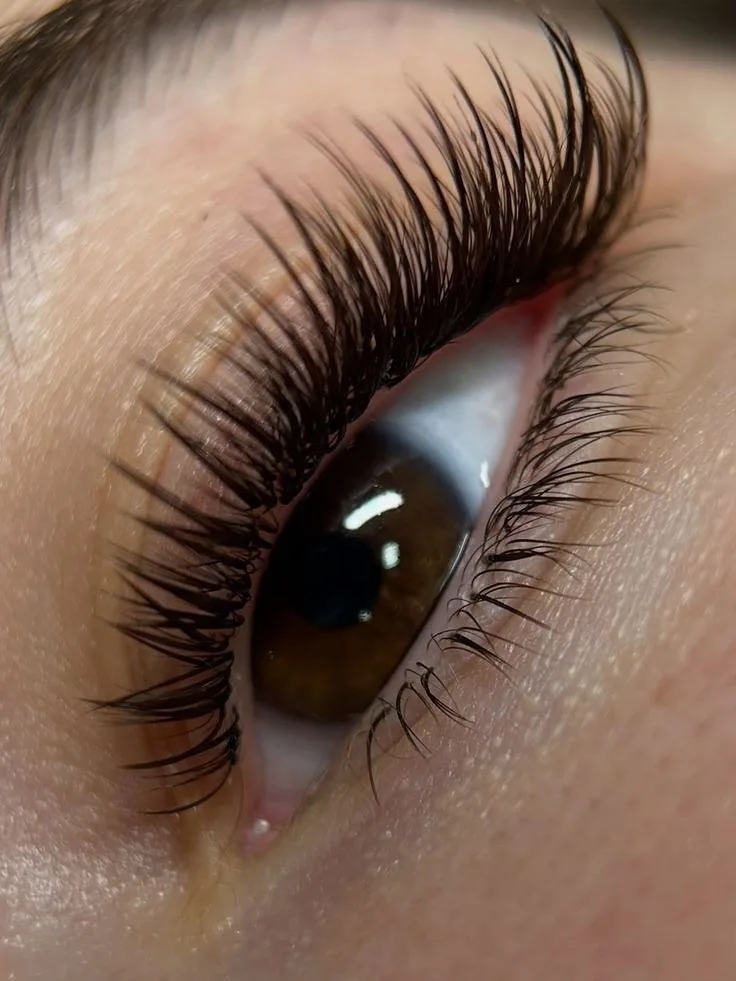
- ShapeUpturned — the lash line rises on its own from inner to outer.
- EffectCat-eye with mixed texture: singles and fans along one climbing line.
- Where everyone strugglesTexture goes along the climb, not on the corner. The corner stays even.
Why Why it is laid out this way
Mixing singles and fans on a cat map is usually a way to add drama, and on this shape that is exactly the risk. The eye supplies its own lift at the outer end, so the interest has to move inboard, along the part of the line the eye itself keeps low. Hybrid earns its place here by filling a thin inner half without adding a millimetre of length to it.
The order the zones go on, and where the fans land
- Fill the inner with fans, not lengthSoft fans in the two innermost zones at their mapped short length. They close a thin line without lengthening the end that should stay short.
- Run singles up the climbSingle strands set the length in each middle zone. They are what makes an even step visible; fans blur one.
- Scatter texture below the top zonesPlace your longer texture strands through the middle of the climb, never past it. A textured corner on this shape reads as damage, not design.
- Keep the last two zones uniformThe outer top is one length and one look. Uniformity out there is what stops a lifted eye from looking angry.
- Blend the joinsNo zone should start where a technique starts. Overlap fans and singles by a lash or two so the change of texture never lines up with a change of length.
The length curve on upturned eyes
The line climbs in equal steps and then flattens for two zones, which gives you one long readable gradient and one calm plateau. Texture belongs on the gradient because the eye tracks change there and a little irregularity reads as softness. On the plateau, irregularity reads as a mistake, because there is no length change left to disguise it.
Where does a cat-eye map go wrong on upturned eyes?
Deep The physics underneath
Two techniques on one lid means two load profiles on one lid. Here is how they divide up this particular climb.
The same map, built four ways
- Classic 1:1
- Singles are the ruler on this map. They mark the top of each step cleanly, which is why the length skeleton of a hybrid cat is usually built from them and the fans are fitted around it.
- Handmade volume
- Fine strands fanned by hand are how you make a short inner corner look full without lengthening it — the one thing this shape genuinely needs. You also keep the width adjustable, which matters when the mapped length changes at every zone.
- Promade / pre-made fans
- Fast and repeatable, and on a hybrid the repetition is the problem: identical fans dropped between varied singles make the texture look printed. Best kept to the inner zones where the length is not changing much anyway.
- Woven / clover
- Wide coverage from one bond, but a shape that repeats itself is visible on a line that is otherwise deliberately irregular. On this map it fights the very thing hybrid was chosen for.
Spread angle versus weight
Spread does not change what a lash carries, only where that weight sits relative to its own axis. On a hybrid cat the temptation is to widen the fans as the mapped length grows, so the outer zones get long and wide together and the twist compounds with the bending load. Hold spread constant up the whole climb and let only the length change.
What an upturned lash line can carry
- The top of this map is two zones wide, and a mixed set means the strongest natural lashes and the weakest ones are both being asked for the same length there — the weak ones set the real limit and they are usually the outermost.
- Longer costs twice over: more material to hold up, held further from the root. On a climbing map that penalty is stacked at the end where the natural lashes are thinnest.
- A fan and a single of the same length are not the same load, but they are close enough that mixing them does not buy you extra reach — hybrid buys evenness of coverage, not a higher ceiling.
Where this map fails first
The join between the textured climb and the uniform top gives way first, because it is where two techniques and the greatest length meet on one stretch of lid. As lashes cycle out there, the texture and the plateau stop being distinguishable and the map turns into a plain long tail. The very corner is the slowest place to recover, since the lashes that shed there are the finest on the line. Check that seam at every fill before you check anything else.
FAQ Common questions
Where do spikes go on an upturned cat map?
Through the middle of the climb, and not past it. The outer corner is already the highest and longest part of the set, so texture added there stops looking like texture and starts looking aggressive.
Is hybrid better than classic for a cat-eye here?
It is better when the inner half is thin, which on this shape it often is. Hybrid lets you close that gap with fans while keeping the mapped inner length short.
How do you stop a hybrid from looking messy?
Change one thing at a time. If the length is stepping up in a zone, keep the texture steady there; if the texture is varying, keep the length flat.
Can I use the same fan width the whole way along?
Yes, and on this map you should. Widening the fans as the length grows loads the outer end twice and it drops sooner than the rest of the set.
Print this page or save it as PDF — the diagrams are drawn to stay readable in black and white on plain paper. Or download the diagrams below as SVG. No account, no fee, nothing to sign. Every file carries this page’s address, so wherever it ends up it can be traced back here.
Teaching from these? The offer, and how to credit it.
Also in: Upturned eyes · Cat-Eye · Hybrid
Read next: what a cat eye lash map actually is · questions clients ask about lash extensions