Upturned Eyes · Cat-Eye · Volume
The cat-eye lash map for upturned eyes, built in Volume — zone order, where the length peaks, and the point this one usually goes wrong.
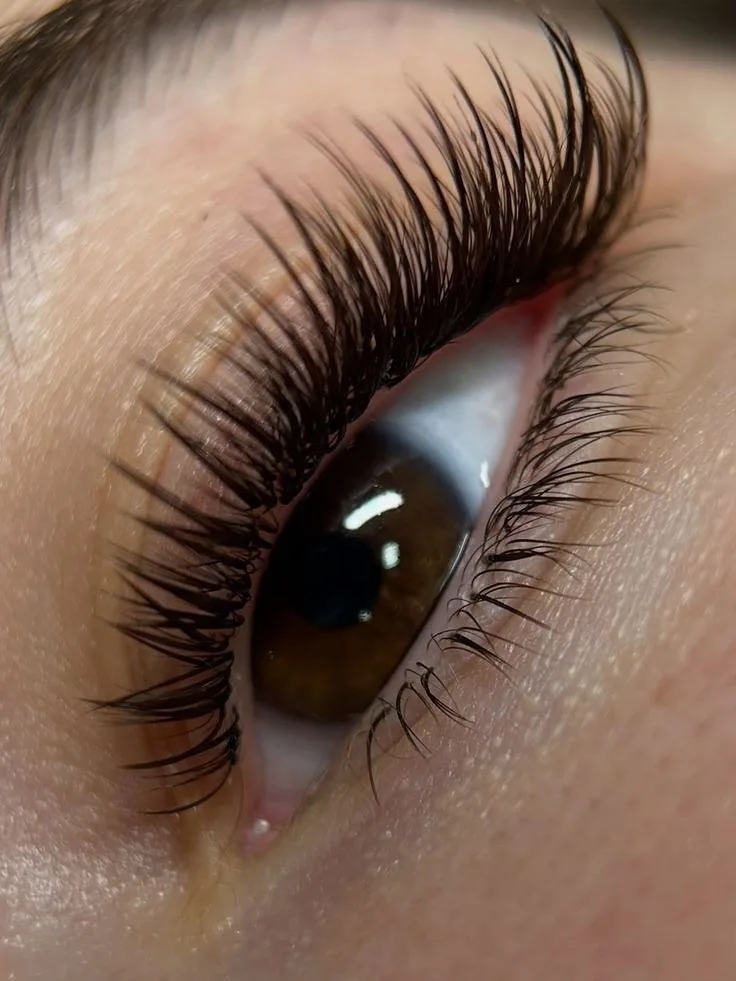
- ShapeUpturned — the outer end of the lash line starts high without help.
- EffectCat-eye in fans: a climbing line finished with a levelled, layered top.
- Where everyone strugglesDarkness reads as length here. Keep the outer fans open and airy.
Why Why it is laid out this way
Volume changes what makes this map go wrong. On a single-strand cat you overshoot with length; in fans you overshoot with density, because a solid dark corner on a raised eye looks longer and harder than it measures. The layering has to get denser toward the middle and lighter at the very end, which is the opposite of most people's instinct.
The order the zones go on, fan by fan
- Layer the inner zones for bodyTwo shallow layers of narrow fans at the mapped short length. The inner corner needs substance, never reach.
- Step length up, hold fan widthLength climbs one even notch per zone while every fan keeps the same spread. Width and length must not grow together.
- Put your densest work mid-lidThe middle of the climb is where extra fullness is safe and where it makes the gradient read. Load there, not at the end.
- Thin out over the top two zonesThe final zones keep the longest length but fewer, airier fans. This is what stops a lifted corner from turning into a solid dark block.
- Check it open and from the frontStep back and look at the client's eyes open. On this shape the corner darkens faster than you can see from above.
The length curve on upturned eyes
The curve is a straight climb ending in a two-zone plateau, and in volume the plateau is the dangerous part. A flat top built from dense fans stops looking like a line of lashes and starts looking like a stroke of liner, which on an eye that already tilts up reads as severity. Keep the plotted length and drop the density out there, and the same curve stays soft.
Where does a cat-eye map go wrong on upturned eyes?
Deep The physics underneath
Fans move mass around; they do not create carrying capacity. On this map the question is what the outer third of the lid is actually being asked to hold.
The same map, built four ways
- Classic 1:1
- One strand per lash keeps the plateau naturally airy, which is the effect volume has to work for here. The trade is that fullness at the top can only be bought with thickness, and thickness at the end of this climb is expensive.
- Handmade volume
- The reason to build it this way: several fine strands give the same coverage as one thick one for less mass, and you can narrow the fan zone by zone as the mapped length rises. That adjustability is the whole point on a curve that changes at every step.
- Promade / pre-made fans
- Consistent and quick across a dense set, with a small extra node of mass right at the root where it costs least. The stiffer base is the catch, and the outer zones of this map are where a stiff base has the least natural lash to grip.
- Woven / clover
- Wide, repeating coverage from one bond — useful low down where the length is short and the line needs closing. Across the levelled top it lays width where this map is already at its widest and the corner goes solid.
Spread angle versus weight
The peak on this map is a two-zone stretch rather than a point, so the spread you choose out there is repeated over the most visible part of the eye. Wide fans there put their outer legs off the lash's axis, and the twisting that follows turns a tidy plateau into a rough one within a couple of weeks. Widen inboard where the lengths are short, narrow toward the end where they are not.
What an upturned lash line can carry
- Fanning splits the mass across several strands but the natural lash underneath still carries the sum, so a wide dense fan at the top of this climb reaches the deflection limit as fast as a thick single would — and when it goes, it goes as a droop across the whole plateau.
- Length is charged twice on this curve: more material plus a longer arm to hold it. That is why density spent mid-lid is nearly free and the same density spent at the top is not.
- Volume's discount is real but it is spent per lash, and the outer third of an upturned lid tends to hold the finest lashes on the line — the weakest of those, not the average, is what the plateau can carry.
Where this map fails first
The plateau fails together rather than one lash at a time, which is what makes it obvious. Every fan out there carries the same maximum length on the thinnest lashes of the lid, so they reach their limit at roughly the same moment and the flat top rolls into a downward curve. The client will describe it as the set having dropped, not thinned. Building that stretch light is the only thing that buys you a longer honeymoon.
FAQ Common questions
Why does a volume cat-eye look harsher on upturned eyes?
Because density reads as extra length here. The corner already sits high, so a dark solid end exaggerates a tilt that was there before you started.
Where should the densest part of the set go?
Through the middle of the climb. That is where fullness makes the gradient visible without adding to the lift, and where the natural lashes are strongest.
Should fans get wider toward the tail?
No — the reverse. Widen where the mapped length is short and narrow as it climbs, so the outer zones are never long and wide at the same time.
How many layers does the inner corner need?
Two shallow ones is usually enough. The inner zones are mapped short, so what they lack is body rather than reach, and a second light layer supplies it.
Print this page or save it as PDF — the diagrams are drawn to stay readable in black and white on plain paper. Or download the diagrams below as SVG. No account, no fee, nothing to sign. Every file carries this page’s address, so wherever it ends up it can be traced back here.
Teaching from these? The offer, and how to credit it.
Also in: Upturned eyes · Cat-Eye · Volume
Read next: what a cat eye lash map actually is · questions clients ask about lash extensions