Upturned Eyes · Doll / Open-Eye · Hybrid
The doll lash map for upturned eyes, built in Hybrid — zone order, where the length peaks, and the point this one usually goes wrong.
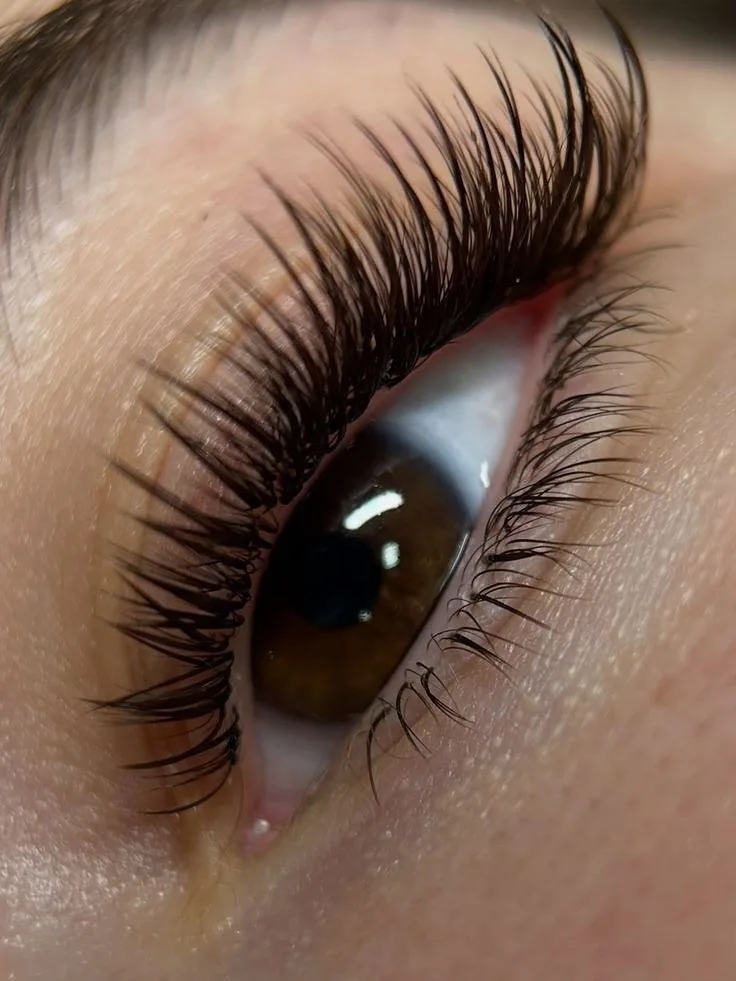
- ShapeUpturned — the lid line keeps rising toward the outer corner.
- EffectDoll in mixed texture: a broad centre peak, both corners short.
- Where everyone strugglesTexture must not smuggle length into the tail. Short means short.
Why Why it is laid out this way
A centre-weighted map is the one layout this eye shape does not want, and hybrid is the most honest way to build it anyway. Irregular tips soften the point where your lengths start falling and the lid keeps climbing — the exact place a doll map betrays itself here. What hybrid must not do is quietly return the length it was supposed to take away.
The order the zones go on, and where the fans land
- Set the skeleton in singlesMap every zone with single strands first, corners short and the two centre zones long. That is the shape you are committed to.
- Fill the inner half with soft fansThe inner zones are short and this eye keeps them low. Fans give them presence at the mapped length instead of borrowed length.
- Break the descent with texturePast the peak, alternate slightly finer and slightly fuller work at each mapped length. The variation hides the disagreement between falling lashes and a rising lid.
- Keep every texture strand inside the mapNo spike, no fan and no single may exceed its zone's plotted length. On this map, one long tail strand undoes the whole effect.
- Look from the front before the last zoneCheck the outer third with her eyes open while you can still adjust. The kink shows from the front long before it shows from above.
The length curve on upturned eyes
The plotted curve climbs to a wide middle plateau and comes back down to short corners on both sides. Its weak point on this shape is the descending half, where the numbers fall while the lid rises, and a perfectly even taper draws attention to that. Mixed texture keeps the same lengths but breaks up the edge so the eye reads softness rather than a sudden change of mind.
Where does a doll map go wrong on upturned eyes?
Deep The physics underneath
Two techniques, one curve, and a descending half doing the difficult work. Here is how each way of building a lash lands on this particular map.
The same map, built four ways
- Classic 1:1
- Singles set the plotted lengths and hold the taper honest, which on this map is the whole argument. They are also the safest thing to put on short corner lashes that must stay short.
- Handmade volume
- Fans give the centre plateau fullness without pushing its length any higher, and on a map that cannot buy openness with reach that is a real gain. Their spread can be closed off zone by zone as the taper drops.
- Promade / pre-made fans
- Uniform work suits a broad flat peak and undermines a taper, so this map wants them in the middle and nowhere else. Their consistency is exactly what the descending half is trying not to have.
- Woven / clover
- One bond, wide sideways coverage, useful for closing a short inner line quickly. Anywhere past the peak it flattens the texture you deliberately built in.
Spread angle versus weight
The plateau sits over the two middle zones on the sturdiest lashes of the lid, so a fuller spread is affordable there in a way it is not on this shape's outward-weighted maps. Coming down the outer side, close the spread as the length shortens — a wide fan on a short corner lash adds twist without adding anything you can see. Matching spread to length is what keeps the descent looking deliberate.
What an upturned lash line can carry
- The centre plateau lands on the thickest, most upright lashes on the eye, so the load ceiling here is generous; what limits the map is texture discipline, not weight.
- Length costs both material and reach, and the only place this map spends much of either is the middle — which is precisely why the outer corner failing has nothing to do with overload.
- In a mixed set the lightest natural lash in a zone still fixes what that zone will hold, and hybrid makes it easy to forget by putting a fan on a lash you would never have given a long single to.
Where this map fails first
The descending half is the first thing to lose, because its whole effect is texture and texture is the first casualty of a natural shedding cycle. Once the irregular tips thin out, what remains is a plain even taper falling against a rising lid, which is the look the hybrid was chosen to avoid. The corner then shows patches because it is mapped short and there is nothing nearby to cover a gap. Refresh the outer third more often than the centre and the map holds its character.
FAQ Common questions
Does hybrid make a doll map work on upturned eyes?
It makes it more forgiving, not correct. The centre peak still pulls against the natural lift; mixed texture just keeps the descending half from looking like an abrupt decision.
Can I add spikes at the outer corner for interest?
No. Corner spikes are the standard way this map turns into a cat-eye by accident, and on this shape a lengthened corner is the one thing you were avoiding.
Where should the fans go on a hybrid doll?
Through the inner half and across the centre plateau. Both places need fullness rather than length, which is what a fan is for.
How do I keep the texture from looking random?
Vary the fullness and keep the length obedient. Every strand stays inside its zone's plotted length, so the irregularity is only ever in the weight and never in the outline.
Print this page or save it as PDF — the diagrams are drawn to stay readable in black and white on plain paper. Or download the diagrams below as SVG. No account, no fee, nothing to sign. Every file carries this page’s address, so wherever it ends up it can be traced back here.
Teaching from these? The offer, and how to credit it.
Also in: Upturned eyes · Doll / Open-Eye · Hybrid
Read next: open eye versus doll — one family, two intents · questions clients ask about lash extensions