Upturned Eyes · Natural · Hybrid
The natural lash map for upturned eyes, built in Hybrid — zone order, where the length peaks, and the point this one usually goes wrong.
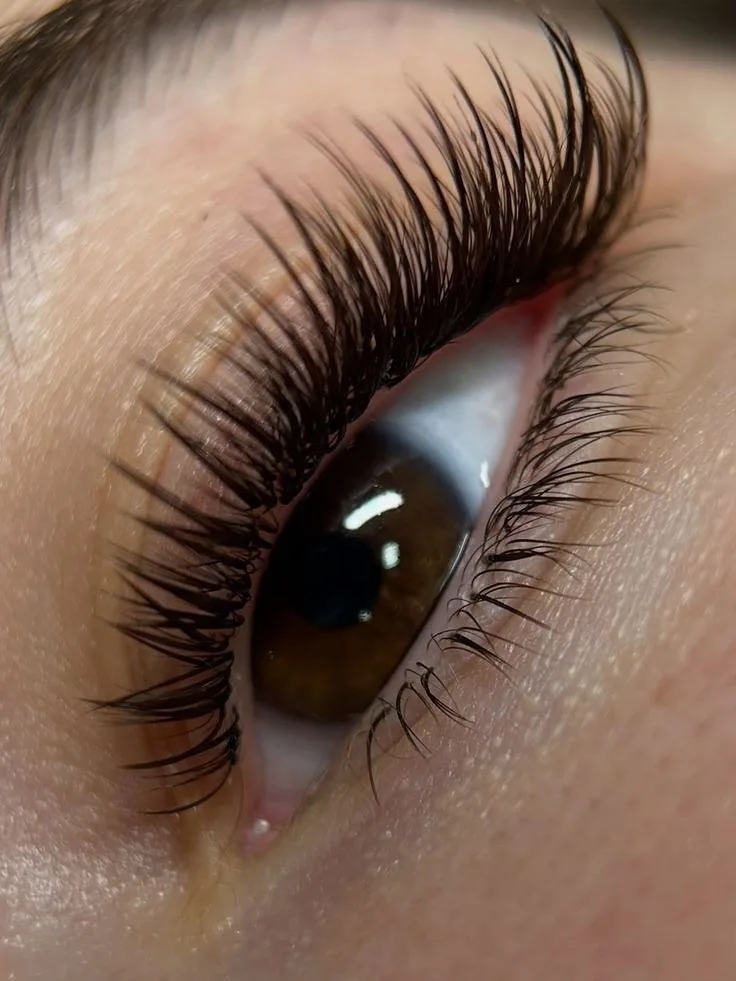
- ShapeUpturned — the outer end of the line sits higher without help.
- EffectNatural with quiet texture: broad middle peak, level outer run.
- Where everyone strugglesTexture varies the weight, never the length. The outline stays plotted.
Why Why it is laid out this way
Mixing techniques on a natural set sounds like a contradiction until you look at the outer half of this map, where one length runs for three zones. A perfectly even run of identical strands is the least natural thing on a lash line, and a little irregularity is what rescues it. Everything here is about adding that without adding anything the client can name.
The order the zones go on, and where the fans land
- Anchor the map in singlesSet the plotted length in every zone with single strands before you place a fan. That outline is not open to negotiation.
- Give the inner corner fans, not lengthThe two innermost zones are short and this eye keeps them low. Soft fans at the mapped length give them presence without lifting them.
- Alternate weight along the level runAcross the outer zones swap between finer singles and light fans at the same length. That is what stops three zones of one length looking printed.
- Keep the step down cleanThe single notch off the peak is the map's only landmark. Do not blur it with a fan that reaches back up to peak length.
- Stagger the joinsNever let a change of technique fall on a change of length. Overlap them by a lash or two so no one line does both jobs.
The length curve on upturned eyes
The plotted curve climbs fast, holds across the middle, steps down once and runs level to the corner — and that level run is over a third of the visible lash line. In a set that is meant to look like nobody did anything, uniformity over that distance is what gives it away. Varying only the weight keeps the plotted shape exact while breaking the regularity the eye notices.
Where does a natural map go wrong on upturned eyes?
Deep The physics underneath
A hybrid is two load profiles sharing one lash line. On a map with a long level outer run, that matters more than it sounds.
The same map, built four ways
- Classic 1:1
- Singles are what make the one step down measurable, so they carry the outline on this map while the fans do the texturing. They are also the lightest thing you can put on the fine lashes at the outer end.
- Handmade volume
- Fans are how you fill the short inner corner this shape keeps low, without touching its plotted length. Made by hand, their spread can also be trimmed back along the level run where narrow matters.
- Promade / pre-made fans
- Every fan the same, which is precisely the quality the level run is trying to lose. Serviceable inboard, self-defeating on the outer third of this particular map.
- Woven / clover
- One bond, wide coverage, a repeating outline. On a natural map with three zones at one length, a repeating outline reads as a manufactured edge.
Spread angle versus weight
Spread does not change what the lash carries, only how far the weight sits from its own line — and this map runs near-peak length across the outer third where the lashes are finest. Wide fans out there twist as they settle and the level run turns ragged, which on a natural set is the failure everyone can see and nobody can name. Give the width to the inner zones, where the lengths are short and the lashes are not being asked for much.
What an upturned lash line can carry
- The load ceiling on this map is met across a stretch, not at a point: three outer zones share nearly the peak length, so the whole level run approaches its limit at the same time.
- Length buys mass and reach in one transaction, which is why the single step off the peak is doing more mechanical work than its size suggests — it takes the outer third out of the expensive band.
- Mixing techniques does not raise what any individual lash can hold, and the finest lash in a zone still sets the limit; a fan on a weak outer lash fails exactly as a long single would.
Where this map fails first
Two things fade, in this order. The texture on the outer third thins out first, since irregular light work is the first thing a shed cycle removes, and the level run reverts to the flat even line the hybrid was chosen to avoid. Then the single step down blurs as lashes turn over on either side of it, and the map loses its only landmark. Both are fill-interval problems rather than mapping problems, so say so at the consultation.
FAQ Common questions
Why bother with hybrid on a natural set?
Because this map runs one length across the outer third, and identical strands over that distance look manufactured. Mixing the weight breaks the regularity without changing the outline.
How much texture is too much?
The moment it shows up in the silhouette. If you can see the irregularity in the outline of the set from the front, it stopped being texture and became a style.
Should the fans be longer than the singles beside them?
No. On this map every strand in a zone shares that zone's plotted length, and the variation lives only in how full each one is.
Where does hybrid help most on this shape?
At the inner corner. It is mapped short and the eye's own line keeps it low, so fans give it presence without the length that would flatten the climb.
Print this page or save it as PDF — the diagrams are drawn to stay readable in black and white on plain paper. Or download the diagrams below as SVG. No account, no fee, nothing to sign. Every file carries this page’s address, so wherever it ends up it can be traced back here.
Teaching from these? The offer, and how to credit it.
Also in: Upturned eyes · Natural · Hybrid
Read next: questions clients ask about lash extensions