Upturned Eyes · Natural · Volume
The natural lash map for upturned eyes, built in Volume — zone order, where the length peaks, and the point this one usually goes wrong.
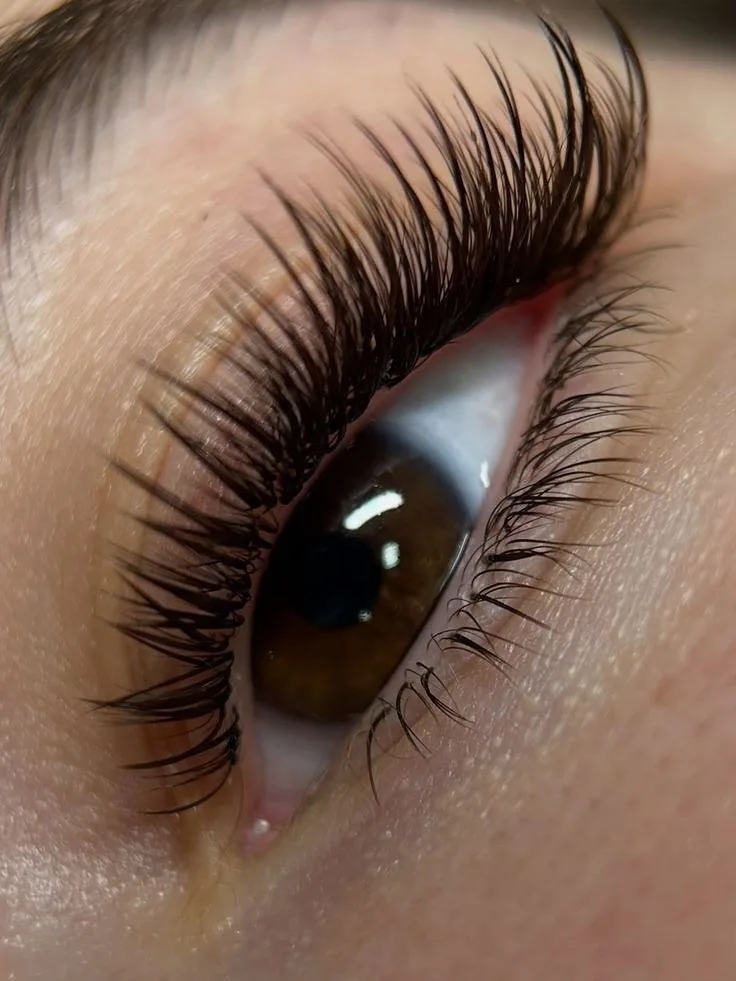
- ShapeUpturned — the lash line climbs toward the outer corner by itself.
- EffectNatural in fans: middle peak, one step down, then a level outer run.
- Where everyone strugglesFullness fades outward. A dense level run stops looking natural fast.
Why Why it is laid out this way
Volume on a natural map is a density decision, not a length one, and this shape gives that decision a clear answer. The inner corner is short and low and wants filling; the outer third holds near-peak length on the finest lashes and wants leaving alone. Build it the wrong way round and the same plotted curve reads as a full set with a heavy end.
The order the zones go on, fan by fan
- Fill the inner corner properlyNarrow fans on every innermost lash, at the mapped short length. Density is the only thing this zone is allowed to gain.
- Climb with length, not with widthThrough the inner half let the plotted length do the rising while the fans stay the same width. Two variables moving together is how a natural set stops being one.
- Layer only the middle peakA second light layer across the two centre zones and nowhere else. That is where the natural set gets its depth.
- Take the density down with the stepWhen the length steps off the peak, thin the work at the same point. One landmark, marked twice.
- Run the tail single-layer and narrowThe level outer run stays one layer of close fans. It is the longest thing sitting on the thinnest lashes you have.
The length curve on upturned eyes
The plotted line rises fast, holds across the middle, drops a single notch and then runs level to the corner rather than tapering away. In fans you are drawing that curve twice — once in length and once in fullness — and the two drawings have to agree. Where they disagree, the fullness wins, and the map you plotted is not the map anyone sees.
Where does a natural map go wrong on upturned eyes?
Deep The physics underneath
Fans redistribute mass, they do not add capacity. On a map that keeps its length going all the way to the corner, that distinction decides the fill interval.
The same map, built four ways
- Classic 1:1
- Single strands keep the level run as light as it can be, which is the one part of this map that genuinely needs the help. What they cannot do is fill a short inner corner without lengthening it.
- Handmade volume
- Several fine strands give the coverage of one thick one for less mass, and that saving is what makes the inner corner solvable here. Adjustable width also lets you narrow the fans as you move outward, in step with the falling density.
- Promade / pre-made fans
- Speed and evenness across a dense middle, with the extra bond mass sitting at the root where the lever is shortest. Their sameness shows on the level run, where there is no length change to hide behind.
- Woven / clover
- Wide coverage from one bond suits the short inner zones that need closing. Across the outer third it lays width onto the lashes that are already carrying the most length.
Spread angle versus weight
This map's demanding stretch is the outer third, where the plotted length stays one step off the peak across progressively finer lashes. Spread there should be the narrowest on the eye, because a wide fan puts its legs off the lash's line and the twist that follows shows up as a level run gone crooked. Save the generous spreads for the inner zones, where the lengths are short and the geometry forgives them.
What an upturned lash line can carry
- The ceiling is reached along a run rather than at a peak, so this map does not fail one lash at a time — the whole outer third approaches its limit together and drops as a stretch.
- Adding length is the only move that costs twice, mass and reach at once, which is why the map buys its outer presence with fullness and gives back a single notch of length in exchange.
- Fanning splits the strand, not the follicle: the finest lash in the outer zones still decides what those zones hold, and volume makes it easy to hand one of them more than it ever had.
Where this map fails first
The level run gives way as a piece. Every fan out there sits at nearly the peak length on the thinnest lashes of the lid, so they reach their limit at similar times and the outer third settles as one. What the client sees is not thinning but flattening — the step down disappears and the set looks like a plain even line. Building that run single-layer and narrow is the only thing that meaningfully delays it.
FAQ Common questions
Where does the extra fullness go on a natural volume set here?
Into the inner half and the middle peak. The outer third keeps its plotted length but stays single-layer, because that is where the lashes are finest and the length is highest.
Can I use volume to fill a thin inner corner?
That is its best use on this shape. The inner zones must stay short, and fans are the only way to give them presence without adding length.
Should the tail be shortened to keep the set light?
No. Thin it instead. Cutting the length back shortens the highest part of an already-lifted eye and it reads as cropped.
Why does my volume natural set look heavier than the map?
Because fullness is a second curve, and if it does not follow the plotted one the fullness is what people see. Fade the density in the same places the length falls.
Print this page or save it as PDF — the diagrams are drawn to stay readable in black and white on plain paper. Or download the diagrams below as SVG. No account, no fee, nothing to sign. Every file carries this page’s address, so wherever it ends up it can be traced back here.
Teaching from these? The offer, and how to credit it.
Also in: Upturned eyes · Natural · Volume
Read next: questions clients ask about lash extensions