Upturned Eyes · Squirrel / Fox · Hybrid
The squirrel lash map for upturned eyes, built in Hybrid — zone order, where the length peaks, and the point this one usually goes wrong.
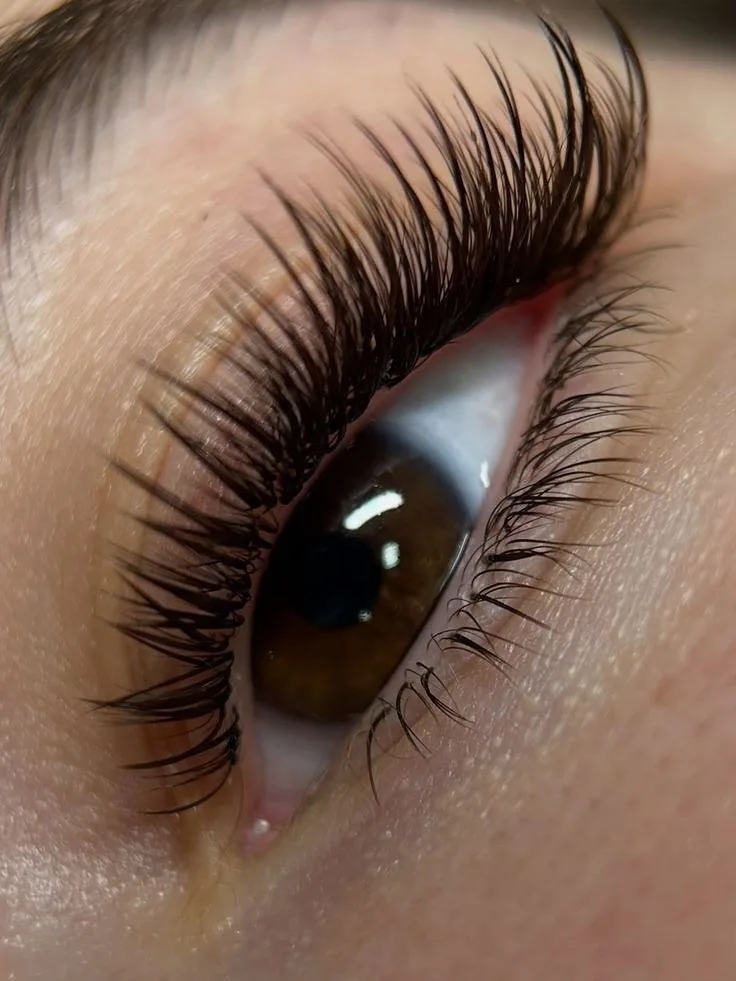
- ShapeUpturned — the corner rides high, so the map supports it rather than lifting it.
- EffectSquirrel with texture: an arch past the middle, stepping down to a long corner.
- Where everyone strugglesTexture below the arch, never on it. A blurred peak is no peak.
Why Why it is laid out this way
Every squirrel map lives or dies on the descent after its peak, and hybrid is the technique most likely to kill it. Irregular tips are lovely on a long even stretch and disastrous on two small steps that are already hard to see. The layout below puts the mixing where the length is flat and leaves it out of the places where the length is doing the talking.
The order the zones go on, and where the fans land
- Texture the low inner thirdMix soft fans and fine singles across the three inner zones. Their lengths barely change, so texture is free there and it fills a thin end.
- Build the jump in singlesThe one big step into the arch is drawn with single strands only. It is the map's largest length change and it must be clean.
- Keep the arch uniformOne length, one look across the peak zone. Any variation up there reads as an untidy peak, not as texture.
- Mark both steps down plainlyTwo clear drops to the corner, each set in singles first. Add fans afterwards, never above the plotted length.
- Finish the corner full but longThe last zone is textured and still noticeably longer than the inner third. This eye holds the corner high and it needs body out there.
The length curve on upturned eyes
The curve idles low across the inner third, jumps once, peaks just outer of centre and then comes down in two even steps to a corner that stays long. The flat parts of that description are where texture belongs and the changing parts are where it does damage. Read the diagram as a map of where you are allowed to be irregular.
Where does a squirrel map go wrong on upturned eyes?
Deep The physics underneath
Mixed techniques mean mixed loads, and this map concentrates its load into one arch zone. Here is how each build behaves around it.
The same map, built four ways
- Classic 1:1
- Singles draw the jump and the two steps, which is most of what this map is. They also keep the arch light, and the arch is the one zone with no neighbour at the same length to share the strain.
- Handmade volume
- Fans give the low inner third the body it needs while its plotted lengths stay short, which is the concession this shape asks for. Their width can be closed off as you move up to the peak so the arch stays narrow.
- Promade / pre-made fans
- Repeatable and fast, and their sameness is only safe where the map is flat. Across the descent they average the two steps into a slope.
- Woven / clover
- Broad coverage from one bond suits the inner zones on a sparse client. Anywhere from the jump outward it lays width across a map that is describing an arch.
Spread angle versus weight
The peak sits in one zone, so all of this map's length and all of its spread land on a single narrow strip of lid. Widening the fans there puts mass either side of the lash's own line and the rotation that follows drags the top of the arch sideways, which looks like a peak in the wrong place rather than a peak gone flat. Widest spread belongs in the low inner third, narrowest at the arch and down the steps.
What an upturned lash line can carry
- One zone carries the top length here, so the deflection ceiling has no company — when the arch settles, nothing beside it is holding the shape and the peak simply goes.
- The jump into the arch adds mass and reach in a single move, which makes the zone just below the peak the second most loaded on the map even though it looks like an ordinary step.
- The corner is mapped long on fine lashes, so its weakest strands set the limit for the supported end; on a mixed set it is easy to hand one of them a fan it could never have carried as a single.
Where this map fails first
This map degrades in the outline rather than in density. As texture sheds around the arch, the peak reads wider and lower than it was mapped, and the two drops behind it lose definition at the same time. Within a cycle the outer half has become a single gentle slope, which is the cat-eye the descent existed to prevent. Refill the peak zone and the two below it first; the inner third can wait.
FAQ Common questions
Can you build a squirrel map in hybrid?
Yes, if you keep the texture off the arch and out of the two steps down. Those are the only parts of the map that carry information, and blurring them removes the effect.
Where is the safest place for spikes here?
The low inner third. The plotted lengths barely change there, so irregular tips read as softness rather than as a wobble in the shape.
How long should the corner be on this shape?
Clearly longer than the inner corner and clearly shorter than the peak. This eye holds the outer end high, so it needs supporting length to look finished rather than clipped.
My hybrid squirrel keeps looking like a cat-eye. Why?
The descent is filled in. Check that no textured strand in the two zones after the peak is reaching back up toward the peak's length.
Print this page or save it as PDF — the diagrams are drawn to stay readable in black and white on plain paper. Or download the diagrams below as SVG. No account, no fee, nothing to sign. Every file carries this page’s address, so wherever it ends up it can be traced back here.
Teaching from these? The offer, and how to credit it.
Also in: Upturned eyes · Squirrel / Fox · Hybrid
Read next: fox eye and squirrel lash mapping, and how they differ · questions clients ask about lash extensions