Wide-Set Eyes · Cat-Eye · Hybrid
The cat-eye lash map for wide-set eyes, built in Hybrid — zone order, where the length peaks, and the point this one usually goes wrong.
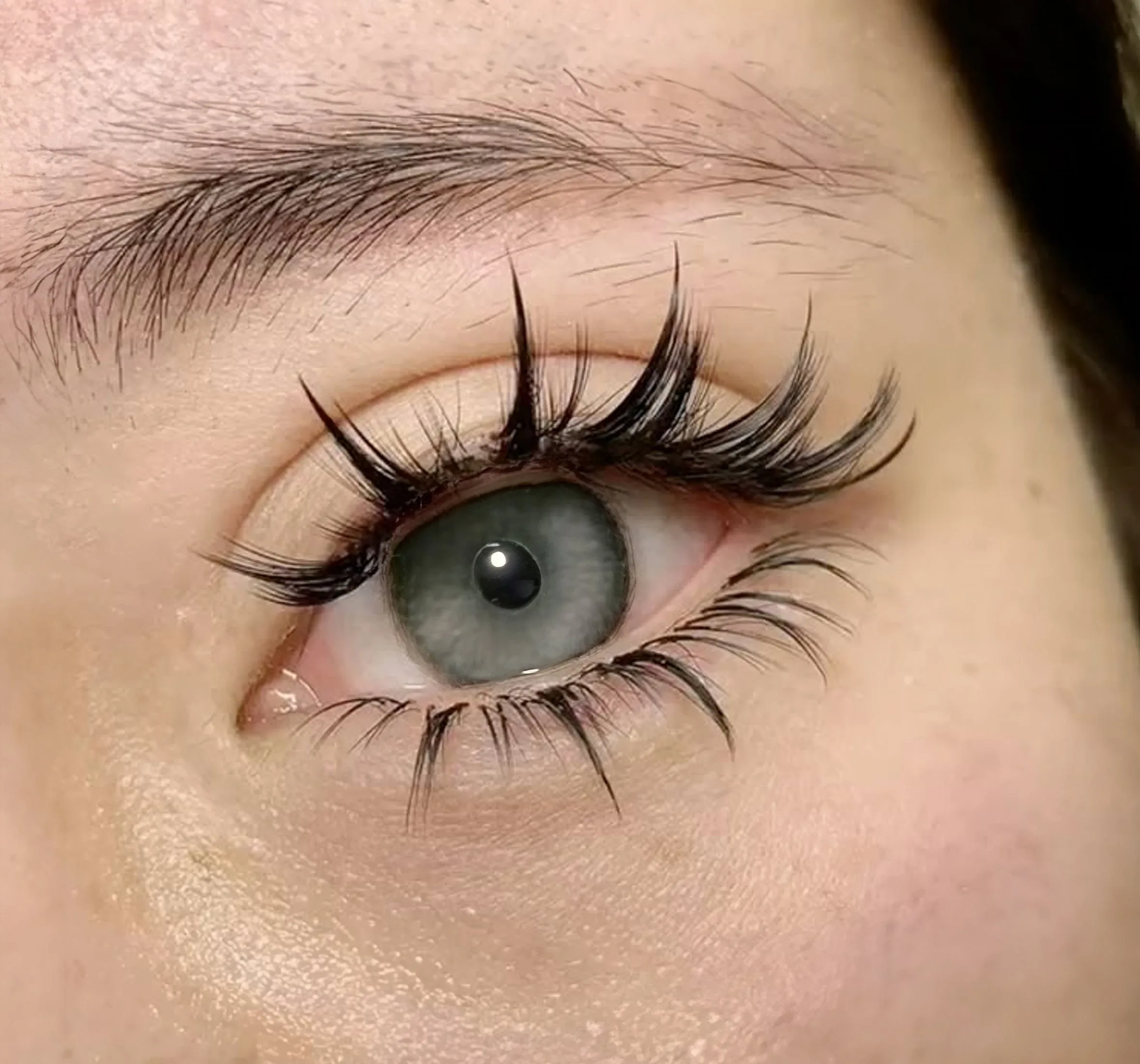
- ShapeWide-set — the bridge reads wide, so weight belongs inboard.
- EffectCat-eye, moderated and textured: mixed line, capped tail.
- Where everyone strugglesTexture goes inboard of the peak. Spikes at the corner widen her.
Why Why it is laid out this way
A hybrid gives you a second lever the classic version does not have — texture — and on this spacing that lever is worth more than length. The map is still the moderated cat: peak over the outer iris, tail capped, nothing travelling past it. What changes is that the interest comes from the mix rather than from reach.
The order the zones go on, and where the fans land
- Lay the classic spineSingle strands carry the length steps from the inner corner up to the top pair. Get the shape right in singles before any fan touches the lid.
- Fan the middle thirdDrop soft fans between the singles from the inner-centre up to the peak. Darkness there does the work a longer tail would have done.
- Hold the double peakTwo zones at full length over the outer iris, then stop. This is the outer limit for singles and fans alike.
- Thin past the peakPast the top pair go back to singles only and step down. Fans in the last zones add visual weight exactly where it hurts.
- Scatter spikes inboardA few closed fans standing just above the base, every one of them inboard of the peak. Never at the tail.
The length curve on wide-set eyes
The curve climbs from a short inner start to a two-zone top and then drops by nearly half. In hybrid, read that drop as a texture instruction as well as a length one — the mixed, darker, busier part of the line lives on the rising side, and the falling side stays plain. Anything that draws attention after the top pair is pulling the face wider.
Where does a cat-eye map go wrong on wide-set eyes?
Deep The physics underneath
Hybrid puts two load types on one lid. Worth knowing which one is sitting where before deciding the peak pair is safe.
The same map, built four ways
- Classic 1:1
- The singles here are structural — they draw the rise and they hold the cap. Because they run the shape, one misplaced long strand past the peak undoes the correction faster than a whole row of fans would.
- Handmade volume
- The fans buy darkness inboard for a fraction of the mass a longer lash would cost, which is the trade this whole map is built on. Tune spread zone by zone: wider through the rise, narrower as you reach the top pair.
- Promade / pre-made fans
- Consistent bases speed up a mixed set, but they arrive with their spread already decided. On a map that wants the spread to shrink as you move outward, that fixed geometry fights you at exactly the wrong end.
- Woven / clover
- Good coverage per bond, and a repeat the eye picks up as a stripe. Keep it in the middle third where a stripe pulls inward; a stripe running to the corner does the opposite.
Spread angle versus weight
The top pair is the heaviest place on this map and the least able to argue. Spread does not change how much material is there, only where it sits relative to the lash's own line — open the fans over the outer iris and the strands twist, and a twisted top lets the shape slide outward. Save the wide spreads for the middle third.
What a wide-set lash line can carry
- Two zones share the longest length, so the ceiling is not one lash but a neighbouring pair. When either sags, the flat top tilts and the cat starts pointing down instead of out.
- A fan and a single of the same length are not the same load: the fan's mass is lower but sits off the lash's line, and past the peak that off-axis load is what starts the outward rotation.
- The mix hides its weakest members. Fine natural lashes given fans look fine on day one and rotate flat first — audit the peak zones lash by lash, not by eye.
Where this map fails first
The peak pair goes first because it holds the longest strands and, in hybrid, often the fans as well. When one of its two zones drops, the flat top tilts and the eye reads a slope where a shoulder used to be. The tail is the second failure and the sneakier one: as the capped zones thin, the survivors are the longest strands out there, and the cap you built quietly stops existing. Rebook before that happens rather than after.
FAQ Common questions
Is hybrid a better way to do a cat-eye on wide-set eyes?
Better than classic, because texture can carry interest that length would otherwise have to carry outward. It does not make a full cat-eye safe here; it makes the moderated one look less flat.
Where do the accent lashes sit on this map?
Inboard of the peak, scattered, never in the last two zones. Spikes are the brightest points on a set and wide-set eyes cannot afford bright points at the far edge.
Should the fans get wider toward the outer corner?
The other way round. Widest through the rising middle, narrowing as you reach the peak pair, and back to plain singles past it.
How do I explain the capped tail to a client who wanted drama?
Show her the peak sitting over her outer iris and tell her the drama is being spent there instead of at the corner. On her spacing, corner length reads as distance, not as drama.
Print this page or save it as PDF — the diagrams are drawn to stay readable in black and white on plain paper. Or download the diagrams below as SVG. No account, no fee, nothing to sign. Every file carries this page’s address, so wherever it ends up it can be traced back here.
Teaching from these? The offer, and how to credit it.
Also in: Wide-Set eyes · Cat-Eye · Hybrid
Read next: what a cat eye lash map actually is · questions clients ask about lash extensions