Wide-Set Eyes · Cat-Eye · Volume
The cat-eye lash map for wide-set eyes, built in Volume — zone order, where the length peaks, and the point this one usually goes wrong.
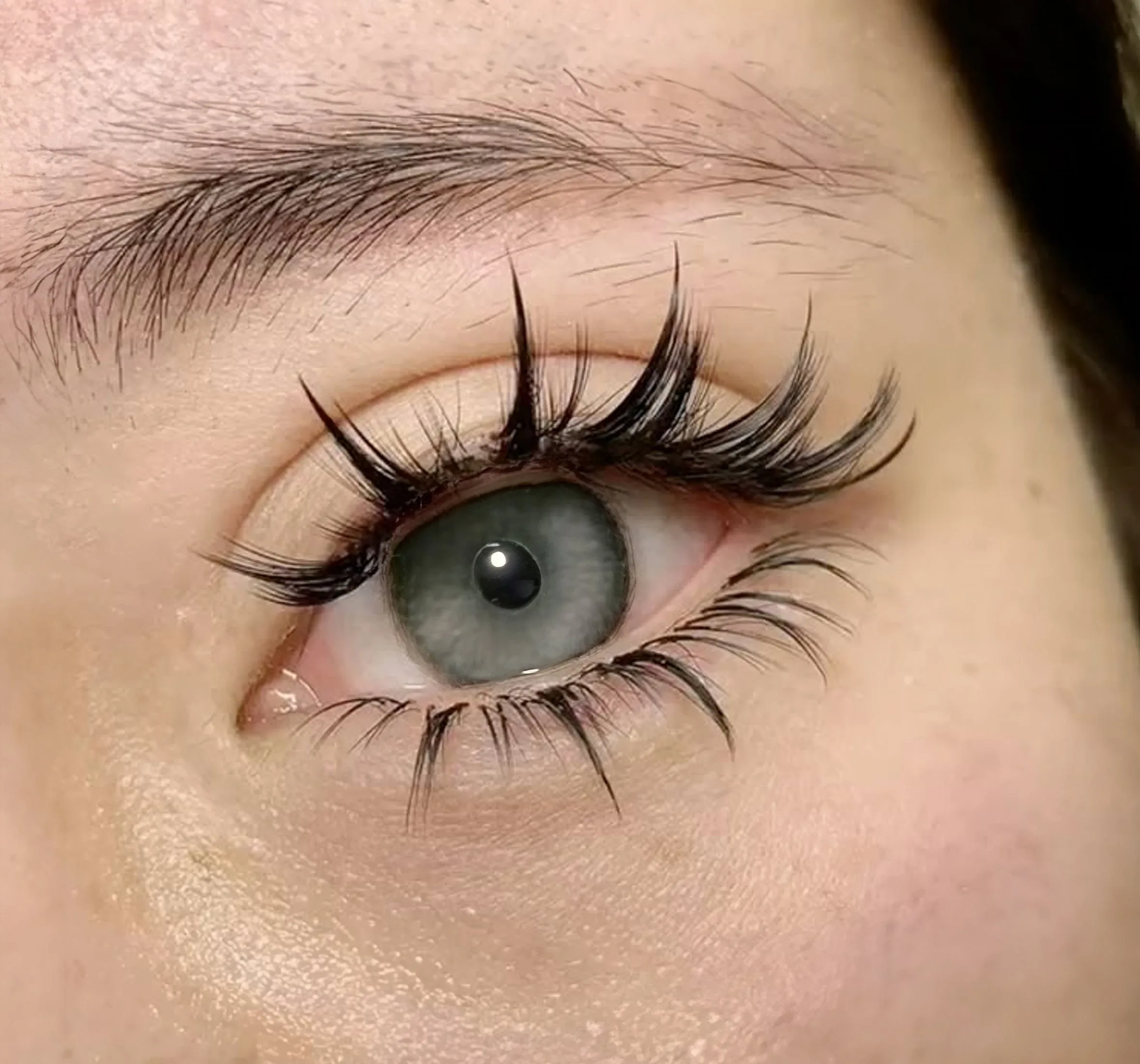
- ShapeWide-set — the gap between the eyes exceeds one eye width.
- EffectCat-eye in volume: density builds the flare, not distance.
- Where everyone strugglesFullness rises to the peak, then stops dead. No dark tail.
Why Why it is laid out this way
Volume lets you make a flare out of darkness instead of reach, which is the most useful thing it offers on this spacing. The outline is unchanged — short inner start, two-zone top over the outer iris, capped tail — and the extra density gets spent on the rise. Nothing about the outline becomes more generous just because fans are lighter than single strands.
The order the zones go on, fan by fan
- Set the base layerLay a full base of light fans across the lid at the mapped lengths. Density first, shape second.
- Build the rise darkerIncrease fullness step by step from the inner-centre toward the top pair. The gradient of darkness should match the gradient of length.
- Double the peak zonesBoth top zones carry the fullest and longest fans. That pair is the entire cat statement.
- Drop density with lengthPast the top, thin the fans as you shorten. A dark tail on a short tail still reads as width.
- Keep the inner lightThe inner zones stay short and airy. Loading them tempts you to balance with a longer tail, which is how this map fails.
The length curve on wide-set eyes
The length line tops out and then halves, and in volume the darkness line has to follow it. Hold density flat across the lid and the eye stops seeing the length curve at all, reading a solid band instead — on wide spacing a solid band is the worst possible outcome, because it has no direction to pull inward. Length and density move together here or neither reads.
Where does a cat-eye map go wrong on wide-set eyes?
Deep The physics underneath
Volume's whole argument is coverage bought cheaply. This map spends that discount inboard, and the reason is mechanical as much as visual.
The same map, built four ways
- Classic 1:1
- Singles would force you to buy the flare with length alone, and length is the one currency this spacing taxes. Still useful as a spine beneath the fans when you want a crisper edge on the top pair.
- Handmade volume
- The reason this cell beats its classic sibling: several fine strands give the peak its darkness for a fraction of the mass one long strand would need. Spend the saving on fullness over the iris, never on reach past it.
- Promade / pre-made fans
- Fast across a dense set and consistent zone to zone, with a small node of mass at the root where the lever is shortest. The cost is that the peak's spread is decided in a factory rather than on the lid.
- Woven / clover
- Wide coverage per bond, but an identical shape repeating. Across the rise it reads as richness; across the capped tail it becomes a pattern marching outward, which is precisely what wide-set eyes should not display.
Spread angle versus weight
Two zones share the top, so whatever spread you choose there is doubled in the reader's eye. A wide fan covers more per unit of mass but hangs its outer legs off the lash's own line, and that twist accumulates across a pair of zones until the flat top rolls. Widest through the rise, narrower on the two peak zones.
What a wide-set lash line can carry
- Fanning does not raise what the natural lash can hold — it only lets you reach a given darkness for less mass. The peak's ceiling is still two individual lashes, and they do not care that their load arrived as several strands.
- On this map the deflection limit shows as the flat top bending down toward the tail, and it shows before anything sheds. If the top slopes at the two-week check, the fans were too full rather than too long.
- Every zone is only as strong as its finest lashes. On the outer peak zone those are usually the finest anywhere on the lid, which is why the cap is a mechanical rule as well as a styling one.
Where this map fails first
The outer of the two peak zones. It carries the same length and the same fullness as its neighbour but sits on shorter, finer natural lashes, so it reaches its limit first. When it rolls, the top loses its outer shoulder and the whole line reads as a slope running toward the temple — the exact direction this map was built to avoid.
FAQ Common questions
Does volume make a cat-eye safe on wide-set eyes?
It makes it workable, not safe. Density can carry a flare that length is not allowed to carry, but the outline stays moderated and the tail stays capped either way.
How full should the fans be at the peak?
Fuller than anywhere else on the lid, and no fuller than the two peak lashes can hold without bending. If the flat top slopes at the first check, back off next time.
Should the inner corner get fans at all?
Yes, light ones. Bare inner lashes open a gap beside the nose, and on this spacing that costs more than a slightly under-dramatic tail.
Why does the darkness have to drop after the peak?
Because a short but dark tail still reads as visual weight at the far edge. The eye measures width by where the attention stops, not by where the length stops.
Print this page or save it as PDF — the diagrams are drawn to stay readable in black and white on plain paper. Or download the diagrams below as SVG. No account, no fee, nothing to sign. Every file carries this page’s address, so wherever it ends up it can be traced back here.
Teaching from these? The offer, and how to credit it.
Also in: Wide-Set eyes · Cat-Eye · Volume
Read next: what a cat eye lash map actually is · questions clients ask about lash extensions