Wide-Set Eyes · Doll / Open-Eye · Classic 1:1
The doll lash map for wide-set eyes, built in Classic 1:1 — zone order, where the length peaks, and the point this one usually goes wrong.
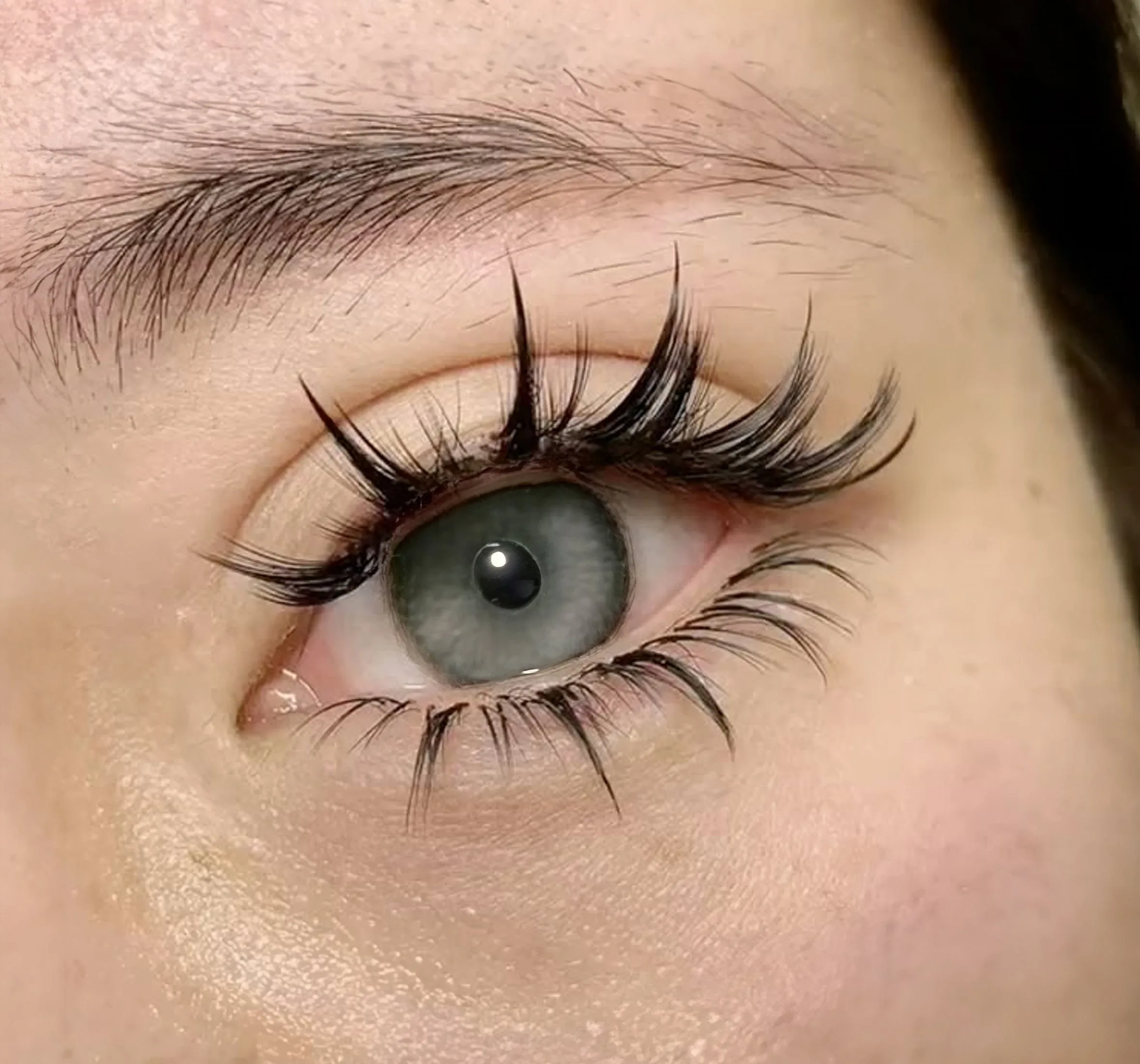
- ShapeWide-set — eyes far apart; the middle of the face reads empty.
- EffectDoll: one round peak straight over the pupil.
- Where everyone strugglesDo not let the peak drift outward. Over the pupil or nowhere.
Why Why it is laid out this way
Doll is the map wide-set spacing actually wants. Its high point sits over the pupil and everything falls away from it, so attention gathers toward the middle of the face instead of running to the temples. In classic 1:1 the shape lives entirely in the length steps, which makes this the strictest way to learn where that peak belongs.
The order the zones go in
- Start the inner fullerThe innermost zone runs noticeably longer than you would set it on balanced eyes. That extra length is what stops a pale patch opening beside the nose.
- Rise to the pupilClimb in clear steps through the first three zones so the longest length lands directly over the pupil.
- Round the peakNeighbouring zones sit close to the peak length so the top reads curved. A sharp single-zone spike looks like a mistake on a doll map.
- Fall away quickly outwardPast the peak, drop faster than you climbed. The outer corner finishes shortest on the whole map.
- Hold one curlA single curl family throughout. Adding curl at the corner to make up for the short tail reintroduces outward pull.
The length curve on wide-set eyes
The curve is deliberately lopsided: a fuller start, a fast climb, a rounded top over the pupil, then a steep fall to the shortest zone at the outer corner. Read that asymmetry as the correction itself — length is being moved off the side of the face that reads too wide and onto the side that reads too empty. A symmetrical doll map with matched tails gives back half of it.
Where does a doll map go wrong on wide-set eyes?
Deep The physics underneath
The mid-lid lashes are the strongest on the eye, and this is the map that finally uses them. Here is what that buys and what it still costs.
The same map, built four ways
- Classic 1:1
- Single strands put the peak's load on the mid-lid lashes, the longest and stiffest available — a rare map where technique and anatomy agree. The catch is that the rounded top has to be drawn in length alone, a hair at a time.
- Handmade volume
- Fans would let the top read round through darkness rather than pure length, easing the demand on the peak strands. Outside this cell's remit, and the direction to take if her mid-lid lashes cannot hold the length.
- Promade / pre-made fans
- Convenient, and the wrong instinct on a map whose whole quality lives in a smooth curve across five zones. A fixed spread makes even steps harder to judge as you place them.
- Woven / clover
- Repeating spread reads as texture, and a doll map wants an unbroken arc over the pupil. If it appears anywhere, keep it low in the inner zones where the arc is still climbing.
Spread angle versus weight
There are no fans on a 1:1 map, but the same principle decides how you set each strand: anything hanging off the lash's own line becomes a twist. Over the pupil the strands are longest, so a bond placed even slightly off-square rotates within days and the round top goes lumpy. Set the peak zone square before you set anything else.
What a wide-set lash line can carry
- The peak sits on the best lashes on the lid, so the ceiling here is higher than on any outward-peaking map — which is why the doll shape suits this spacing beyond how it looks.
- Length still charges twice, in mass and in lever. The fuller inner start is the risky part of this map, because you are asking the finest lashes on the eye to run longer than they normally would.
- A zone's weakest strands set its limit. On the inner zones that limit is low, so buy the fullness there with the smallest length increase that closes the gap.
Where this map fails first
Two places, for opposite reasons. The inner zones are running longer than they normally would, on the finest lashes on the eye, so they droop first and the gap beside the nose reopens. The peak fails second and more slowly — it sits on strong lashes but carries the longest strands, and when it flattens the round top turns into a straight run. A flattened doll still looks fine; it has simply stopped correcting.
FAQ Common questions
Why is doll the standard map for wide-set eyes?
Because its high point sits over the pupil rather than the outer corner, which gathers attention toward the centre of the face. On spacing that already reads wide, that is the whole job.
How much longer should the inner corner be?
Longer than you would set it on balanced eyes, but still the second-shortest area on the map. Enough to stop a bare patch, not enough to make those lashes droop.
Does the outer corner really finish that short?
Yes, shortest on the map. Every extra zone of length out there reads as extra distance between the eyes, and the steep fall is what converts that into a correction.
Can I run this on wide-set eyes that are also round?
Not as drawn. A centred peak exaggerates roundness, so shift the high point slightly off centre and lengthen the fall — the inward pull survives without the eye getting rounder.
Print this page or save it as PDF — the diagrams are drawn to stay readable in black and white on plain paper. Or download the diagrams below as SVG. No account, no fee, nothing to sign. Every file carries this page’s address, so wherever it ends up it can be traced back here.
Teaching from these? The offer, and how to credit it.
Also in: Wide-Set eyes · Doll / Open-Eye · Classic 1:1
Read next: open eye versus doll — one family, two intents · questions clients ask about lash extensions