Wide-Set Eyes · Doll / Open-Eye · Hybrid
The doll lash map for wide-set eyes, built in Hybrid — zone order, where the length peaks, and the point this one usually goes wrong.
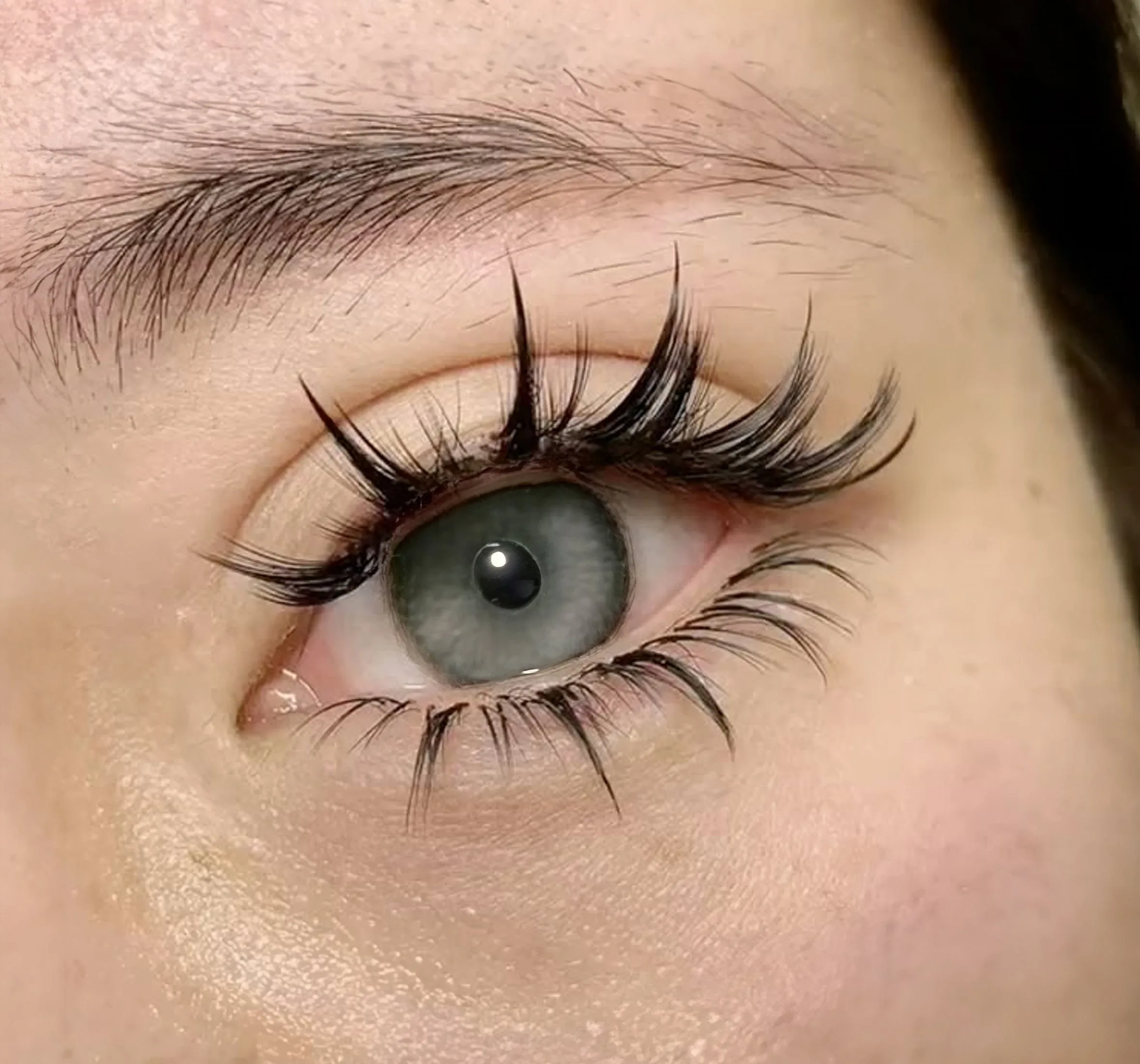
- ShapeWide-set — spacing, not lid shape, is what this map treats.
- EffectDoll in hybrid: round centred crown with a mixed, softer edge.
- Where everyone strugglesTexture belongs on the climb. Keep the outer third plain and short.
Why Why it is laid out this way
Adding fans to a doll map changes the arc's texture, not its position. The crown still lands over the pupil, the outer third still finishes shortest, and the extra tool you gain is softness rather than reach. Use it to stop the centred peak looking drawn.
The order the zones go on, and where the fans land
- Draw the arc firstPlace single strands at every mapped length so the curve is visible before any texture goes on.
- Fan the climbSoft fans between the singles from the inner corner up to the crown. That is where the map wants richness.
- Keep the crown mixedOver the pupil, alternate singles and fans rather than going all fans. A mixed crown reads round; a solid one reads blocky.
- Strip the outer thirdSingles only past the crown, dropping fast. No fans, no spikes, nothing to look at out there.
- Fill the inner gapFans at the inner corner stay narrow but present. Their job is coverage against the nose, not length.
The length curve on wide-set eyes
The curve climbs, crowns over the pupil, then gives up most of its height across the last three zones. Hybrid lets you say the same thing a second way: the busy, mixed section sits under the crown and the plain section sits past it. When texture and length agree, the eye follows both inward at once.
Where does a doll map go wrong on wide-set eyes?
Deep The physics underneath
Two kinds of load on one arc. The question is which zones get which, and the answer is not evenly.
The same map, built four ways
- Classic 1:1
- The singles are the drawing. They fix the crown's position and the steepness of the fall, and because they run the shape, one long single in the outer third does more damage than a whole row of fans.
- Handmade volume
- Fans buy darkness under the crown for less mass than lengthening would cost, which is what lets the inner corner sit fuller without drooping. Tune spread by zone — widest on the climb, narrowest at the two ends.
- Promade / pre-made fans
- Even and quick through the climb, where consistency helps. Their fixed base is a poor match for the inner corner, where the lashes are finest and the bond needs to wrap rather than perch.
- Woven / clover
- Strong coverage per bond and a repeating shape the eye reads as a stripe. A stripe running up toward the crown works for this map; one continuing past it does not.
Spread angle versus weight
Spread decides where mass sits relative to the lash, not how much of it there is. Under the crown the strands are longest, so a wide fan there carries the most twist and rotates the arc's high point off true — the one thing a doll client notices immediately. Widest on the climb, narrowest at the crown and the inner corner.
What a wide-set lash line can carry
- The crown sits on the strongest lashes on the lid, so it can hold a mixed load an outward peak could not. That is the structural argument for putting the doll shape on this spacing, not just the visual one.
- The fuller inner start is the fragile end. Fans there add darkness cheaply, but they still add something to the finest lashes on the eye, and they are what sags if you get greedy.
- A zone fails at its weakest strand, and a hybrid hides its weak strands well. Check the inner corner and the crown individually at the first fill rather than judging the line as a whole.
Where this map fails first
The inner corner shows first because it is doing something unusual for its anatomy — running fuller and longer than those lashes normally carry. Rotation is the symptom rather than shedding: the fans turn flat, coverage drops, and the bare patch beside the nose comes back. The crown goes second and more gently, easing from a curve into a straight run as the longest strands deflect. Both are fill-visit repairs, not restarts.
FAQ Common questions
Why put fans on a doll map at all?
To make the arc look softer than a pure classic version, and to let the inner corner sit fuller without adding length to fragile lashes. The shape does not change; only its texture does.
Should the outer corner get any texture?
No. Past the crown it is plain singles dropping fast, because anything interesting out there pulls the eye toward the temple and undoes the correction.
How do I keep the crown round rather than blocky?
Alternate singles and fans across the peak zones instead of running solid fans. That variation is what the eye reads as a curve.
Is hybrid harder than classic here?
Different, not harder. Classic tests your length steps; hybrid tests your discipline about where texture is allowed to go.
Print this page or save it as PDF — the diagrams are drawn to stay readable in black and white on plain paper. Or download the diagrams below as SVG. No account, no fee, nothing to sign. Every file carries this page’s address, so wherever it ends up it can be traced back here.
Teaching from these? The offer, and how to credit it.
Also in: Wide-Set eyes · Doll / Open-Eye · Hybrid
Read next: open eye versus doll — one family, two intents · questions clients ask about lash extensions