Wide-Set Eyes · Doll / Open-Eye · Volume
The doll lash map for wide-set eyes, built in Volume — zone order, where the length peaks, and the point this one usually goes wrong.
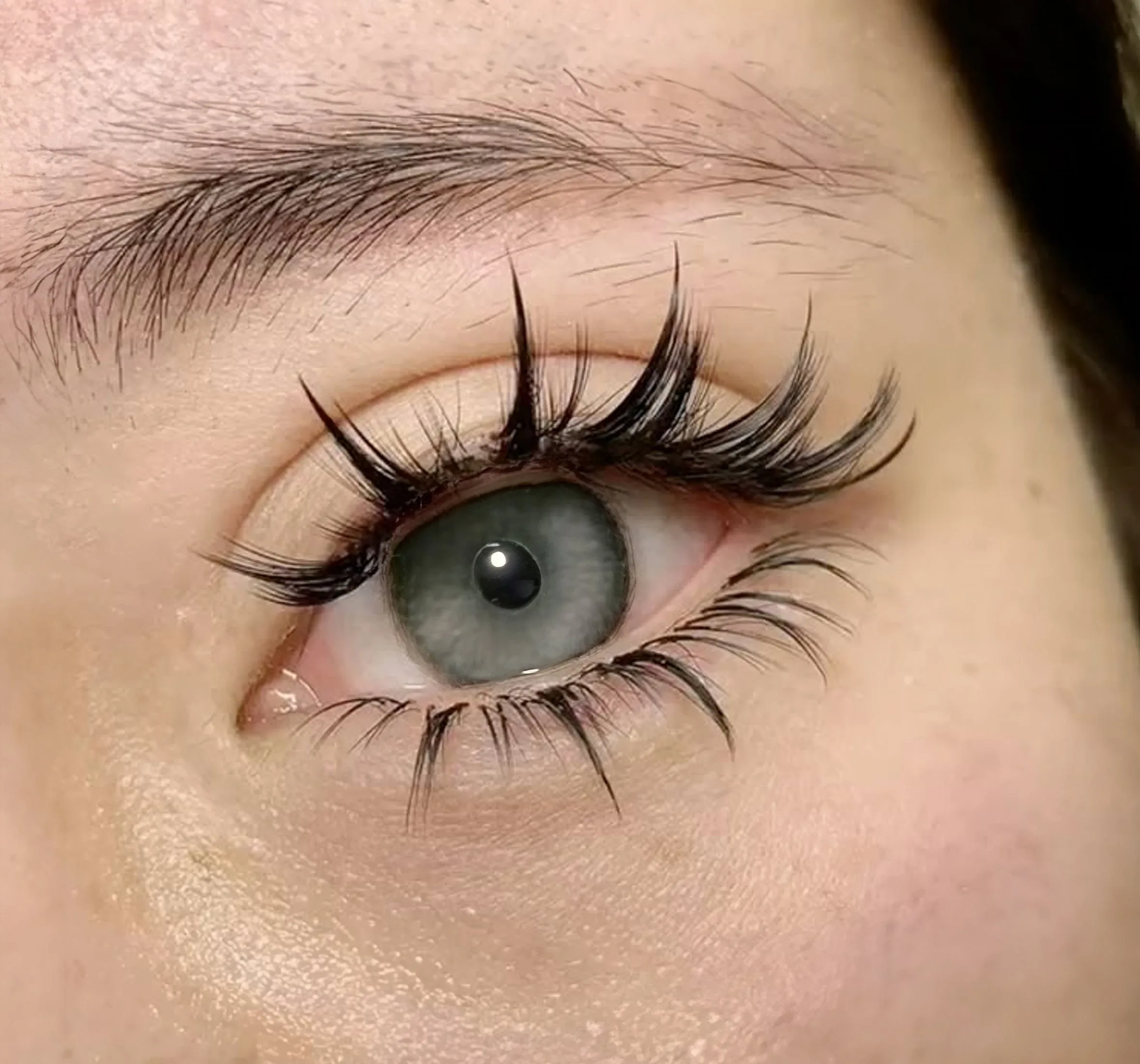
- ShapeWide-set — a wide bridge, so attention has to be pulled in.
- EffectDoll in volume: a dense round crown over the pupil.
- Where everyone strugglesDensity peaks with the length. A dark outer third kills the map.
Why Why it is laid out this way
Volume is where the doll shape reaches full strength on this spacing, because darkness gathers attention inward without a single extra unit of length. The arc is unchanged — fuller inner start, crown over the pupil, steep fall to the shortest outer corner — but now density rides the same curve. The failure mode is stronger too: a flat dense band is a worse result than any classic map could produce.
The order the zones go on, fan by fan
- Build the base firstLight fans at every mapped length, whole line, before any stacking. The shape has to be right in the base layer.
- Concentrate under the crownIncrease fullness through the climb so the densest fans sit over the pupil. Darkness should peak exactly where length does.
- Layer, don't widenBuild height at the crown with a second stacked layer rather than wider fans. Height at the centre reads round; width reads wide.
- Thin past the crownFullness drops with length across the outer third. Short and dark is still weight at the far edge.
- Keep the inner softNarrow fans at the inner corner, closing the gap without dragging those lashes down.
The length curve on wide-set eyes
The line rises to a crown over the pupil and gives up most of its height by the outer corner. In volume the density curve has to travel with it, because the eye reads darkness as size — hold density flat and the length gradient becomes invisible, leaving a broad even band across a face that already reads broad. Two curves, one direction.
Where does a doll map go wrong on wide-set eyes?
Deep The physics underneath
The crown is the most loaded point in this shape's whole grid. What holds it up is worth a paragraph.
The same map, built four ways
- Classic 1:1
- Singles would have to buy the crown's presence with length, and this map has already spent its length budget on being lopsided. A row of singles underneath still helps if you want a crisper edge on the arc.
- Handmade volume
- The reason to run this cell. Several fine strands give the crown its darkness for a fraction of the mass one thick strand would need, and mid-lid lashes reward that discount better than any other zone on the eye.
- Promade / pre-made fans
- Consistent through a dense build and quick across a five-zone climb. The node's small mass lands at the root where the lever is shortest, but you lose the zone-by-zone spread control this arc depends on.
- Woven / clover
- High coverage per bond, and an identical shape repeating along the line. Under the climb that repetition passes as richness; past the crown it becomes a visible march outward.
Spread angle versus weight
The crown is where every spread decision compounds, holding the most fans and the longest strands at once. Open them wide and you gain coverage per unit of mass, but the outer legs sit off the lash's line and each carries a twist — a whole crown of twist rolls the top within weeks. Stack layers for height and keep the spread moderate.
What a wide-set lash line can carry
- Fanning lowers the mass needed for a given darkness; it does not raise what the lash underneath will hold. The crown's ceiling is still one lash at a time, and this map puts more material there than any other wide-set map in the set.
- Deflection arrives before shedding. The first sign is the crown losing its curve — if it reads flatter at the two-week check, the fans were too full rather than too long.
- The inner corner sets its own ceiling, lower than the crown's, on the finest lashes on the eye. Treat it as a separate map with a separate budget, not as the far end of this one.
Where this map fails first
The crown, and it fails by rotating rather than falling out. It carries the fullest fans and the longest strands on the map, so it hits the deflection limit before any other zone, and a fan that rolls stops reading as height and starts reading as width. On this spacing that is the worst direction to fail in — the correction does not just fade, it inverts. Book the fill on the crown's timetable, not the tail's.
FAQ Common questions
Is volume the best technique for a wide-set doll map?
It is the strongest, because it gathers attention inward with darkness instead of length. It is also the least forgiving, since a dense set that ignores the length curve reads as a flat band.
Where should the densest fans go?
Directly over the pupil, with fullness rising through the climb and dropping through the fall. Density and length peak in the same place or the map does not read.
How do I add drama without going outward?
Stack a second layer at the crown for height. Height at the centre is the only kind of drama this spacing pays for.
Does the inner corner need volume too?
Yes, but narrow and light. It is there to stop a bare patch beside the nose, and those are the finest lashes on the eye.
Print this page or save it as PDF — the diagrams are drawn to stay readable in black and white on plain paper. Or download the diagrams below as SVG. No account, no fee, nothing to sign. Every file carries this page’s address, so wherever it ends up it can be traced back here.
Teaching from these? The offer, and how to credit it.
Also in: Wide-Set eyes · Doll / Open-Eye · Volume
Read next: open eye versus doll — one family, two intents · questions clients ask about lash extensions