Wide-Set Eyes · Natural · Hybrid
The natural lash map for wide-set eyes, built in Hybrid — zone order, where the length peaks, and the point this one usually goes wrong.
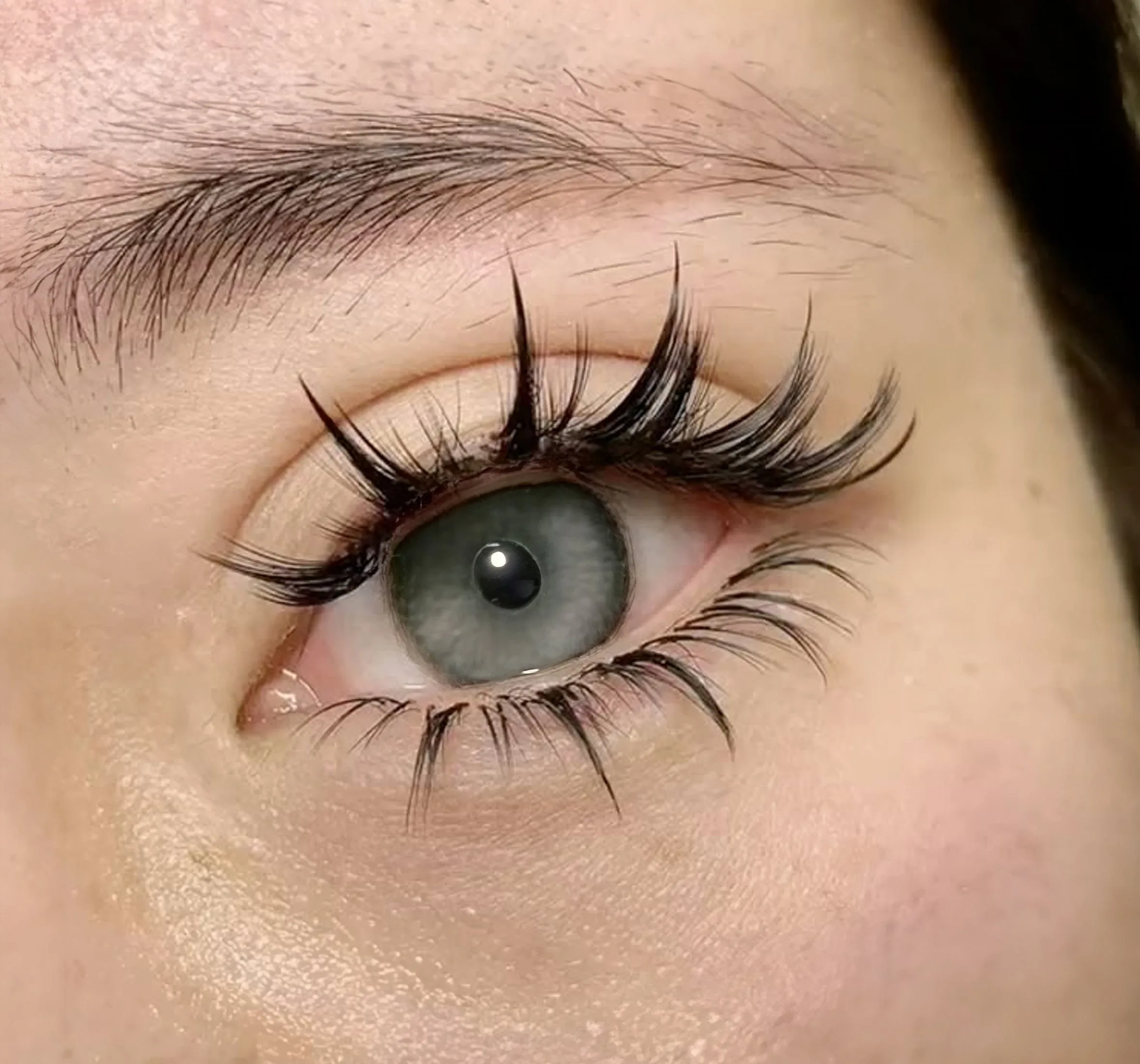
- ShapeWide-set — the eyes read separated, so length moves inward.
- EffectNatural in hybrid: soft mixed line, weight held toward the nose.
- Where everyone strugglesKeep the fans inboard. The outer run stays plain and short.
Why Why it is laid out this way
A hybrid natural set is mostly about making the line look unplanned. On this spacing that has to happen without any of the softness drifting outward, so the mix is deliberately lopsided: fans inboard, singles running out to a short tail. It reads casual and behaves like a correction.
The order the zones go on, and where the fans land
- Set the singles firstLay the whole length curve in single strands — fuller inner start, level peak pair, short tail.
- Fan the inner halfAdd soft fans from the inner corner through the peak pair. That is the half doing the correcting.
- Vary the fan widthsMix a couple of widths inboard so the line looks uneven rather than groomed.
- Singles to the tailPast the peak the map returns to singles and steps down to the shortest zone. Nothing textured out there.
- Check with eyes openStand back before you finish the last zones. If your eye travels to the corner, the mix went too far out.
The length curve on wide-set eyes
The curve is front-loaded and short-tailed, and in hybrid the texture has to match it. Rich, mixed and slightly irregular from the nose to just past the pupil; plain, even and quick from there to the corner. If texture and length disagree, the eye follows the texture — and the whole correction rides on where the eye stops.
Where does a natural map go wrong on wide-set eyes?
Deep The physics underneath
A mixed line is two different loads sharing one gradient. Where each of them sits decides whether the correction lasts.
The same map, built four ways
- Classic 1:1
- The singles carry the shape and the tail. They are the only thing in the outer third, which makes their length discipline out there the whole correction — one long single at the corner is visible from across a room.
- Handmade volume
- Fans give the inner half its fullness for less mass than lengthening the same zones would cost, and the inner lashes need that discount most. Widths can be varied deliberately here, which is what stops the line looking groomed.
- Promade / pre-made fans
- Even and quick, and even is the problem — a natural hybrid wants slight irregularity and identical bases work against it. Useful under the peak pair, less so at the inner corner where fine lashes need a wrapping bond.
- Woven / clover
- Strong coverage and a shape that repeats. A repeat reads as pattern in a set whose entire point is looking unplanned, so if it goes anywhere it is one or two, low and inboard.
Spread angle versus weight
Spread moves mass sideways off the lash's line without reducing it, and every fan on this map sits on the inner half, where the natural lashes are finest. Open them too far and those strands twist rather than droop, which shows as a scruffy inner corner rather than a short one. Narrow spreads inside, wider only around the peak pair where the lashes can argue back.
What a wide-set lash line can carry
- The inner half carries the fans and the fuller start at once — two demands stacked on the eye's finest lashes. That combination, not the peak, sets this map's real ceiling.
- Length adds mass and lever together while a fan adds mass without adding much of either. That is why the inner fullness here comes mostly from fans and only a little from length.
- A zone breaks at its lightest strands, and a textured line disguises which ones those are. On the inner half, place by individual lash rather than by the look of the row.
Where this map fails first
Two ends, two different symptoms. Inboard the fans sit on fine lashes and fail by twisting, so the corner looks untidy before it looks sparse — and untidy near the nose is exactly where a wide-set client's eye lands. The tail fails by simple attrition: it is the shortest and least loaded zone but also the least dense, so it empties out and the line stops before the corner. The first ruins the correction; the second only ruins the finish.
FAQ Common questions
How do I keep a hybrid natural set from looking styled?
Vary the fan widths inboard and let the line stay slightly uneven. Groomed and even is what makes a natural set look applied.
Why do the fans stop at the peak?
Because texture holds the eye, and anything past the peak holds it toward the temple. The outer third is plain singles for the same reason it is short.
Can I use spikes on this map?
One or two, inboard, standing barely above the base. A wispy edge is a different cell and here it would fight the natural read.
Does the fuller inner start apply in hybrid too?
Yes, but you buy most of it with fans rather than with length. Same fullness, far less strain on the finest lashes on the eye.
Print this page or save it as PDF — the diagrams are drawn to stay readable in black and white on plain paper. Or download the diagrams below as SVG. No account, no fee, nothing to sign. Every file carries this page’s address, so wherever it ends up it can be traced back here.
Teaching from these? The offer, and how to credit it.
Also in: Wide-Set eyes · Natural · Hybrid
Read next: questions clients ask about lash extensions